

Earth’s Life Support Systems SG2
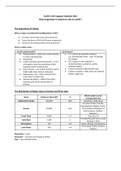
How Important is Carbon to Life on Earth?
The Importance of Carbon
Why is carbon considered the building block of life?
● It’s able to bond with many other elements
● Forms the basis of 95% of all known compounds
● Necessary for photosynthesis and all plant life
How is carbon used…
…by the natural world? …by humans?
● Photosynthesis – plants use carbon dioxide ● It is used as an economic resource
to make carbohydrates e.g. burning fossil fuels – coal, oil and gas
● Respiration for energy
● Carbon Dioxide (a greenhouse gas) – in the ● Oil is used as a raw material in
atmosphere, aids the greenhouse effect manufacturing e.g. plastics, paints,
(regulates Earth temperature) synthetic fabrics
● Sea creatures – use carbon dioxide to grow ● Carbon is stored in agricultural crops
shells made from calcium carbonate ● Carbon is stored in trees which are used for
● Sedimentary rock - shell creatures fall to timber, paper etc.
ocean floor to make rock
● Animals eat plants – carbon from plant
becomes part of fats and proteins in
animals.
The Distribution of Major Stores of Carbon and Their Sizes
What Carbon Can be
Store Carbon in Store (GT) %
Incorporated Into
Sedimentary Rocks 100,000 68.6 Limestone, Chalk, Shale
Dissolved Carbon Dioxide,
Phytoplankton (Algae), Clams,
Oceans 39,000 26.5 Coral, Shells & Skeletons of
Sea Creatures, Seafloor
Sediment
Fossil Fuels 4,000 2.7 Coal, Gas, Oil
Partially Decayed Roots, Dead
Soils/Peat 1,500 1
Animals in Peat
Atmosphere 720 0.5 Carbon Dioxide and Methane
Tree Leaves, Roots, Grasses,
Land Plants 560 0.4
Flowers
Repository = store
Sequester = removal and storage of carbon
Flux = rate of flow/transfer
, The Global Pattern of Carbon Storage
Oceans as a Carbon Store – 2nd biggest store
Key Facts:
● Deep ocean is the largest store of carbon – 38,100 GT
● 0.38% of oceanic carbon is stored in oceanic sediment
● Photosynthesis by marine biota sequesters carbon in the
upper sections of the ocean
● Ocean surface holds carbon for shortest period of time,
and deep ocean for the longest
Why?
Rapid fluxes, e.g. photosynthesis, lead to short term storage
in ocean surfaces. Lithification stores carbon for a long time
in the deep ocean.
Lithification = the transformation of sediment into rock
The Atmosphere as a Carbon Store – 5th largest store
During Northern Hemisphere Winter/Spring:
High levels of CO2 in the atmosphere…
● Industrial production = fossil fuel combustion
● Plants die/dormant so little photosynthesis
● CO2 dispersed by wind
During Northern Hemisphere Summer:
Low levels of CO2 in the atmosphere…
● More plant life so more photosynthesis – removes carbon from atmosphere
● CO2 from forest fires
How are scientific agencies monitoring levels of CO 2 in the atmosphere?
Atmospheric CO2 is monitored by NOAA in the Mauna Loa Observatory (Hawaii) by sampling gases, and NASA
uses satellites.
The Terrestrial Carbon Store – land plants (6th) and soils (4th)
Terrestrial ecosystems store 2100 GT of carbon in living organisms, litter and soil organic matter – 3x amount
stored in the atmosphere.
Tropical Rainforest – Very high density of vegetation and trees are tall = there is a very large store of
carbon in vegetation. There is also a lot of organic matter in/on the soil as these plants decay.
Desert – Very little vegetation = very little carbon stored in vegetation. Very little organic matter in the
soils.
Tundra (periglacial) - When vegetation dies it remains frozen in the soil and does not decompose. This has
built up over thousands to create a large store of carbon.
How Important is Carbon to Life on Earth?
The Importance of Carbon
Why is carbon considered the building block of life?
● It’s able to bond with many other elements
● Forms the basis of 95% of all known compounds
● Necessary for photosynthesis and all plant life
How is carbon used…
…by the natural world? …by humans?
● Photosynthesis – plants use carbon dioxide ● It is used as an economic resource
to make carbohydrates e.g. burning fossil fuels – coal, oil and gas
● Respiration for energy
● Carbon Dioxide (a greenhouse gas) – in the ● Oil is used as a raw material in
atmosphere, aids the greenhouse effect manufacturing e.g. plastics, paints,
(regulates Earth temperature) synthetic fabrics
● Sea creatures – use carbon dioxide to grow ● Carbon is stored in agricultural crops
shells made from calcium carbonate ● Carbon is stored in trees which are used for
● Sedimentary rock - shell creatures fall to timber, paper etc.
ocean floor to make rock
● Animals eat plants – carbon from plant
becomes part of fats and proteins in
animals.
The Distribution of Major Stores of Carbon and Their Sizes
What Carbon Can be
Store Carbon in Store (GT) %
Incorporated Into
Sedimentary Rocks 100,000 68.6 Limestone, Chalk, Shale
Dissolved Carbon Dioxide,
Phytoplankton (Algae), Clams,
Oceans 39,000 26.5 Coral, Shells & Skeletons of
Sea Creatures, Seafloor
Sediment
Fossil Fuels 4,000 2.7 Coal, Gas, Oil
Partially Decayed Roots, Dead
Soils/Peat 1,500 1
Animals in Peat
Atmosphere 720 0.5 Carbon Dioxide and Methane
Tree Leaves, Roots, Grasses,
Land Plants 560 0.4
Flowers
Repository = store
Sequester = removal and storage of carbon
Flux = rate of flow/transfer
, The Global Pattern of Carbon Storage
Oceans as a Carbon Store – 2nd biggest store
Key Facts:
● Deep ocean is the largest store of carbon – 38,100 GT
● 0.38% of oceanic carbon is stored in oceanic sediment
● Photosynthesis by marine biota sequesters carbon in the
upper sections of the ocean
● Ocean surface holds carbon for shortest period of time,
and deep ocean for the longest
Why?
Rapid fluxes, e.g. photosynthesis, lead to short term storage
in ocean surfaces. Lithification stores carbon for a long time
in the deep ocean.
Lithification = the transformation of sediment into rock
The Atmosphere as a Carbon Store – 5th largest store
During Northern Hemisphere Winter/Spring:
High levels of CO2 in the atmosphere…
● Industrial production = fossil fuel combustion
● Plants die/dormant so little photosynthesis
● CO2 dispersed by wind
During Northern Hemisphere Summer:
Low levels of CO2 in the atmosphere…
● More plant life so more photosynthesis – removes carbon from atmosphere
● CO2 from forest fires
How are scientific agencies monitoring levels of CO 2 in the atmosphere?
Atmospheric CO2 is monitored by NOAA in the Mauna Loa Observatory (Hawaii) by sampling gases, and NASA
uses satellites.
The Terrestrial Carbon Store – land plants (6th) and soils (4th)
Terrestrial ecosystems store 2100 GT of carbon in living organisms, litter and soil organic matter – 3x amount
stored in the atmosphere.
Tropical Rainforest – Very high density of vegetation and trees are tall = there is a very large store of
carbon in vegetation. There is also a lot of organic matter in/on the soil as these plants decay.
Desert – Very little vegetation = very little carbon stored in vegetation. Very little organic matter in the
soils.
Tundra (periglacial) - When vegetation dies it remains frozen in the soil and does not decompose. This has
built up over thousands to create a large store of carbon.

