

Interpersonal Communication
Lecture 1 – Introduction
Fundamental aspects of interpersonal communication
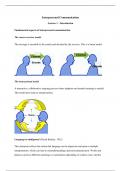
The source-receiver model
The message is encoded by the sender and decoded by the receiver. This is a linear model
The transactional model
A transactive, collaborative ongoing process where adaption and mutual meaning is needed.
This model also leads to interpretations.
Language is ambiguous! (Derek Bentley, 1952)
This statement reflects the notion that language can be imprecise and open to multiple
interpretations, which can lead to misunderstandings and miscommunication. Words and
phrases can have different meanings or connotations depending on context, tone, and the
,perspectives of the people involved in a conversation. This ambiguity in language is a
fundamental challenge in communication and often requires additional context or clarification
to convey intended meanings accurately.
Misinterpretations
(unintentional) touch/eye contact
Sexual overperception bias: the tendency to believe that others are more sexually
interested in you than they actually are (Haselton, 2003)
"It is a common misperception that language use has primarily to do with words and what
they mean. It does not. It has primarily to do with people and what they mean. It is essentially
about speakers' intentions” (Clark & Schober, 1992)
Context dimensions (mutual understanding):
set induction
physical environment
temporal factors
social psychological factors
o interpersonal relationship
o communication history
culture
type of situation
Behavior and mutual understanding
The behavior of conversation partners determines the course of conversations,
interdependence. Some important topics for this in IPC are nonverbal behavior, (non)verbal
dominance, questioning, reflecting, listening and response styles.
The medium and mutual understanding
Medium determines which (interactive) behavior is possible, which signals go back and forth.
, constraints and affordances of different media
media richness
social presence
Nonverbal communication
Purposes of nonverbal communication:
replacing, complementing and modifying verbal communication
regulating conversations
expressing emotions and interpersonal attitudes
negotiating relationships
conveying personal and social identity
contextualising interaction
Negotiating relationships
The concept of "negotiating relationships" in interpersonal communication refers to the
ongoing process of managing and defining the nature of a relationship between two or more
individuals. Interpersonal relationships are complex and dynamic, and they often require
communication and interaction to establish boundaries, expectations, and mutual
understandings.
Nonverbal behavior Mimicry
The phenomenon in which one person unconsciously imitates or mirrors the nonverbal
behaviors, gestures, expressions, or postures of another person during a social interaction.
This mimicry can include subtle and unintentional copying of various nonverbal cues, such as
facial expressions, body language, vocal tones, and even gestures.
Mimicry occurs automatically. With more mimicry interaction is experienced as more
pleasant, interaction partner is judged as nicer.
Communication Accomodation Theory
Nonverbal complementarity (power related)
, Dominant body posture: taking up a lot of space, postural expansion
Submissive body posture: taking up little space, postural constriction
In the first experiment by Tiedens and Fragale (2003) it was found that participants tend to
spontaneously take the complementary (opposite) body posture.
In the second experiment it was found that interaction was experienced nicer when the body
postures were complementary.
Verbally submissive:
Hedges (sort of…, maybe…)
Hesitations
Tag questions (…right?)
Higher vocal pitch/low volume
Not interrupting
Eye gaze: divert
Interpersonal circumplex models
Lecture 1 – Introduction
Fundamental aspects of interpersonal communication
The source-receiver model
The message is encoded by the sender and decoded by the receiver. This is a linear model
The transactional model
A transactive, collaborative ongoing process where adaption and mutual meaning is needed.
This model also leads to interpretations.
Language is ambiguous! (Derek Bentley, 1952)
This statement reflects the notion that language can be imprecise and open to multiple
interpretations, which can lead to misunderstandings and miscommunication. Words and
phrases can have different meanings or connotations depending on context, tone, and the
,perspectives of the people involved in a conversation. This ambiguity in language is a
fundamental challenge in communication and often requires additional context or clarification
to convey intended meanings accurately.
Misinterpretations
(unintentional) touch/eye contact
Sexual overperception bias: the tendency to believe that others are more sexually
interested in you than they actually are (Haselton, 2003)
"It is a common misperception that language use has primarily to do with words and what
they mean. It does not. It has primarily to do with people and what they mean. It is essentially
about speakers' intentions” (Clark & Schober, 1992)
Context dimensions (mutual understanding):
set induction
physical environment
temporal factors
social psychological factors
o interpersonal relationship
o communication history
culture
type of situation
Behavior and mutual understanding
The behavior of conversation partners determines the course of conversations,
interdependence. Some important topics for this in IPC are nonverbal behavior, (non)verbal
dominance, questioning, reflecting, listening and response styles.
The medium and mutual understanding
Medium determines which (interactive) behavior is possible, which signals go back and forth.
, constraints and affordances of different media
media richness
social presence
Nonverbal communication
Purposes of nonverbal communication:
replacing, complementing and modifying verbal communication
regulating conversations
expressing emotions and interpersonal attitudes
negotiating relationships
conveying personal and social identity
contextualising interaction
Negotiating relationships
The concept of "negotiating relationships" in interpersonal communication refers to the
ongoing process of managing and defining the nature of a relationship between two or more
individuals. Interpersonal relationships are complex and dynamic, and they often require
communication and interaction to establish boundaries, expectations, and mutual
understandings.
Nonverbal behavior Mimicry
The phenomenon in which one person unconsciously imitates or mirrors the nonverbal
behaviors, gestures, expressions, or postures of another person during a social interaction.
This mimicry can include subtle and unintentional copying of various nonverbal cues, such as
facial expressions, body language, vocal tones, and even gestures.
Mimicry occurs automatically. With more mimicry interaction is experienced as more
pleasant, interaction partner is judged as nicer.
Communication Accomodation Theory
Nonverbal complementarity (power related)
, Dominant body posture: taking up a lot of space, postural expansion
Submissive body posture: taking up little space, postural constriction
In the first experiment by Tiedens and Fragale (2003) it was found that participants tend to
spontaneously take the complementary (opposite) body posture.
In the second experiment it was found that interaction was experienced nicer when the body
postures were complementary.
Verbally submissive:
Hedges (sort of…, maybe…)
Hesitations
Tag questions (…right?)
Higher vocal pitch/low volume
Not interrupting
Eye gaze: divert
Interpersonal circumplex models

