
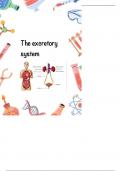
The excretory
system
, What is exertion:
• the removal of waste products from the body. (Waste formed by
metabolic reactions)
why does excretion happen:
To maintain homeostasis (balance in the body)
maintains the internal environment (tissue fluid - controlled by
hormones)
Waste products:
Nitrogenous waste is formed in the liver but excreted elsewhere in
the body.
Nitrogenous waste is formed by breaking down proteins(amino acids)
by process called deamination ( denatures proteins to become
inactive)
• Urea - formed by excess amino acids (urine)
• Uric acid - breakdown of nucleic acids.
• creatinine - from creatine phosphate
Non-nitrogenous waste:
• toxins and drugs eg. painkillers
• Alcohol
• Bile pigment and cholesterol (formed in liver)
To maintain homeostasis = get rid of waste products which
continually diffuse into the blood stream.
Excretory organs:
Skin:
Water, salts, urea(very little) by sweat
Sweat evaporates heat is lost
Lungs:
Co2 from cellular respiration
Water and heat


