Employee Benefits
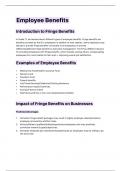
Introduction to Fringe Benefits
In Grade 11, we learned about different types of employee benefits. Fringe benefits are
benefits provided by the B to employees in addition to their salaries. Some employers may
decide to provide fringe benefits universally to all employees or provide
different/additional fringe benefits to executive management. The B has different reasons
for providing employees with fringe benefits, which include, among others, compensating
employees for costs related to their work + improving overall job satisfaction.
Examples of Employee Benefits
• Medical Aid Fund/Health Insurance Fund
• Pension Fund
• Provident Fund
• Funeral benefits
• Car/Travel/Housing/Cellphone/Clothing allowance
• Performance-based incentives
• Issuing of bonus shares
• Staff discount/Free or low-cost meal/Canteen facilities
Impact of Fringe Benefits on Businesses
Positives/Advantages
1. Attractive fringe benefit packages may result in higher employee retention/reduce
employee turnover/low attrition rates.
2. Attracts/Retains qualified/skilled/experienced employees who may positively
contribute towards B goals/objectives.
3. Increases employee job satisfaction/loyalty/morale as employees may be willing to go
the extra mile.
, 4. Improves productivity → higher profitability.
5. Bs save money as benefits are tax-deductible.
6. Fringe benefits can be used as leverage for salary negotiations.
Negatives/Disadvantages
1. Fringe benefits are additional costs that may result in cash flow problems for the B.
2. Administrative costs increase as benefits need to be correctly recorded for tax
purposes.
3. Decreases B profits because incentive/package/remuneration costs are higher.
4. Creates conflict/leads to corruption if fringe benefits are allocated unfairly.
5. Workers may only stay with the B for fringe benefits + may not be committed/loyal to
the tasks/B.
6. Bs that offer employees different benefit plans may create resentment among those
who receive fewer benefits, → lower productivity.
7. Bs that cannot offer fringe benefits fail to attract skilled workers.
8. Bs have to pay advisors/attorneys to help them create benefit plans that comply with
the law.
Unemployment Insurance Fund (UIF) as a
Benefit Required by Law (Compulsory Benefit)
UIF offers short-term financial assistance to workers when they become unemployed or
are unable to work due to illness/maternity/adoption leave.
UIF assists the dependents of a contributing worker who has died.
By law, employees must contribute 1% of their basic salary towards UIF.
Employers must also contribute 1% of an employee’s basic salary towards UIF.
Employers pay the 2% dire ctly to the UIF on behalf of the employees.
Contributions are paid to the Unemployment Insurance Fund (UIF) or the South African
Revenue Services (SARS).
Implications of Legislation on
the Human Resources Function
Introduction to Fringe Benefits
In Grade 11, we learned about different types of employee benefits. Fringe benefits are
benefits provided by the B to employees in addition to their salaries. Some employers may
decide to provide fringe benefits universally to all employees or provide
different/additional fringe benefits to executive management. The B has different reasons
for providing employees with fringe benefits, which include, among others, compensating
employees for costs related to their work + improving overall job satisfaction.
Examples of Employee Benefits
• Medical Aid Fund/Health Insurance Fund
• Pension Fund
• Provident Fund
• Funeral benefits
• Car/Travel/Housing/Cellphone/Clothing allowance
• Performance-based incentives
• Issuing of bonus shares
• Staff discount/Free or low-cost meal/Canteen facilities
Impact of Fringe Benefits on Businesses
Positives/Advantages
1. Attractive fringe benefit packages may result in higher employee retention/reduce
employee turnover/low attrition rates.
2. Attracts/Retains qualified/skilled/experienced employees who may positively
contribute towards B goals/objectives.
3. Increases employee job satisfaction/loyalty/morale as employees may be willing to go
the extra mile.
, 4. Improves productivity → higher profitability.
5. Bs save money as benefits are tax-deductible.
6. Fringe benefits can be used as leverage for salary negotiations.
Negatives/Disadvantages
1. Fringe benefits are additional costs that may result in cash flow problems for the B.
2. Administrative costs increase as benefits need to be correctly recorded for tax
purposes.
3. Decreases B profits because incentive/package/remuneration costs are higher.
4. Creates conflict/leads to corruption if fringe benefits are allocated unfairly.
5. Workers may only stay with the B for fringe benefits + may not be committed/loyal to
the tasks/B.
6. Bs that offer employees different benefit plans may create resentment among those
who receive fewer benefits, → lower productivity.
7. Bs that cannot offer fringe benefits fail to attract skilled workers.
8. Bs have to pay advisors/attorneys to help them create benefit plans that comply with
the law.
Unemployment Insurance Fund (UIF) as a
Benefit Required by Law (Compulsory Benefit)
UIF offers short-term financial assistance to workers when they become unemployed or
are unable to work due to illness/maternity/adoption leave.
UIF assists the dependents of a contributing worker who has died.
By law, employees must contribute 1% of their basic salary towards UIF.
Employers must also contribute 1% of an employee’s basic salary towards UIF.
Employers pay the 2% dire ctly to the UIF on behalf of the employees.
Contributions are paid to the Unemployment Insurance Fund (UIF) or the South African
Revenue Services (SARS).
Implications of Legislation on
the Human Resources Function