
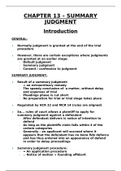
CHAPTER 13 – SUMMARY
JUDGMENT
Introduction
GENERAL:
Normally judgment is granted at the end of the trial
procedure
However, there are certain exceptions where judgments
are granted at an earlier stage:
Default judgment
Summary judgment
Consent / confession to judgment
SUMMARY JUDGMENT:
Result of a summary judgment:
= an extraordinary remedy
The speedy conclusion of a matter, without delay
and expenses of trial
Pleadings phase is cut short
No preparation for trial or trial stage takes place
Regulated by HCR 32 and MCR 14 (rules are aligned)
So... rules of court allows a plaintiff to apply for
summary judgment against a defendant
After defendant delivers is notice of intention to
defend
As long as the plaintiffs claim falls within 4 of the
certain categories
Generally – an applicant will succeed where it
appears that the defendant has no bona fide defence
and has thus entered into an appearance of defend
in order to delay proceedings
Summary judgment procedure:
= An application procedure
Notice of motion + founding affidavit
, = An interlocutory application thus does not have to
be issued by sheriff
Allegations in the founding affidavit must be
answered in the by the defendant in the opposing
affidavit
ADVANTAGES OF SUMMARY JUDGMENT:
Advantageous for 2 reasons:
It results in a final judgment in favour of the plaintiff
at a very early stage in litigation (thus eliminates
unnecessary expenses and allows speedy relief)
Even if application is not successful – it forces the
defendant to deliver an answering affidavit in order
to avoid summary judgment – thus defendant places
his defence on record at an early stage
CIRCUMSTANCES WHERE SUMMARY JUDGMENT IS
APPROPRIATE:
Summary judgment may only be requested by the
plaintiff
AFTER defendant has entered into is appearance to
defend
AND when the plaintiff’s cause of action falls within
one of the 4 specific categories
These 4 categories include:
A liquid document OR
A liquidated amount of money OR
The delivery of specified movable property OR
Ejectment
Plaintiff whose summons contains more than one claim –
may apply for summary judgment if the claim falls within
one of the categories – if a claim does not, it will then
continue in the ordinary way
Cannot apply for summary judgment:
In all types of liquidated claims – only certain
categories
Damages
Unliquidated amounts
JUDGMENT
Introduction
GENERAL:
Normally judgment is granted at the end of the trial
procedure
However, there are certain exceptions where judgments
are granted at an earlier stage:
Default judgment
Summary judgment
Consent / confession to judgment
SUMMARY JUDGMENT:
Result of a summary judgment:
= an extraordinary remedy
The speedy conclusion of a matter, without delay
and expenses of trial
Pleadings phase is cut short
No preparation for trial or trial stage takes place
Regulated by HCR 32 and MCR 14 (rules are aligned)
So... rules of court allows a plaintiff to apply for
summary judgment against a defendant
After defendant delivers is notice of intention to
defend
As long as the plaintiffs claim falls within 4 of the
certain categories
Generally – an applicant will succeed where it
appears that the defendant has no bona fide defence
and has thus entered into an appearance of defend
in order to delay proceedings
Summary judgment procedure:
= An application procedure
Notice of motion + founding affidavit
, = An interlocutory application thus does not have to
be issued by sheriff
Allegations in the founding affidavit must be
answered in the by the defendant in the opposing
affidavit
ADVANTAGES OF SUMMARY JUDGMENT:
Advantageous for 2 reasons:
It results in a final judgment in favour of the plaintiff
at a very early stage in litigation (thus eliminates
unnecessary expenses and allows speedy relief)
Even if application is not successful – it forces the
defendant to deliver an answering affidavit in order
to avoid summary judgment – thus defendant places
his defence on record at an early stage
CIRCUMSTANCES WHERE SUMMARY JUDGMENT IS
APPROPRIATE:
Summary judgment may only be requested by the
plaintiff
AFTER defendant has entered into is appearance to
defend
AND when the plaintiff’s cause of action falls within
one of the 4 specific categories
These 4 categories include:
A liquid document OR
A liquidated amount of money OR
The delivery of specified movable property OR
Ejectment
Plaintiff whose summons contains more than one claim –
may apply for summary judgment if the claim falls within
one of the categories – if a claim does not, it will then
continue in the ordinary way
Cannot apply for summary judgment:
In all types of liquidated claims – only certain
categories
Damages
Unliquidated amounts


