TOP-DOWN PROFILING 🇺🇸 🥸🫠
● Aim: to narrow down a list of suspects
● American approach, used by the FBI
● Classification to data: uses a classification (2 types of offender) already known, then
a behavioural analysis is developed based on the crime scene/witness/victims
● Classification developed from 36 sexually motivated offenders who were interviewed,
crime scene data reviewed, and personality/background lead to the developed
● Based on the view that offenders have a ‘signature way of working’
● Best fit model
Attempts to fit crime details under pre-existing categories (typologies), whereas the bottom-
up British approach (or investigative psychology) starts with small details and creates the big
picture
4 steps:
1. Assimilation - data from crime scene reviewed (photos, pathology, weapons etc)
2. Characteristics of crime scene
- Organised offender🤓 - evidence of planning, victim a stranger, use of restraint,
removes evidence (higher IQ, socially and sexually competent, lives with partner)
- or Disorganised offender🫠 - no planning, victim known, little use of restraint, weapon
and evidence left at crime scene (lower IQ, socially and sexually incompetent, lives
alone)
3. Crime recognition - hypothesis about behaviour and events created
4. Profile created - profile created about the offender (background and physical
characteristics)
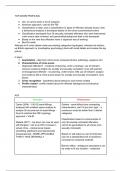
AO3
Strengths Weaknesses
Carter (2004) - 100 US serial killings Godwin - serial killers have contrasting
analysed with smallest space analysis to characteristics, don’t fit just one ‘type’ - a
analyse 39 occurrences of serial killings - continuum would be better than 2 distinct
found it matched the FBI’s typology categories
approach = VALID
Classification based on small sample of
Meketa (2017) - top down can now be used only 36 sexually motivated offenders -
with Burglary = led to an 85% increase in cannot be generalised to all crimes (non-
solved crime - interpersonal (steals sexually motivated)
something significant) and opportunistic
(inexperienced) - MORE APPLICABLE Based on self-report so can lie+interview
THAN IT WAS ORIGINALLY was not a standardised set of questions -
not based on empirical methods
Barnum effect - ambiguous descriptions can
be made to fit any situation - subjective
● Aim: to narrow down a list of suspects
● American approach, used by the FBI
● Classification to data: uses a classification (2 types of offender) already known, then
a behavioural analysis is developed based on the crime scene/witness/victims
● Classification developed from 36 sexually motivated offenders who were interviewed,
crime scene data reviewed, and personality/background lead to the developed
● Based on the view that offenders have a ‘signature way of working’
● Best fit model
Attempts to fit crime details under pre-existing categories (typologies), whereas the bottom-
up British approach (or investigative psychology) starts with small details and creates the big
picture
4 steps:
1. Assimilation - data from crime scene reviewed (photos, pathology, weapons etc)
2. Characteristics of crime scene
- Organised offender🤓 - evidence of planning, victim a stranger, use of restraint,
removes evidence (higher IQ, socially and sexually competent, lives with partner)
- or Disorganised offender🫠 - no planning, victim known, little use of restraint, weapon
and evidence left at crime scene (lower IQ, socially and sexually incompetent, lives
alone)
3. Crime recognition - hypothesis about behaviour and events created
4. Profile created - profile created about the offender (background and physical
characteristics)
AO3
Strengths Weaknesses
Carter (2004) - 100 US serial killings Godwin - serial killers have contrasting
analysed with smallest space analysis to characteristics, don’t fit just one ‘type’ - a
analyse 39 occurrences of serial killings - continuum would be better than 2 distinct
found it matched the FBI’s typology categories
approach = VALID
Classification based on small sample of
Meketa (2017) - top down can now be used only 36 sexually motivated offenders -
with Burglary = led to an 85% increase in cannot be generalised to all crimes (non-
solved crime - interpersonal (steals sexually motivated)
something significant) and opportunistic
(inexperienced) - MORE APPLICABLE Based on self-report so can lie+interview
THAN IT WAS ORIGINALLY was not a standardised set of questions -
not based on empirical methods
Barnum effect - ambiguous descriptions can
be made to fit any situation - subjective