Gaseous exchange:
- the exchange of O2 and CO2at a respiratory surface
occurs at two places in mammals:
1. at a gaseous exchange
surface (lungs) and the
blood
2. between the blood and
the body cells at the tissue
level
Di erence between cellular respiration, breathing and
gas exchange:
- Breathing is the taking of air in and out of the lungs.
- Gas exchange is the intake of oxygen and the excretion of carbon dioxide at the lung surface.
Oxygen moves into the blood and carbon dioxide moves out of the blood.
- Cell respiration is the process that releases energy from the food
Requirements of an E ective Gaseous:
• Large – to ensure the maximum exchange of gases can take place.
• Thin and permeable – so that di usion can take place easily and rapidly.
• Moist – so that gases can dissolve to form a solution.
• Well ventilated – good oxygen supply and carbon dioxide removal.
HUMAN GASEOUS EXCHANGE
The human gas exchange system consists of the following distinct sections:
- air passages
- lung
- muscles involved in the
mechanism of
breathing (ventilation)
ff ff ff
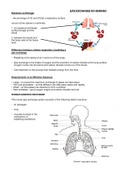
, Structure and function:
nostrils = air inhale air into the nose
Nasal cavities = cilia trap dirt and sweep it out of the nose; keeps cavity moist
trachea = C-shaped cartilage rings protect trachea and keep it open for easy movement of air
bronchus /bronchi = held open by O-shaped cartilage rings; lined with mucous membranes
bronchioles/ bronchioles = Transport air from bronchi to alveolus
alveoli = increase the surface area to maximise the gas Exchange right bronchus bronchiole
alveolus (air sac) Ribs diaphragm intercostal muscles
lungs = Contains the alveoli for gaseous exchange , also aid in inhalation and exhalation
ribs = protect the lungs from injury
Intercostal muscles = contract and relax during inhalation and exhalation altering the volume of
air in the chest (thoracic cavity)
diaphragm = contracts and attens altering the volume of the chest cavity and is important in the
breathing
The mechanism of breathing (Ventilation of the lungs):
- The process of breathing is a mechanical process.
- Air moves in and out of the lungs as a result of di erences in atmospheric air pressure
and the air pressure inside the lungs.
- It involves di erent muscles and volume and pressure changes in the thoracic cavity.
- Inhalation: the breathing in of air
- Exhalation: the breathing out of air
ff fl ff
- the exchange of O2 and CO2at a respiratory surface
occurs at two places in mammals:
1. at a gaseous exchange
surface (lungs) and the
blood
2. between the blood and
the body cells at the tissue
level
Di erence between cellular respiration, breathing and
gas exchange:
- Breathing is the taking of air in and out of the lungs.
- Gas exchange is the intake of oxygen and the excretion of carbon dioxide at the lung surface.
Oxygen moves into the blood and carbon dioxide moves out of the blood.
- Cell respiration is the process that releases energy from the food
Requirements of an E ective Gaseous:
• Large – to ensure the maximum exchange of gases can take place.
• Thin and permeable – so that di usion can take place easily and rapidly.
• Moist – so that gases can dissolve to form a solution.
• Well ventilated – good oxygen supply and carbon dioxide removal.
HUMAN GASEOUS EXCHANGE
The human gas exchange system consists of the following distinct sections:
- air passages
- lung
- muscles involved in the
mechanism of
breathing (ventilation)
ff ff ff
, Structure and function:
nostrils = air inhale air into the nose
Nasal cavities = cilia trap dirt and sweep it out of the nose; keeps cavity moist
trachea = C-shaped cartilage rings protect trachea and keep it open for easy movement of air
bronchus /bronchi = held open by O-shaped cartilage rings; lined with mucous membranes
bronchioles/ bronchioles = Transport air from bronchi to alveolus
alveoli = increase the surface area to maximise the gas Exchange right bronchus bronchiole
alveolus (air sac) Ribs diaphragm intercostal muscles
lungs = Contains the alveoli for gaseous exchange , also aid in inhalation and exhalation
ribs = protect the lungs from injury
Intercostal muscles = contract and relax during inhalation and exhalation altering the volume of
air in the chest (thoracic cavity)
diaphragm = contracts and attens altering the volume of the chest cavity and is important in the
breathing
The mechanism of breathing (Ventilation of the lungs):
- The process of breathing is a mechanical process.
- Air moves in and out of the lungs as a result of di erences in atmospheric air pressure
and the air pressure inside the lungs.
- It involves di erent muscles and volume and pressure changes in the thoracic cavity.
- Inhalation: the breathing in of air
- Exhalation: the breathing out of air
ff fl ff