

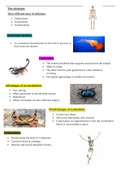
The skeleton:
Three different types of skeletons:
1. Hydrostatic.
2. Exoskeleton.
3. Endoskeleton.
Hydrostatic skeleton:
• An exoskeleton that maintains its form due to pressure of
fluid inside the skeleton.
Exoskeleton:
• The external skeleton that supports and protects the animal.
• Made of chitin.
• The inner muscles pull against hard, outer chitinous
covering.
• Has joined appendages to enable movement.
Advantages of an exoskeleton:
1. Very strong.
2. Offers protection to all soft body tissues.
3. Waterproof
4. Allows formation of many different shapes.
Disadvantages of exoskeleton:
1. Can be very heavy.
2. Allows for movement only at joints
3. Cannot grow so organism has to lose old exoskeleton
before it can continue to grow.
Endoskeleton:
• Found inside the body of vertebrates.
• Consist of bone & cartilage.
• Muscles and tissues attached to bone.
, Advantages of endoskeleton:
1. Bones consist of living tissue = allows growth.
2. Growth continues without losing strength, protection and support.
3. Lighter than exoskeleton, noot limiting growth size.
4. Bones can have other functions inside the body.
Functions of endoskeleton:
➢ Protection of internal organs.
➢ Provides strength, shape and support.
➢ Bones provide joints attachment for muscles.
➢ Assist in hearing.
➢ Place of formation of erythrocytes.
➢ Mineral storage.
Parts of the endoskeleton:
1. Axial skeleton.
2. Appendicular skeleton.
The skull:
• May be divided into the cranium, facial bones and the
mandible.
Functions of the skull:
➢ Protects the brain.
➢ Protects sense organs.
➢ Assist in mastication, breathing and talking.
Three different types of skeletons:
1. Hydrostatic.
2. Exoskeleton.
3. Endoskeleton.
Hydrostatic skeleton:
• An exoskeleton that maintains its form due to pressure of
fluid inside the skeleton.
Exoskeleton:
• The external skeleton that supports and protects the animal.
• Made of chitin.
• The inner muscles pull against hard, outer chitinous
covering.
• Has joined appendages to enable movement.
Advantages of an exoskeleton:
1. Very strong.
2. Offers protection to all soft body tissues.
3. Waterproof
4. Allows formation of many different shapes.
Disadvantages of exoskeleton:
1. Can be very heavy.
2. Allows for movement only at joints
3. Cannot grow so organism has to lose old exoskeleton
before it can continue to grow.
Endoskeleton:
• Found inside the body of vertebrates.
• Consist of bone & cartilage.
• Muscles and tissues attached to bone.
, Advantages of endoskeleton:
1. Bones consist of living tissue = allows growth.
2. Growth continues without losing strength, protection and support.
3. Lighter than exoskeleton, noot limiting growth size.
4. Bones can have other functions inside the body.
Functions of endoskeleton:
➢ Protection of internal organs.
➢ Provides strength, shape and support.
➢ Bones provide joints attachment for muscles.
➢ Assist in hearing.
➢ Place of formation of erythrocytes.
➢ Mineral storage.
Parts of the endoskeleton:
1. Axial skeleton.
2. Appendicular skeleton.
The skull:
• May be divided into the cranium, facial bones and the
mandible.
Functions of the skull:
➢ Protects the brain.
➢ Protects sense organs.
➢ Assist in mastication, breathing and talking.


