

Flowers
Reproductive Structures
- Most dominant terrestrial plants
- Most distinguishing feature: reproductive organs
- Reproductive developments: pollen tube & seed
What is a flower:
- Organ of sexual reproduction
- Contains organs (for gametes) & attracts pollinators (for fertilisation)
- Like the cone in gymnosperms, contain a series of leaves for reproduction
- Holds & protects female gametes
Structure:
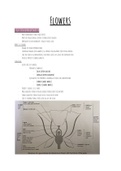
- Leaves are in 4 whorls:
- Perinath (2 whorls):
- Colyx (often green)
- Corolla (often coloured)
- equivalent to sporophylls making up cones in gymnosperms
- Stamen (male whorl)
- Carpels (female whorl)
- Variety: colour, size, shape
- Male gametes form in pollen grains produced by the anthers
- Female gametes form inside ovules enclosed by ovary
- Seed is formed from a fertilized egg in the ovule
, Purpose:
- Contain reproductive organs (stamen &/or carpel)
- Stamen: anther that produce pollen grains in which male gametes are formed
- Carpel: female gamete in ovule of ovary
- Attract pollinators who transport pollen from anther to stigma
- Advantages of pollinators:
- Self-pollination is avoided to plant stays strong, pollinators take pollen to distant plants of
different species
- Not wasteful and more precise while wind can be wasteful
Pollination
- Sexual reproduction relies on male & female gamete combining
- In flowers the male gametes are in pollen grains in the anthers and female gametes are in ovules of ovary
- 2 stages of a male gametes journey to a female gamete
1. Male gamete is carried in a pollen grain to stigma
2. Gamete moves in pollen tube to female gamete
- First stage is pollination
- 2 types: self & cross pollination
- Plant can pollinate itself or a pollinator/wind can
- Value to humans:
- There would be no fertilization which is needed for seed or fruit formation
- Vital for production of fruit & seed crops
a. Pollination by pollinators
- Animals that move pollen from anther to stigma for fertilization
- 80% of flowering plants need pollinators
- Main reason for pollinators is for food in there pollen and/or nectar form
- Plants and pollinators form a mac mutual benefit (pollination for food)
- Called co-evolution and has happened since before angiosperms
- Mostly insects but some vertebrates:
- Variety of insects but most important are bees
- Birds are main vertebrates as well as bats in tropical areas
- Most plant species are pollinated by one kind of pollinator
Insect-pollinated flowers adaptations
- Flowers have large petals in bright colours except red (bees cannot distinguish from black)
- Sweet scent for moths and butterflies
- Give off nectar and/or pollen
- Anther & stigma often inside flower so insect has to brush past them to get nectar
- Pollen grains stick to insects
- Large amounts of pollen produced as some is eaten or taken to wrong flower
- Flowers have contrast markings that lead insect to centre quickly
Reproductive Structures
- Most dominant terrestrial plants
- Most distinguishing feature: reproductive organs
- Reproductive developments: pollen tube & seed
What is a flower:
- Organ of sexual reproduction
- Contains organs (for gametes) & attracts pollinators (for fertilisation)
- Like the cone in gymnosperms, contain a series of leaves for reproduction
- Holds & protects female gametes
Structure:
- Leaves are in 4 whorls:
- Perinath (2 whorls):
- Colyx (often green)
- Corolla (often coloured)
- equivalent to sporophylls making up cones in gymnosperms
- Stamen (male whorl)
- Carpels (female whorl)
- Variety: colour, size, shape
- Male gametes form in pollen grains produced by the anthers
- Female gametes form inside ovules enclosed by ovary
- Seed is formed from a fertilized egg in the ovule
, Purpose:
- Contain reproductive organs (stamen &/or carpel)
- Stamen: anther that produce pollen grains in which male gametes are formed
- Carpel: female gamete in ovule of ovary
- Attract pollinators who transport pollen from anther to stigma
- Advantages of pollinators:
- Self-pollination is avoided to plant stays strong, pollinators take pollen to distant plants of
different species
- Not wasteful and more precise while wind can be wasteful
Pollination
- Sexual reproduction relies on male & female gamete combining
- In flowers the male gametes are in pollen grains in the anthers and female gametes are in ovules of ovary
- 2 stages of a male gametes journey to a female gamete
1. Male gamete is carried in a pollen grain to stigma
2. Gamete moves in pollen tube to female gamete
- First stage is pollination
- 2 types: self & cross pollination
- Plant can pollinate itself or a pollinator/wind can
- Value to humans:
- There would be no fertilization which is needed for seed or fruit formation
- Vital for production of fruit & seed crops
a. Pollination by pollinators
- Animals that move pollen from anther to stigma for fertilization
- 80% of flowering plants need pollinators
- Main reason for pollinators is for food in there pollen and/or nectar form
- Plants and pollinators form a mac mutual benefit (pollination for food)
- Called co-evolution and has happened since before angiosperms
- Mostly insects but some vertebrates:
- Variety of insects but most important are bees
- Birds are main vertebrates as well as bats in tropical areas
- Most plant species are pollinated by one kind of pollinator
Insect-pollinated flowers adaptations
- Flowers have large petals in bright colours except red (bees cannot distinguish from black)
- Sweet scent for moths and butterflies
- Give off nectar and/or pollen
- Anther & stigma often inside flower so insect has to brush past them to get nectar
- Pollen grains stick to insects
- Large amounts of pollen produced as some is eaten or taken to wrong flower
- Flowers have contrast markings that lead insect to centre quickly


