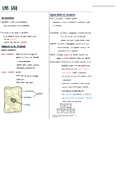
the cell
:/
physical nature of protoplasm
the protoplasm *
water is the solvent in biological systems
* matter
living is known as the protoplasm protoplasm is really composition of different types
-
a
Cell protoplasm of solutions
-
is the smallest unit of
* •
cell consists of the nucleus & cytoplasm true solution -
the solution is homogenous ( all particles have same
membrane encloses liquid contents of the naked eye)
-
the cell the size R can 't be seen with the
cell
,
the
ground plasm EXAMPLES : salts , sugar & gases dissolved in water
together they make the
cytoplasm
-
• Suspension -
the solution is heterogenous ( particles can be seen
composition of the Protoplasm with the naked eye organelles the
,
cell
floating in
chemical composition :
ground plasm form a suspension
÷ ÷ ÷ ÷ ÷ :÷ ÷ ÷ i÷:
" ""
:
""
"
inorganic components
-
proteins
:÷: ÷ ÷ i÷ ÷ ÷ ÷ ÷ ÷: ÷ ÷ ÷ ÷ ÷ ÷ ÷ :÷ ÷:÷ ÷:÷
repel EACHOTHER .
( Remain in suspension)
.
carbs ( most NB source of
energy )
-
the particles can also form strings & clumps
lipids ( fats ) ( aggregates)
nucleic acids ( DNA RNA )
hold water
-
, AGGREGATES can in spaces between
particles . Proteins form colloidal solutions
solid liquid Sol
-
form Jet a form ,
,
the endoplasm ( ground plasm in centre of
-
cell in SOL STATE A ectoplasm in TEL STATE
,
these States are reversible
, '
t.it ! I E tis
bfll WALL 11-11 MEMBRANE
•
that encloses cell contents & is
definetly part of
•
in plant part the
only cells
NOT
• a
living part of the cell the living protoplasm
found
•
directly outside the cell membrane formed BY the •
protective role l police )
cell membrane
being differentially permeable the
-
controls
, meaning it
•
made up of cellulose fibres impregnated with carbohydrates
movement of substances
-
arranged disorderly
•
primary cell walls consist of fibres in a cell membrane
theory
-
Floating mosaic theory
•
manner Fibres permeated with a
sugary substance according to this model a cell membrane consists of 2 layers
,
called pectin of phospholipids ( fats a phosphate ions ) in which proteins
-
secondary cell wall consists of
neatly arranged fibres permeated molecules move around
,
with lignin
FUNCTIONS :
*
Lend support to the plant cell ( Responsible for shape )
* Offer
protection against mechanical injury to the plant cell .
-
Plasmodesmata are thin cytoplasmic threads connect
cytoplasm
,
THEORY model
adjacent floating mosaic cell membrane
•
of cells :
consists of two layers of
,
in secondary walls as pits phospholipids
-
gaps are known
When surrounded it 's known bordered pit phosphate hydrophilic ( likes water ) allows soluble
-
pit is water
-
a as a ion
, ,
molecules to move through the membrane
hydrophobic water )
-
lateral lipid part ( doesn't like allows substances
pits only
-
allow ,
,
support between cells that are not water soluble to move through the membrane
FUNCTIONS :
*
* enclose cell contents
*
Differentially permeable
*
important for cellular immunity
* membranes inside cell link the cell a the membrane .
:/
physical nature of protoplasm
the protoplasm *
water is the solvent in biological systems
* matter
living is known as the protoplasm protoplasm is really composition of different types
-
a
Cell protoplasm of solutions
-
is the smallest unit of
* •
cell consists of the nucleus & cytoplasm true solution -
the solution is homogenous ( all particles have same
membrane encloses liquid contents of the naked eye)
-
the cell the size R can 't be seen with the
cell
,
the
ground plasm EXAMPLES : salts , sugar & gases dissolved in water
together they make the
cytoplasm
-
• Suspension -
the solution is heterogenous ( particles can be seen
composition of the Protoplasm with the naked eye organelles the
,
cell
floating in
chemical composition :
ground plasm form a suspension
÷ ÷ ÷ ÷ ÷ :÷ ÷ ÷ i÷:
" ""
:
""
"
inorganic components
-
proteins
:÷: ÷ ÷ i÷ ÷ ÷ ÷ ÷ ÷: ÷ ÷ ÷ ÷ ÷ ÷ ÷ :÷ ÷:÷ ÷:÷
repel EACHOTHER .
( Remain in suspension)
.
carbs ( most NB source of
energy )
-
the particles can also form strings & clumps
lipids ( fats ) ( aggregates)
nucleic acids ( DNA RNA )
hold water
-
, AGGREGATES can in spaces between
particles . Proteins form colloidal solutions
solid liquid Sol
-
form Jet a form ,
,
the endoplasm ( ground plasm in centre of
-
cell in SOL STATE A ectoplasm in TEL STATE
,
these States are reversible
, '
t.it ! I E tis
bfll WALL 11-11 MEMBRANE
•
that encloses cell contents & is
definetly part of
•
in plant part the
only cells
NOT
• a
living part of the cell the living protoplasm
found
•
directly outside the cell membrane formed BY the •
protective role l police )
cell membrane
being differentially permeable the
-
controls
, meaning it
•
made up of cellulose fibres impregnated with carbohydrates
movement of substances
-
arranged disorderly
•
primary cell walls consist of fibres in a cell membrane
theory
-
Floating mosaic theory
•
manner Fibres permeated with a
sugary substance according to this model a cell membrane consists of 2 layers
,
called pectin of phospholipids ( fats a phosphate ions ) in which proteins
-
secondary cell wall consists of
neatly arranged fibres permeated molecules move around
,
with lignin
FUNCTIONS :
*
Lend support to the plant cell ( Responsible for shape )
* Offer
protection against mechanical injury to the plant cell .
-
Plasmodesmata are thin cytoplasmic threads connect
cytoplasm
,
THEORY model
adjacent floating mosaic cell membrane
•
of cells :
consists of two layers of
,
in secondary walls as pits phospholipids
-
gaps are known
When surrounded it 's known bordered pit phosphate hydrophilic ( likes water ) allows soluble
-
pit is water
-
a as a ion
, ,
molecules to move through the membrane
hydrophobic water )
-
lateral lipid part ( doesn't like allows substances
pits only
-
allow ,
,
support between cells that are not water soluble to move through the membrane
FUNCTIONS :
*
* enclose cell contents
*
Differentially permeable
*
important for cellular immunity
* membranes inside cell link the cell a the membrane .