Biopsychology Essay Plans
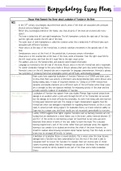
Discuss What Research Has Shown about Localisation of Function in the Brain
AO1:
- In the 19th century psychologists discovered that specific areas of the brain are associated with particular
physical and psychological functions.
- Before this, psychologists believed in the holistic view that all parts of the brain are involved with every
aspect.
- The brain is divided into left and right hemispheres. The left hemisphere controls the right side of the body,
and the right side controls the left side of the body.
- The outer layer of both hemispheres is called the cerebral cortex this is divided into 4 different lobes each
associated with different functions.
- Motor area is at the back of the frontal lobe, it controls voluntary movement in the opposite side of the
body.
- Somatosensory area is at the front of the parietal lobe, it processes sensory information
- Visual area is in the occipital lobe at the back of the brain, sends information from the right visual field to
the left visual cortex, and from the left visual field to the right visual cortex.
- The auditory area is in the temporal lobe, and analyses speech-based information.
- Language us restricted to the left side of the brain, Broca’s area is in the left frontal lobe and is responsible
for speech production. Damage to this area results in Broca’s aphasia which gives slow speech lacking fluency.
- Wernicke’s area is in the left temporal lobe and is responsible for language comprehension., Wernicke’s aphasia
has symptoms of producing fluent but meaningless speech and difficulty understanding language.
Brain scans Brain scans have supported localisation of function. Peterson et al (1988) used brain scans
to show that there was activity in Wernicke’s area during listening tasks and in Broca’s area
during reading tasks. A study of long-term memory by Tulving et al (1994) showed that
semantic and episodic memories are in different parts of the prefrontal cortex. Brain scans
are a strength as they are objective methods for measuring activity of the brain and this
provides scientific evidence of localisation of function.
Case study evidence Localisation of function has support from case studies. Phineas Gage received serious brain
Phineas Gage damage in an accident where a pole went through the left of his frontal lobe. He survived
but the damage to his brain affected his personality, he went from being calm and reserved
to being quick-tempered and rude. This change in Gage’s temperament suggests that the
frontal lobe which was damaged is responsible for regulating mood However, as this is a case
study it cannot provide strong support for localisation theory as it lacks external validity as
Gage may be a unique case, and these results are not necessarily generalisable to everyone.
Lashley’s research Lashley (1950) suggests that higher cognitive functions such as learning processes are not
localised but are distributed in a more holistic way in the brain. Lashley removed between 10
and 50% of the cortex in rats learning a maze. He found that no one area was more
important than others in terms of the rats’ ability to learn the maze. This is because
learning required every part of the cortex rather than just particular areas, this suggests
learning is too complex to be localised and involves the whole of the brain. However, we
should be cautious about drawing conclusions about human learning from this study as mice’s
brains may be arranged differently to humans.
Neural plasticity A limitation of localisation theory is neural plasticity. This is where when the brain become
damaged and a function has been compromised or lost, the rest of the brain is able to
reorganise itself to recover the function. For example, there are several cases of stroke
victims recovering abilities that they seemingly lost because of the illness. This means that
functions cannot be strictly localised to one part of the brain and so limits localisation
theory.
, Describe and Evaluate Split-Brain Research
AO1:
- Hemispheric lateralisation is when behaviours are controlled by just one hemisphere of the brain.
- Right hemisphere controls the left side of the body, and left hemisphere controls the right side of the body.
- A split-brain operation is where the connections between the right and left hemispheres are severed (mainly
the corpus callosum). This procedure is called a commissurotomy and is performed to reduce epilepsy as it
prevents the excessive electrical activity from travelling between the hemispheres which occurs during a
seizure.
- Split brain research studies show how the hemispheres function when they can’t communicate with each
other.
- Sperry (1968) studied 11 people who had a split-brain operation. An image or word was projected into a
patients right visual field and another image into the left visual filed.
- In a normal brain the corpus callosum shared information between both hemispheres. However, in a split brain,
the information cannot be conveyed from the chosen hemisphere to the other.
- The found that when an image was in the right visual field the participant could describe what was seen, but
if the object was in the left visual field, they said there was nothing there. They could not give verbal labels
to object projected in the left visual field, but they could select an object that was most closely associated
with the object.
- If a pinup picture was shown to the left visual field there was an emotional reaction such as a laugh, but the
participants usually reported seeing nothing or just a flash of light.
- They concluded that this was because in a connected brain messages from the right hemisphere are relayed
to the language centres in the left hemisphere, but this is not possible in a split brain.
Strong methodology The methodology that Sperry used was very strong. It was a careful standardised procedure
of presenting visual information to one hemispheric filed at a time. Participants stared at a
fixed point with one eye and an image flashed up for 0.1 seconds which means that there
was no time to move eyes over to the image and spread information across both sides of
the visual field or both sides of the brain. This allows Sperry to ensure only one hemisphere
received information at a time and is a very useful and controlled procedure.
Issues with The findings from Sperry’s research may not be able to be widely generalised as split-brain
generalisation patients are an unusual sample of people. Only 11 participants took part in the study, and all
of them had a history of seizures, this may have caused unique changes in the structure or
function of the brain that influenced the results. This limits the extent to which findings
can be generalised to normal brains, reducing the validity of the conclusions.
Confounding variables Another limitation in Sperry’s research is that there are issues with confounding variables.
The behaviour of Sperry’s split-brain participants was compared to a neurotypical control
group. None of the control group had epilepsy, whereas all of the test group did. Therefore,
any differences observed between the two groups may be the result of the epilepsy rather
than the split brain.
Hemispheres process A strength is that even in a connected brain the hemispheres process information
information differently differently. Fink et al (1996) used PET scans to identify which areas of the brain were
active during a visual processing task. When participants were asked to look at global
elements of an image regions of the right hemisphere were much more active, however
when required to focus on the finer detail areas of the left hemisphere dominated. This
suggests that hemispheric lateralisation is a feature of the connected brain as well as the
split-brain and supports Sperry’s findings.
Discuss What Research Has Shown about Localisation of Function in the Brain
AO1:
- In the 19th century psychologists discovered that specific areas of the brain are associated with particular
physical and psychological functions.
- Before this, psychologists believed in the holistic view that all parts of the brain are involved with every
aspect.
- The brain is divided into left and right hemispheres. The left hemisphere controls the right side of the body,
and the right side controls the left side of the body.
- The outer layer of both hemispheres is called the cerebral cortex this is divided into 4 different lobes each
associated with different functions.
- Motor area is at the back of the frontal lobe, it controls voluntary movement in the opposite side of the
body.
- Somatosensory area is at the front of the parietal lobe, it processes sensory information
- Visual area is in the occipital lobe at the back of the brain, sends information from the right visual field to
the left visual cortex, and from the left visual field to the right visual cortex.
- The auditory area is in the temporal lobe, and analyses speech-based information.
- Language us restricted to the left side of the brain, Broca’s area is in the left frontal lobe and is responsible
for speech production. Damage to this area results in Broca’s aphasia which gives slow speech lacking fluency.
- Wernicke’s area is in the left temporal lobe and is responsible for language comprehension., Wernicke’s aphasia
has symptoms of producing fluent but meaningless speech and difficulty understanding language.
Brain scans Brain scans have supported localisation of function. Peterson et al (1988) used brain scans
to show that there was activity in Wernicke’s area during listening tasks and in Broca’s area
during reading tasks. A study of long-term memory by Tulving et al (1994) showed that
semantic and episodic memories are in different parts of the prefrontal cortex. Brain scans
are a strength as they are objective methods for measuring activity of the brain and this
provides scientific evidence of localisation of function.
Case study evidence Localisation of function has support from case studies. Phineas Gage received serious brain
Phineas Gage damage in an accident where a pole went through the left of his frontal lobe. He survived
but the damage to his brain affected his personality, he went from being calm and reserved
to being quick-tempered and rude. This change in Gage’s temperament suggests that the
frontal lobe which was damaged is responsible for regulating mood However, as this is a case
study it cannot provide strong support for localisation theory as it lacks external validity as
Gage may be a unique case, and these results are not necessarily generalisable to everyone.
Lashley’s research Lashley (1950) suggests that higher cognitive functions such as learning processes are not
localised but are distributed in a more holistic way in the brain. Lashley removed between 10
and 50% of the cortex in rats learning a maze. He found that no one area was more
important than others in terms of the rats’ ability to learn the maze. This is because
learning required every part of the cortex rather than just particular areas, this suggests
learning is too complex to be localised and involves the whole of the brain. However, we
should be cautious about drawing conclusions about human learning from this study as mice’s
brains may be arranged differently to humans.
Neural plasticity A limitation of localisation theory is neural plasticity. This is where when the brain become
damaged and a function has been compromised or lost, the rest of the brain is able to
reorganise itself to recover the function. For example, there are several cases of stroke
victims recovering abilities that they seemingly lost because of the illness. This means that
functions cannot be strictly localised to one part of the brain and so limits localisation
theory.
, Describe and Evaluate Split-Brain Research
AO1:
- Hemispheric lateralisation is when behaviours are controlled by just one hemisphere of the brain.
- Right hemisphere controls the left side of the body, and left hemisphere controls the right side of the body.
- A split-brain operation is where the connections between the right and left hemispheres are severed (mainly
the corpus callosum). This procedure is called a commissurotomy and is performed to reduce epilepsy as it
prevents the excessive electrical activity from travelling between the hemispheres which occurs during a
seizure.
- Split brain research studies show how the hemispheres function when they can’t communicate with each
other.
- Sperry (1968) studied 11 people who had a split-brain operation. An image or word was projected into a
patients right visual field and another image into the left visual filed.
- In a normal brain the corpus callosum shared information between both hemispheres. However, in a split brain,
the information cannot be conveyed from the chosen hemisphere to the other.
- The found that when an image was in the right visual field the participant could describe what was seen, but
if the object was in the left visual field, they said there was nothing there. They could not give verbal labels
to object projected in the left visual field, but they could select an object that was most closely associated
with the object.
- If a pinup picture was shown to the left visual field there was an emotional reaction such as a laugh, but the
participants usually reported seeing nothing or just a flash of light.
- They concluded that this was because in a connected brain messages from the right hemisphere are relayed
to the language centres in the left hemisphere, but this is not possible in a split brain.
Strong methodology The methodology that Sperry used was very strong. It was a careful standardised procedure
of presenting visual information to one hemispheric filed at a time. Participants stared at a
fixed point with one eye and an image flashed up for 0.1 seconds which means that there
was no time to move eyes over to the image and spread information across both sides of
the visual field or both sides of the brain. This allows Sperry to ensure only one hemisphere
received information at a time and is a very useful and controlled procedure.
Issues with The findings from Sperry’s research may not be able to be widely generalised as split-brain
generalisation patients are an unusual sample of people. Only 11 participants took part in the study, and all
of them had a history of seizures, this may have caused unique changes in the structure or
function of the brain that influenced the results. This limits the extent to which findings
can be generalised to normal brains, reducing the validity of the conclusions.
Confounding variables Another limitation in Sperry’s research is that there are issues with confounding variables.
The behaviour of Sperry’s split-brain participants was compared to a neurotypical control
group. None of the control group had epilepsy, whereas all of the test group did. Therefore,
any differences observed between the two groups may be the result of the epilepsy rather
than the split brain.
Hemispheres process A strength is that even in a connected brain the hemispheres process information
information differently differently. Fink et al (1996) used PET scans to identify which areas of the brain were
active during a visual processing task. When participants were asked to look at global
elements of an image regions of the right hemisphere were much more active, however
when required to focus on the finer detail areas of the left hemisphere dominated. This
suggests that hemispheric lateralisation is a feature of the connected brain as well as the
split-brain and supports Sperry’s findings.