- Study guides, Revision notes & Summaries
Looking for the best study guides, study notes and summaries about ? On this page you'll find 5 study documents about .
All 5 results
Sort by:
-
Exam (elaborations)
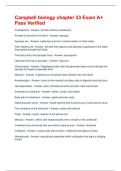
Campbell biology chapter 33 Exam A+ Pass Verified
-
---5November 20252025/2026A+
- Campbell biology chapter 33 Exam A+ Pass Verified 
 
Invertebrates - Answer- Animals without a backbone 
 
Animals in the phylum Porifera - Answer- sponges 
 
Sponges are - Answer- sedentary and live in marine waters or fresh water 
 
Filter feeders are - Answer- animals that capture food particles suspended in the water that passes through their body 
 
The body cavity that sponges have - Answer- spongocoel 
 
Opening at the top of sponges - Answer- Osculum 
 
Choanocytes - Answer- Flagellated ...
-
£9.49 More Info
Stuviaascorers
-
Exam (elaborations)
Campbell Biology Chapter 33 Exam Questions With All Correct Answers Verified Answers 2025 Marking Scheme New Update
-
---8November 20252025/2026A+
- Campbell Biology Chapter 33 Exam Questions With All Correct Answers Verified Answers 2025 Marking Scheme New Update 
 
Invertebrates - Answer- Animals without a backbone. About 95% of known animal species. 
 
Calcarea and Silicea - Answer- phylum that includes sponges; no symmetry, tissues, body cavity, organs, nervous system; basal animals; mostly marine; contain spicules; most are hermaphrodites; free-swimming during larval stage and sessile (non motile) as adults; suspension/filter feeders 
 ...
-
£9.53 More Info
Stuviaascorers
-
Exam (elaborations)
CAMPBELL BIOLOGY CHAPTER 33 Q’S AND A’S
-
--7November 20252025/2026A+Available in bundle
- CAMPBELL BIOLOGY CHAPTER 33 Q’S AND A’S 
Invertebrates - ANSWER-Animals without a backbone. About 95% of known animal species. 
 
Calcarea and Silicea - ANSWER-phylum that includes sponges; no symmetry, tissues, body cavity, organs, nervous system; basal animals; mostly marine; contain spicules; most are hermaphrodites; free-swimming during larval stage and sessile (non motile) as adults; suspension/filter feeders 
 
Suspention feeders - ANSWER-small and large organisms that use filtering an...
-
£16.39 More Info
Freshy
-
Exam (elaborations)
Campbell Biology Chapter 33 Test Bank Review 2025
-
---22October 20252025/2026A+
- Which cells in a sponge are primarily responsible for trapping and removing food particles from circulating water? A) choanocytes B) mesoglea cells C) pore cells (porocytes) D) epidermal cells Answer: A) choanocytes Rationale: Choanocytes have flagella that create water currents and trap food particles with their collars, making them the main feeding cells in sponges. 
Which of the following is correctly associated with sponges? A) osculum B) body cavity C) cnidocytes D) spicules made of chitin ...
-
£12.20 More Info
lisarhodes411
-
Exam (elaborations)
Campbell Biology Chapter 33 Quiz and Study Guide 2025
-
---37October 20252025/2026A+
- What are the products of linear photophosphorylation? A) heat and fluorescence B) ATP and P700 C) ATP and NADPH D) ADP and NADP E) P700 and P680 Rationale: Linear photophosphorylation uses both photosystem II and I, producing ATP and NADPH as energy carriers for the Calvin cycle. 
As a research scientist, you measure the amount of ATP and NADPH consumed by the Calvin cycle in 1 hour. You find 30,000 molecules of ATP consumed, but only 20,000 molecules of NADPH. Where did the extra ATP molecules ...
-
£25.16 More Info
lisarhodes411