Pearson BTEC • Forensic and Criminal Investigation
Latest uploads for Forensic and Criminal Investigation at Pearson BTEC. Looking for Forensic and Criminal Investigation notes at Pearson BTEC? We have lots of notes, study guides and revision notes available for Forensic and Criminal Investigation at Pearson BTEC.
-
267
- 0
-
51
Modules Forensic and Criminal Investigation at Pearson BTEC
Notes available for the following courses of Forensic and Criminal Investigation at Pearson BTEC
- Unit 1 - Principles and Applications of Science
- Unit 2 - Practical Scientific Procedures and Techniques
- Unit 3 - Science Investigation Skills
- Unit 4 - Forensic Investigation Procedures in Practice
- Unit 5 - Applications of Criminology
- Unit 6 - Criminal Investigation Procedures in Practice
- Unit 7 - Applications of Criminal and Forensic Psychology
- Unit 8 - Physiology of Human Body Systems
- Unit 9 - Environmental Forensics
- Unit 10 - Forensic Fire Investigation
- Unit 11 - Forensic Traffic Collision Investigation
- Unit 12 - Forensic Photography
- Unit 13 - Forensic Genetics
- Unit 14 - Forensic Anthropology and Archaeology
- Unit 15 - Practical Chemical Analysis
- Unit 16 - Microbiology and Microbiological Techniques
Latest content Pearson BTEC • Forensic and Criminal Investigation
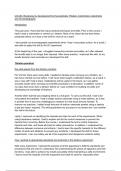
A presentation or report that focuses on the evaluation of learners’ performance and skill development across all scientific procedures and techniques carried out in learning aims A, B and C 
 
This assignment was graded a distinction, so is a reliable assignment to receive a good grade
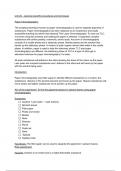
Results from the paper chromatography and TLC of extracted plant pigments from paper chromatography of amino acids. An explanation of the principles behind the chromatographic separations. Suggestions for improvements to the chromatographic procedures carried out and full justification of these suggestions. An observation report with a checklist, 
completed by the teacher, including safety. 
 
This assignment was graded a distinction piece, so guarantees a high quality grade.
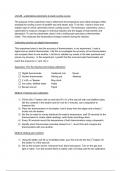
Results from checking the calibration of at least two types of thermometer. A table of time/temperature data and a graph of temperature against time for a substance cooling. Calculations of the rate of cooling at points on the graph. An analysis of how the rate of cooling is related to intermolecular forces and the state of the substance. A report evaluating the accuracy of the cooling curve experiment. An observation report with a checklist, completed by the teacher, including safety. 
 
This a...
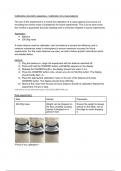
Pro formas of results for checking the calibration of a pipette and balance(s) and calibration of a pH meter. A report on the use of Na2CO3 to standardise HCl, used in turn to standardise NaOH. pH curve from the titration plus a differential plot. Results, calculations and calibration graph for the determination of the concentration of a coloured solution using colorimetry. Explanations of how the accuracy, precision and safety of the quantitative techniques may be optimised. Observation checkli...
This summaries collision theory, a key topic needed in the Scientific Investigative Skill Exam. This will help learners understand in a simpler way what Collision Theory is and how it can be applied into physics an chemistry
An appropriately structured expert witness statement should be produced that includes results, explanations and aspects of probability. 
 
Received a distinction grade on this assignment, useful to gain a good grade.
Learners should produce a portfolio of laboratory examination forms, including drawings and photographs where appropriate, method sheets and results of analysis. This should be supported with an observation document, completed by the assessor. 
 
Received a distinction on this piece, useful document to gain a good grade.
Learners should preserve and process a mock scene and produce crime scene notes with photographs of their evidence. This should be supported with an observation document, completed by the assessor. Learners should produce a written report that demonstrates understanding of how to gather forensic evidence 
 
For this assignment I was graded a Distinction, reliable and easy way to gain a good grade on the assignment
Achieved Distinction with these notes. Covers all three questions, including offender profiling, top down and bottom-up approach, biological and non-biological approach, treatment programs, and more. 
Applications of criminal and forensic psychology 2024
unit 7 applications of criminal and forensic psychology 
Achieved Distinction with these notes. Covers all three questions, including offender profiling, top down and bottom up approach, biological and non-biological approach, treatment programs, and more.