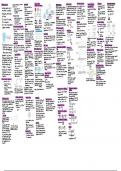
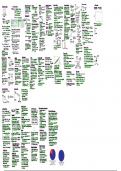
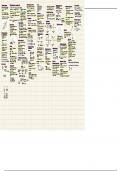
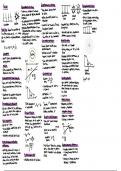
AQA A Level Physics Paper 2 notes
AQA
All 6 results
Sort by
-
AQA A-Level Physics Paper 2
- Package deal • 5 items • 2024
-
- £6.99
- + learn more
QA A-Level Physics Paper 2 covers material from Year 2 of the syllabus and some content from Year 1. It typically includes:

Thermal Physics: Specific heat capacity, latent heat, and the kinetic theory of gases.
Fields and their Consequences: Gravitational fields, electric fields, capacitance, and magnetic fields.
Nuclear Physics: Radioactive decay
-
Thermal Physics
- Summary • 2 pages • 2024
- Available in package deal
-
- £7.16
- + learn more
Thermal physics deals with the study of heat, temperature, and the transfer of energy between systems. Key concepts include: 
 
Temperature: A measure of the average kinetic energy of particles in a substance. 
Heat: The energy transferred between systems due to a temperature difference. 
Specific Heat Capacity: The amount of heat needed to raise the temperature of a unit mass of a substance by one degree Celsius. 
Latent Heat: The heat required for a substance to change state (e.g., from solid ...
-
Radioactivity
- Summary • 5 pages • 2024
- Available in package deal
-
- £7.16
- + learn more
Radioactivity is the spontaneous emission of particles or energy from the unstable nuclei of certain atoms as they decay to become more stable. This process occurs in three main forms: 
 
Alpha decay: Emission of alpha particles (2 protons and 2 neutrons), decreasing the atomic number by 2. 
Beta decay: Emission of beta particles (electrons or positrons), altering the number of protons or neutrons. 
Gamma decay: Emission of gamma rays (high-energy electromagnetic radiation), which often follows ...
-
Magnetic fields
- Summary • 13 pages • 2024
- Available in package deal
-
- £7.16
- + learn more
Magnetic fields are regions around a magnet or a moving electric charge where magnetic forces can be observed. These fields are produced by magnets, electric currents, or changing electric fields. Magnetic field lines show the direction and strength of the field, going from the north to the south pole of a magnet. 
 
Magnetic fields exert a force on moving charged particles or current-carrying wires. The direction of the force on a moving charge is perpendicular to both the magnetic field and th...
-
Gravitation and Electric fields
- Summary • 2 pages • 2024
- Available in package deal
-
- £7.16
- + learn more
Gravitational and electric fields are both examples of force fields that act over a distance. 
 
Gravitational fields are regions around a mass where another mass experiences an attractive force. The force is proportional to the product of the masses and inversely proportional to the square of the distance between them. Gravitational fields are always attractive. 
 
Electric fields exist around charged particles. A positive charge creates a field that repels other positive charges and attracts n...
-
Capacitance
- Summary • 1 pages • 2024
- Available in package deal
-
- £7.16
- + learn more
Capacitance is the ability of a system to store electrical charge when a voltage is applied. It’s measured in farads (F), which indicate how much charge can be stored per volt of potential difference. A capacitor is a device designed to store electrical energy, consisting of two metal plates separated by an insulating material called a dielectric. Capacitors are widely used in electronic circuits for energy storage, filtering, and signal processing. The energy stored in a capacitor is held in ...
Did you know that on average a seller on Stuvia earns £76 per month selling revision notes? Hmm, hint, hint. Discover all about earning on Stuvia