Types of Experiments
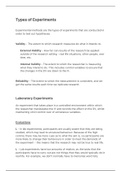
Experimental methods are the types of experiments that are conducted in
order to test out hypotheses.
Validity - The extent to which research measures do what it intends to.
External Validity - How far can results of the research be applied
outside of the research setting - real life situations, other people, over
time, etc.
Internal Validity - The extent to which the researcher is measuring
what they intend to do. This includes control variables to ensure that
the changes in the DV are down to the IV.
Reliability - The extent to which the measurement is consistent, and we
get the same results each time we replicate research.
Laboratory Experiments
An experiment that takes place in a controlled environment within which
the researcher manipulates the IV and records the effect on the DV, whilst
maintaining strict control over of extraneous variables.
Evaluations
L - In lab experiments, participants are usually aware that they are being
studied, which may lead to unnatural behaviour. Because of the high
control, there may be more cues as to what the aim is, so participants are
more likely to change their behaviours in order to meet the demands of
the experiment - this means that the research may not be true to real life.
L - Lab experiments have low amounts of realism, as the tasks that the
participants have to carry out are not things that they would typically do in
real life. For example, we don’t normally have to memorise word lists.
, L - They may lack generalisability, because lab environments may be
artificial and not like everyday life. We are trying to study behaviour in
everyday life, which is problematic, as in unfamiliar contexts the
participants may act differently.
S - They have high control over extraneous variables. This means that you
can establish cause and effect. Replication is also more possible because
of the high level of control. This ensures the extraneous variables are not
introduced when repeating the study. Replication is vital to check the
results are valid, or just a one off.
Field Experiments
This is an experiment that takes place in a natural setting, where the
researcher manipulates the IV and records the effect of the DV.
The basic scientific procedures are still followed as best they can.
– The participants are randomly allocated to a degree.
– The IV is manipulated.
– All other variables are held constant, as best they can.
– The effect on the DV is measured.
They don’t have to be conducted in a field.
Reality TV is full of Field Experiments: ‘Love Island’ and ‘I’m A Celebrity
Get Me Out Of Here’ are two examples.
A field experiment is still an experiment because of one essential thing -
The psychologist still manipulates the IV.
Evaluations
L - There may be some ethical issues if the participants aren’t aware that
they are being studied and cannot consent to being studied, which may
also mean that a participants privacy may be invaded.
Experimental methods are the types of experiments that are conducted in
order to test out hypotheses.
Validity - The extent to which research measures do what it intends to.
External Validity - How far can results of the research be applied
outside of the research setting - real life situations, other people, over
time, etc.
Internal Validity - The extent to which the researcher is measuring
what they intend to do. This includes control variables to ensure that
the changes in the DV are down to the IV.
Reliability - The extent to which the measurement is consistent, and we
get the same results each time we replicate research.
Laboratory Experiments
An experiment that takes place in a controlled environment within which
the researcher manipulates the IV and records the effect on the DV, whilst
maintaining strict control over of extraneous variables.
Evaluations
L - In lab experiments, participants are usually aware that they are being
studied, which may lead to unnatural behaviour. Because of the high
control, there may be more cues as to what the aim is, so participants are
more likely to change their behaviours in order to meet the demands of
the experiment - this means that the research may not be true to real life.
L - Lab experiments have low amounts of realism, as the tasks that the
participants have to carry out are not things that they would typically do in
real life. For example, we don’t normally have to memorise word lists.
, L - They may lack generalisability, because lab environments may be
artificial and not like everyday life. We are trying to study behaviour in
everyday life, which is problematic, as in unfamiliar contexts the
participants may act differently.
S - They have high control over extraneous variables. This means that you
can establish cause and effect. Replication is also more possible because
of the high level of control. This ensures the extraneous variables are not
introduced when repeating the study. Replication is vital to check the
results are valid, or just a one off.
Field Experiments
This is an experiment that takes place in a natural setting, where the
researcher manipulates the IV and records the effect of the DV.
The basic scientific procedures are still followed as best they can.
– The participants are randomly allocated to a degree.
– The IV is manipulated.
– All other variables are held constant, as best they can.
– The effect on the DV is measured.
They don’t have to be conducted in a field.
Reality TV is full of Field Experiments: ‘Love Island’ and ‘I’m A Celebrity
Get Me Out Of Here’ are two examples.
A field experiment is still an experiment because of one essential thing -
The psychologist still manipulates the IV.
Evaluations
L - There may be some ethical issues if the participants aren’t aware that
they are being studied and cannot consent to being studied, which may
also mean that a participants privacy may be invaded.