

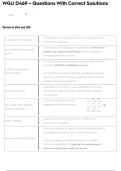
WGU D469 – Questions With Correct Solutions
Save
Terms in this set (51)
The degree to which goods or services conform to the
Quality of conformance
intent of the designers
a philosophy for managing an organization centered on
Total Quality Management
quality and customer satisfaction as “the” strategy for
(TQM)
achieving long-term success.
The official system that measures quality, which evolved
out of the ISO:9001 certification process.
Quality Management
System (QMS) ISO certifies a company’s “quality management system,”
and much of the ISO’s written materials refer directly to
“quality management systems.”
A diagram of the steps in a job, operation, or process.
process flowchart Allows employees to visualize where quality needs to
be improved.
a chart showing the different
cause and effect diagram categories of problem causes
(fishbone diagram)
a quality tool that shows if there is a relationship
scatter diagram
between two variables.
Using this concept for quality, in most cases the majority
of problems come from one or just a few sources.
Pareto Analysis (80/20 rule)
Helps management identify problems or strengths
within an organization by tallying the percentage of
defects resulting from different causes.
, 14 points used to achieve highest level of customer
satisfaction
Many companies reduce their number of suppliers in
order to have more direct influence over their suppliers'
Deming's 14 points
quality and delivery performance, which was one of
Deming's 14 points. It is based on the notion that if a
company has a major portion of a supplier's business,
then the supplier is more willing to meet the customer's
quality standards.
The ability to measure customer satisfaction; to “hear”
An important component what the customer wants. The company needs to know
of any QMS if its QMS is effective by some form of measurement
system.
Voice of the Customer Customer satisfaction surveys, necessary for Baldridge
(VOC) Award applicants
Employees need to be active participants in the quality-
improvement process and must feel a responsibility for
Employee role in quality
quality. A systematic procedure is necessary to involve
workers and solicit their input.
Measure of how much a given product or process
deviates from perfection, or zero defects.
The main idea behind Six Sigma is that if the number of
“defects” in a process can be measured, then it can be
Six Sigma systematically determined how to eliminate them and
get as close to zero defects as possible. This translates
into a statistically based numerical goal of 3.4 defects
per million opportunities (DPMO), which is the near
elimination of defects from a process, product, or
service.
1. align: balanced scorecard is created
2. mobilize: teams are created and empowered to act
Six Sigma steps
3. accelerate: execution
4. govern: monitor and review
Save
Terms in this set (51)
The degree to which goods or services conform to the
Quality of conformance
intent of the designers
a philosophy for managing an organization centered on
Total Quality Management
quality and customer satisfaction as “the” strategy for
(TQM)
achieving long-term success.
The official system that measures quality, which evolved
out of the ISO:9001 certification process.
Quality Management
System (QMS) ISO certifies a company’s “quality management system,”
and much of the ISO’s written materials refer directly to
“quality management systems.”
A diagram of the steps in a job, operation, or process.
process flowchart Allows employees to visualize where quality needs to
be improved.
a chart showing the different
cause and effect diagram categories of problem causes
(fishbone diagram)
a quality tool that shows if there is a relationship
scatter diagram
between two variables.
Using this concept for quality, in most cases the majority
of problems come from one or just a few sources.
Pareto Analysis (80/20 rule)
Helps management identify problems or strengths
within an organization by tallying the percentage of
defects resulting from different causes.
, 14 points used to achieve highest level of customer
satisfaction
Many companies reduce their number of suppliers in
order to have more direct influence over their suppliers'
Deming's 14 points
quality and delivery performance, which was one of
Deming's 14 points. It is based on the notion that if a
company has a major portion of a supplier's business,
then the supplier is more willing to meet the customer's
quality standards.
The ability to measure customer satisfaction; to “hear”
An important component what the customer wants. The company needs to know
of any QMS if its QMS is effective by some form of measurement
system.
Voice of the Customer Customer satisfaction surveys, necessary for Baldridge
(VOC) Award applicants
Employees need to be active participants in the quality-
improvement process and must feel a responsibility for
Employee role in quality
quality. A systematic procedure is necessary to involve
workers and solicit their input.
Measure of how much a given product or process
deviates from perfection, or zero defects.
The main idea behind Six Sigma is that if the number of
“defects” in a process can be measured, then it can be
Six Sigma systematically determined how to eliminate them and
get as close to zero defects as possible. This translates
into a statistically based numerical goal of 3.4 defects
per million opportunities (DPMO), which is the near
elimination of defects from a process, product, or
service.
1. align: balanced scorecard is created
2. mobilize: teams are created and empowered to act
Six Sigma steps
3. accelerate: execution
4. govern: monitor and review


