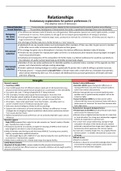
Relationships
Evolutionary explanations for partner preferences (1)
(the adaptive nature of behaviour)
Natural Selection Process whereby organisms better adapted to their environment tend to survive & produce more offspring
Sexual Selection The evolution/ development of characteristics that confer a reproductive advantage (leave more descendants)
• The differences between male & female sex cells (gametes). Male gametes (sperm) are small, highly mobile, created
Anisgamy continuously in vast no.s form puberty to old age & do not require great expenditure of energy to produce.
for mate • Female gametes (eggs) are relatively large, static, produced at intervals for a limited no. of fertility years & require a
selection huge investment of energy.
• No shortage of fertile males but a fertile female is a ‘rare’ resource.
• Individuals of one sex (usually males) must outcompete other members of their sex order to gain access to member
of the other sex in order to become successful & pass on their genes.
• This strategy has given rise to dimorphism in humans: the obvious differences between males & females.
Intrasexual
• Females do not compete for reproductive rights so there is no evolutionary drive towards favouring larger/ stronger/
selection
more resourceful females
• A behavioural consequence of this competition for fertile mates is a distinct preference for youth & a sensitivity to
the indicators of youth/ certain facial features & fertility (certain body shape)
• Members of one sex evolve preferences for desirable qualities in potential mates; members of the opposite sex that
possess such characteristics will gain mating advantage.
Intersexual
• Female’s optimum mating strategy is to select a genetically fit partner who is able & willing to provide resources.
selection
• ‘Runway process’ – encapsulated by Ronald Fisher: a female mates with a male who has a desirable characteristic,
which will be inherited by their son. This increases the likelihood that successive generations of females will mate
with their offspring.
Strengths Limitations
Research support: Gender/ cultural differences:
• David Buss (1989) • Bernstein (2015) argues that gender differences in
• Over 10,000 people from 37 different cultures rated each of 18 characteristics (e.g. mating preferences may stem from cultural traditions
physical attractiveness/ good financial prospects) on a scale based on their desirability. rather than evolved characteristics.
• Four-point sale used; ‘3’ being indispensible & ‘0’ being irrelevant • Women have gained more economic/political power -
• 97% of samples, females valued ‘good financial prospects’ more than men qualities such as ‘good financial prospects’ will not be
• 92% of females valued ‘ambition & industriousness’ more in a mate than men ranked as highly.
• All 37 samples, males preferred younger mates –valued increased fertility • Kasser & Sharma (1999) found that women within
• All samples - males rated ‘good looks’ more than females – providing cues to a cultures with less access to resources/ status will value a
women’s health hence her fertility & reproductive value. mates access to ‘resources’ far more than someone who
• Both sexes desired intelligence (linked to skill at parenting) had a high status.
• Supports the ev behaviours of human behaviour/ Reflects sex differences in mate Reductionist: disregards biological factors:
strategies due to anisgamy/ Supports predictions about partner preferences derived • Pentok-Voak et al (1999) found that female mate choice
from sexual selection theory varies across the menstrual cycle.
• Reflects fundamental human preferences are not primarily dependent upon cultural • Women chose a slightly feminised version of a male face
influences. as ‘most attractive’ for a long-term relationship: suggests
Research support: kindness & cooperation in parental care.
Singh (1993) proposed that a waist to hip ratio served as an 'honest' marker of female • For a short-term sexual relationship, during the high
age / reproductive status / health. conception risk phase of the menstrual cycle, women
• Participants examined 12 randomly arranged line drawings of WHR at three levels of preferred a masculinise face shape more: higher levels of
body weight & rank them in order of attractiveness. testosterone which suppresses the immune system.
• Males & females rated the figure with the lowest WHR (0.7) as being more youthful, • (A male who is healthy despite this, has a highly efficient
healthy, reproductively capable & attractive. immune system – a valuable characteristic to pass onto
The underweight figure with a WHR of 0.7 was rated as being the most youthful but not offspring)
as attractive or reproductively capable. Difficult to test:
• Males show a preference for a female body shape that signals fertility. • Based on evolution
Lonely hearts research: • Evidence is based on presumed knowledge about human
Waynforth & Dunabr (1995) – women tended to offer physical attractiveness & environments leading to speculations about which
indicators of youth & men offered resources ‘successful, ambitious etc) & sought youth & behaviours may have been adaptive.
physical attractiveness.
, Factors affecting attraction: Physical attractiveness (2)
(Importance in determining attraction)
• The degree to which a person's physical features are considered aesthetically pleasing or beautiful.
• Shackelford & Larsen (1997) found that people with symmetrical faces are rated as more attractive – honest signal of genetic
fitness (evolutionary theory)
Physical
• People are also attracted to neotenous (baby-face) features – triggers a protective/ caring instinct – valuable resource for
attraction females wanting to reproduce.
• McNulty et al. (2008) found evidence that the initial attractiveness that brought partners together, continued to be an
important feature of the relationship after marriage, for at least several years.
• The cognitive bias where one particular trait, especially good characteristics, influences or extends to other qualities of the
person.
• One distinguishing feature has a disproportionate influenced on a person’s judgments.
‘halo’
• Physcial attractiveness involves preconceived ideas about the personality traits attractive people have – universally positive.
effect • Dion et al. Found that physically attractive people are consistently rated as kind, strong, sociable & successful compared to
unattractive people.
• The “halo effect” biases one’s decision with a tendency to focus on the good.
• Elaine Walster and her colleagues (1966)
• Claims that when individuals seek a partner for a romantic relationship, they tend to look for someone whose physical
attractiveness approximately equals to their own
Matching
• Individuals assess their own ‘value’ and then select the best available candidates
Hypothesis • Therefore maximising their chances of survival.
• Balanced out by fear of rejection leading to what Walster calls ‘realistic choices’
• We desire the most physical attractive partner possible for evolutionary, social, cultural and psychological reasons – we balance
this against the wish to avoid being rejected by someone.
Evolutionary explanations for partner preferences (1)
(the adaptive nature of behaviour)
Natural Selection Process whereby organisms better adapted to their environment tend to survive & produce more offspring
Sexual Selection The evolution/ development of characteristics that confer a reproductive advantage (leave more descendants)
• The differences between male & female sex cells (gametes). Male gametes (sperm) are small, highly mobile, created
Anisgamy continuously in vast no.s form puberty to old age & do not require great expenditure of energy to produce.
for mate • Female gametes (eggs) are relatively large, static, produced at intervals for a limited no. of fertility years & require a
selection huge investment of energy.
• No shortage of fertile males but a fertile female is a ‘rare’ resource.
• Individuals of one sex (usually males) must outcompete other members of their sex order to gain access to member
of the other sex in order to become successful & pass on their genes.
• This strategy has given rise to dimorphism in humans: the obvious differences between males & females.
Intrasexual
• Females do not compete for reproductive rights so there is no evolutionary drive towards favouring larger/ stronger/
selection
more resourceful females
• A behavioural consequence of this competition for fertile mates is a distinct preference for youth & a sensitivity to
the indicators of youth/ certain facial features & fertility (certain body shape)
• Members of one sex evolve preferences for desirable qualities in potential mates; members of the opposite sex that
possess such characteristics will gain mating advantage.
Intersexual
• Female’s optimum mating strategy is to select a genetically fit partner who is able & willing to provide resources.
selection
• ‘Runway process’ – encapsulated by Ronald Fisher: a female mates with a male who has a desirable characteristic,
which will be inherited by their son. This increases the likelihood that successive generations of females will mate
with their offspring.
Strengths Limitations
Research support: Gender/ cultural differences:
• David Buss (1989) • Bernstein (2015) argues that gender differences in
• Over 10,000 people from 37 different cultures rated each of 18 characteristics (e.g. mating preferences may stem from cultural traditions
physical attractiveness/ good financial prospects) on a scale based on their desirability. rather than evolved characteristics.
• Four-point sale used; ‘3’ being indispensible & ‘0’ being irrelevant • Women have gained more economic/political power -
• 97% of samples, females valued ‘good financial prospects’ more than men qualities such as ‘good financial prospects’ will not be
• 92% of females valued ‘ambition & industriousness’ more in a mate than men ranked as highly.
• All 37 samples, males preferred younger mates –valued increased fertility • Kasser & Sharma (1999) found that women within
• All samples - males rated ‘good looks’ more than females – providing cues to a cultures with less access to resources/ status will value a
women’s health hence her fertility & reproductive value. mates access to ‘resources’ far more than someone who
• Both sexes desired intelligence (linked to skill at parenting) had a high status.
• Supports the ev behaviours of human behaviour/ Reflects sex differences in mate Reductionist: disregards biological factors:
strategies due to anisgamy/ Supports predictions about partner preferences derived • Pentok-Voak et al (1999) found that female mate choice
from sexual selection theory varies across the menstrual cycle.
• Reflects fundamental human preferences are not primarily dependent upon cultural • Women chose a slightly feminised version of a male face
influences. as ‘most attractive’ for a long-term relationship: suggests
Research support: kindness & cooperation in parental care.
Singh (1993) proposed that a waist to hip ratio served as an 'honest' marker of female • For a short-term sexual relationship, during the high
age / reproductive status / health. conception risk phase of the menstrual cycle, women
• Participants examined 12 randomly arranged line drawings of WHR at three levels of preferred a masculinise face shape more: higher levels of
body weight & rank them in order of attractiveness. testosterone which suppresses the immune system.
• Males & females rated the figure with the lowest WHR (0.7) as being more youthful, • (A male who is healthy despite this, has a highly efficient
healthy, reproductively capable & attractive. immune system – a valuable characteristic to pass onto
The underweight figure with a WHR of 0.7 was rated as being the most youthful but not offspring)
as attractive or reproductively capable. Difficult to test:
• Males show a preference for a female body shape that signals fertility. • Based on evolution
Lonely hearts research: • Evidence is based on presumed knowledge about human
Waynforth & Dunabr (1995) – women tended to offer physical attractiveness & environments leading to speculations about which
indicators of youth & men offered resources ‘successful, ambitious etc) & sought youth & behaviours may have been adaptive.
physical attractiveness.
, Factors affecting attraction: Physical attractiveness (2)
(Importance in determining attraction)
• The degree to which a person's physical features are considered aesthetically pleasing or beautiful.
• Shackelford & Larsen (1997) found that people with symmetrical faces are rated as more attractive – honest signal of genetic
fitness (evolutionary theory)
Physical
• People are also attracted to neotenous (baby-face) features – triggers a protective/ caring instinct – valuable resource for
attraction females wanting to reproduce.
• McNulty et al. (2008) found evidence that the initial attractiveness that brought partners together, continued to be an
important feature of the relationship after marriage, for at least several years.
• The cognitive bias where one particular trait, especially good characteristics, influences or extends to other qualities of the
person.
• One distinguishing feature has a disproportionate influenced on a person’s judgments.
‘halo’
• Physcial attractiveness involves preconceived ideas about the personality traits attractive people have – universally positive.
effect • Dion et al. Found that physically attractive people are consistently rated as kind, strong, sociable & successful compared to
unattractive people.
• The “halo effect” biases one’s decision with a tendency to focus on the good.
• Elaine Walster and her colleagues (1966)
• Claims that when individuals seek a partner for a romantic relationship, they tend to look for someone whose physical
attractiveness approximately equals to their own
Matching
• Individuals assess their own ‘value’ and then select the best available candidates
Hypothesis • Therefore maximising their chances of survival.
• Balanced out by fear of rejection leading to what Walster calls ‘realistic choices’
• We desire the most physical attractive partner possible for evolutionary, social, cultural and psychological reasons – we balance
this against the wish to avoid being rejected by someone.