Aggression
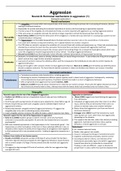
Neural & Hormonal mechanisms in aggression (1)
(biological explanation)
Neural mechanisms
• The amygdalae are located within the temporal lobes of the brain; performing the primary role is processing of memory, decision
making & emotional reactions
• Responsible for quickly evaluating the emotional importance of sensory info & prompting an appropriate response
• If certain areas of the amygdala are stimulated electrically, an animal responds with aggression e.g. snarling/ aggressive posture
• If the same areas are surgically removed, the animal no longer responds to stimuli that previously have led to rage
• Kluver & Bucy (1937) found that the destruction of the amygdala in a monkey who was dominant in a social group caused it to lose
The Limbic its dominant place in the group
System • The hippocampus is in the medial temporal lobe in the brain and plays important roles in the consolidation of information
from short-term memory to long-term memory, and in spatial memory that enables navigation.
• The LTM allows an animal to compare the conditions of a current threat with similar past experiences e.g. if they had previously been
attacked by an animal, the next time they encounter that animal there are likely to respond with aggression/ with fear
• Impaired hippocampal function prevents the nervous system from putting things into a relevant & meaningful context which may
cause the amygdala to respond inappropriately to sensor stimuli – resulting in aggressive behaviour
• Boccardi et al (2010) found that habitually violent offenders exhibited abnormalities of hippocampal functioning
• Serotonin, in normal levels, exerts a calming, inhibitory effect on neural firing in the brain – it also inhibits the firing of the amygdala
(which controls fear, anger & other emotional responses)
• Low levels of serotonin remove this inhibitory effect, with the consequence that individuals are less able to control impulsive &
Serotonin
aggressive behaviour
• Drugs are thought to alter serotonin levels/ increase aggressive behaviour: Mann et al. (1990) gave 35 healthy pps dexfenfluramine
(known to deplete serotonin). The found that the dexfen treatment in males (not females) was linked to an increase in hostility/
aggression scores.
Hormonal mechanisms
• Testosterone produces male characteristics, including aggression
• Removing the source of testosterone different species typically result in lower levels of aggression. Subsequently, reinstating
Testosterone normal testosterone levels with injections of synthetic testosterone leads to a return of aggressive behaviour
• Men are generally more aggressive than women (Archer, 2009)
• Dabbs et al. (1987) measured salivary testosterone in violent & non-violent criminals. Those with the highest testosterone levels
had a history of primarily violent crimes, whereas those with the lowest levels had committed only non-violent crimes.
Strengths Limitations
Research support for the roe of the amygdala in aggression: Aggression or dominance?
• Pardini et al. (2014) carried out a longitudinal study of male pps from childhood to • Mazur (1985) suggests we should distinguish aggression
adulthood from dominance.
• 56 of the pps with varying histories of violence were subjected to a brain MRI at age 26 • Individuals act aggressively when their intent is to inflict
• Results showed that pps with lower amygdala volumes exhibited higher levels of injury, whereas they act dominantly if their wish is to
aggression & violence achieve or maintain status over another individual
• Relationship between amygdala volume & aggressive behaviour → suggest that • Mazur claims that aggression is just from one form of
amygdala plays a key role in evaluating sensory information dominance behaviour
• Lower amygdala volumes comprise this ability & makes a violent response more likely. • Eisnegger et al. (2011) found that testosterone could
Research support for the role of the hippocampus in aggression: make women act ‘nicer’ rather than more aggressively
• Raine et al. (2004) studied 2 groups of violent criminals: some who had faced depending on the situation
conviction (‘unsuccessful psychopaths’) & some who had evaded the law (‘successful • This supports the idea that, rather than directly increasing
psychopaths’) aggression, testosterone promotes status-seeking
• MRI scans revealed asymmetries in the hippocampus in the ‘unsuccessful group’ – the behaviour, of which aggression in one type.
hippocampus in either hemisphere of the brain in these individuals differed in size; an Reductionist:
imbalance which impairs the ability of the hippocampus & amygdala to work together • SLT: Bandura bobo doll study
so that emotional info is not processed correctly – leading to aggressive responses as a • Media: video games/ role models
result • Cause or consequence (change in testosterone levels)
Evidence from studies of non-human species: • Cognitive: authoritarian personality: extreme control
• Rosado et al (2010) compared a sample of 80 dogs of various breeds that had been • According to Adorno's theory, one elements of the
referred to Spanish veterinary hospitals for their aggressive behaviour toward humans Authoritarian personality type is the belief in aggression
with a control sample of 19 dogs of various breeds that did not show such aggressive toward those who do not subscribe to conventional
behaviour thinking, or who are different – anger re-directed to
• The aggressive dogs averaged 278 units of serotonin, while the non-aggressive dogs people lower in status rather than parents (displacement)
averaged 387 units
, Genetic factors in aggression (2)
(biological explanation)
• Monozygotic (identical) twins: share 100% genes/ dizygotic twins (non-identical) share 50%
Twin • Twin studies: researchers compare the degree of similarity for a particular trait between set of MZ & compare this to
Studies the similarity between sets of DZ
• If MZ twins are more similar → behaviour is due to genes // DZ twins are more similar → environmental factors
• Caccaro et al. (1997): sample of adult male twins. Concordance rates for direct physical aggression – 50% MZ & 19% DZ
• Positive correlation between aggressive behaviour in adopted child & aggressive behaviour in biological parents →
genetic
Adoption • Positive correlation between aggressive behaviour in adopted child & aggressive behaviour in adoptive parents →
Studies environmental
• Hutchings & Mednick (1975): study of over 14,000 adoptions in Denmark found that a significant number of adopted
boys with criminal convictions had biological parents (particularly fathers) with convictions for criminal violence
• Monoamine oxidase A is an enzyme that breaks down neurotransmitters in the brain after a nerve impulse has been
transmitted from one neuron to another into constituent chemicals to be recycled/ catabolised.
• Produced/ coded by the MAOA gene, that among other things, regulates the metabolism of serotonin in the brain
• Brunner et al (1993) found in a study of 28 males from a Dutch family that a large proportion had been involved in
MAOA serious crimes of violence, including rape & arson – these men were found to have abnormally low levels of MAOA/ the
MAOA-L variant of the gene
• Variants of the gene: MAOA-H (high-levels) & MAOA-L (low-levels) which disrupts function of MAOA
• MAOA-L: much more frequent in populations with a history of warfare with about 2/3rds of people in these populations
having this version of the gene – ‘warrior gene’
Strengths Limitations
Real life application: Multiple genetic influences:
• In a 2009 criminal trial in the United States, an • Stuart et al (2014) for that intimate partner violence (IPV) in men was associated not
argument based on a combination of "warrior just with MAOA-L gene but also with the serotonin transporter gene (5-HTT) – another
gene" and history of child abuse was gene that influences serotonin activity in the brain
successfully used to avoid a conviction of first- • Vassos et al (2014), in a meta-analysis, could find no evidence of a association
degree murder and the death penalty; between any single gene & aggression
however, the convicted murderer was
sentenced to 32 years in prison. Reductionist:
• High ecological validity/ generalisability • SLT: Bandura bobo doll study
• Media: video games/ role models
• Cause or consequence (change in testosterone levels)
Explains gender differences in aggressive • Cognitive: authoritarian personality: extreme control
behaviour:
• According to Adorno's theory, one elements of the Authoritarian personality type is
• Offers and explanation for the uneven rates of the belief in aggression toward those who do not subscribe to conventional thinking,
violence for males & females or who are different – anger re-directed to people lower in status rather than parents
• The MAOA gene is linked to the X chromosome (displacement)
• Women have two chromosomes, whereas men • Caspi et al (2002), from 500 male children, found that those with the MAOA-L variant
have only one were significantly more likely to grow up to exhibit antisocial behaviour but only if
• When men inherit an X-linked gene from their they had been maltreated as children.
mothers, they are more likely to be affected by • Children with the MAOA-H variant who were maltreated & those with the MAOA-L
it, whereas women inheriting the same gene variant who were not maltreated, did not display antisocial behaviour – many non-
are generally unaffected (they have a 2nd X genetic influences (environmental) on the manifestation of aggression
chromosome with a ‘normal’ gene from MAOA
that prevents expression of the abnormal
version of the MAOA gene) Problems of assessing aggression:
• Explains why males typically show more • Most reported studies of aggression have relied on parental/ self-reports of aggressive
aggressive behaviour than females behaviour; whereas other studies have made use of observational techniques
• If research findings vary depending upon how aggression is measured, then it becomes
very difficult to draw valid conclusions about the role of genetic factors
Neural & Hormonal mechanisms in aggression (1)
(biological explanation)
Neural mechanisms
• The amygdalae are located within the temporal lobes of the brain; performing the primary role is processing of memory, decision
making & emotional reactions
• Responsible for quickly evaluating the emotional importance of sensory info & prompting an appropriate response
• If certain areas of the amygdala are stimulated electrically, an animal responds with aggression e.g. snarling/ aggressive posture
• If the same areas are surgically removed, the animal no longer responds to stimuli that previously have led to rage
• Kluver & Bucy (1937) found that the destruction of the amygdala in a monkey who was dominant in a social group caused it to lose
The Limbic its dominant place in the group
System • The hippocampus is in the medial temporal lobe in the brain and plays important roles in the consolidation of information
from short-term memory to long-term memory, and in spatial memory that enables navigation.
• The LTM allows an animal to compare the conditions of a current threat with similar past experiences e.g. if they had previously been
attacked by an animal, the next time they encounter that animal there are likely to respond with aggression/ with fear
• Impaired hippocampal function prevents the nervous system from putting things into a relevant & meaningful context which may
cause the amygdala to respond inappropriately to sensor stimuli – resulting in aggressive behaviour
• Boccardi et al (2010) found that habitually violent offenders exhibited abnormalities of hippocampal functioning
• Serotonin, in normal levels, exerts a calming, inhibitory effect on neural firing in the brain – it also inhibits the firing of the amygdala
(which controls fear, anger & other emotional responses)
• Low levels of serotonin remove this inhibitory effect, with the consequence that individuals are less able to control impulsive &
Serotonin
aggressive behaviour
• Drugs are thought to alter serotonin levels/ increase aggressive behaviour: Mann et al. (1990) gave 35 healthy pps dexfenfluramine
(known to deplete serotonin). The found that the dexfen treatment in males (not females) was linked to an increase in hostility/
aggression scores.
Hormonal mechanisms
• Testosterone produces male characteristics, including aggression
• Removing the source of testosterone different species typically result in lower levels of aggression. Subsequently, reinstating
Testosterone normal testosterone levels with injections of synthetic testosterone leads to a return of aggressive behaviour
• Men are generally more aggressive than women (Archer, 2009)
• Dabbs et al. (1987) measured salivary testosterone in violent & non-violent criminals. Those with the highest testosterone levels
had a history of primarily violent crimes, whereas those with the lowest levels had committed only non-violent crimes.
Strengths Limitations
Research support for the roe of the amygdala in aggression: Aggression or dominance?
• Pardini et al. (2014) carried out a longitudinal study of male pps from childhood to • Mazur (1985) suggests we should distinguish aggression
adulthood from dominance.
• 56 of the pps with varying histories of violence were subjected to a brain MRI at age 26 • Individuals act aggressively when their intent is to inflict
• Results showed that pps with lower amygdala volumes exhibited higher levels of injury, whereas they act dominantly if their wish is to
aggression & violence achieve or maintain status over another individual
• Relationship between amygdala volume & aggressive behaviour → suggest that • Mazur claims that aggression is just from one form of
amygdala plays a key role in evaluating sensory information dominance behaviour
• Lower amygdala volumes comprise this ability & makes a violent response more likely. • Eisnegger et al. (2011) found that testosterone could
Research support for the role of the hippocampus in aggression: make women act ‘nicer’ rather than more aggressively
• Raine et al. (2004) studied 2 groups of violent criminals: some who had faced depending on the situation
conviction (‘unsuccessful psychopaths’) & some who had evaded the law (‘successful • This supports the idea that, rather than directly increasing
psychopaths’) aggression, testosterone promotes status-seeking
• MRI scans revealed asymmetries in the hippocampus in the ‘unsuccessful group’ – the behaviour, of which aggression in one type.
hippocampus in either hemisphere of the brain in these individuals differed in size; an Reductionist:
imbalance which impairs the ability of the hippocampus & amygdala to work together • SLT: Bandura bobo doll study
so that emotional info is not processed correctly – leading to aggressive responses as a • Media: video games/ role models
result • Cause or consequence (change in testosterone levels)
Evidence from studies of non-human species: • Cognitive: authoritarian personality: extreme control
• Rosado et al (2010) compared a sample of 80 dogs of various breeds that had been • According to Adorno's theory, one elements of the
referred to Spanish veterinary hospitals for their aggressive behaviour toward humans Authoritarian personality type is the belief in aggression
with a control sample of 19 dogs of various breeds that did not show such aggressive toward those who do not subscribe to conventional
behaviour thinking, or who are different – anger re-directed to
• The aggressive dogs averaged 278 units of serotonin, while the non-aggressive dogs people lower in status rather than parents (displacement)
averaged 387 units
, Genetic factors in aggression (2)
(biological explanation)
• Monozygotic (identical) twins: share 100% genes/ dizygotic twins (non-identical) share 50%
Twin • Twin studies: researchers compare the degree of similarity for a particular trait between set of MZ & compare this to
Studies the similarity between sets of DZ
• If MZ twins are more similar → behaviour is due to genes // DZ twins are more similar → environmental factors
• Caccaro et al. (1997): sample of adult male twins. Concordance rates for direct physical aggression – 50% MZ & 19% DZ
• Positive correlation between aggressive behaviour in adopted child & aggressive behaviour in biological parents →
genetic
Adoption • Positive correlation between aggressive behaviour in adopted child & aggressive behaviour in adoptive parents →
Studies environmental
• Hutchings & Mednick (1975): study of over 14,000 adoptions in Denmark found that a significant number of adopted
boys with criminal convictions had biological parents (particularly fathers) with convictions for criminal violence
• Monoamine oxidase A is an enzyme that breaks down neurotransmitters in the brain after a nerve impulse has been
transmitted from one neuron to another into constituent chemicals to be recycled/ catabolised.
• Produced/ coded by the MAOA gene, that among other things, regulates the metabolism of serotonin in the brain
• Brunner et al (1993) found in a study of 28 males from a Dutch family that a large proportion had been involved in
MAOA serious crimes of violence, including rape & arson – these men were found to have abnormally low levels of MAOA/ the
MAOA-L variant of the gene
• Variants of the gene: MAOA-H (high-levels) & MAOA-L (low-levels) which disrupts function of MAOA
• MAOA-L: much more frequent in populations with a history of warfare with about 2/3rds of people in these populations
having this version of the gene – ‘warrior gene’
Strengths Limitations
Real life application: Multiple genetic influences:
• In a 2009 criminal trial in the United States, an • Stuart et al (2014) for that intimate partner violence (IPV) in men was associated not
argument based on a combination of "warrior just with MAOA-L gene but also with the serotonin transporter gene (5-HTT) – another
gene" and history of child abuse was gene that influences serotonin activity in the brain
successfully used to avoid a conviction of first- • Vassos et al (2014), in a meta-analysis, could find no evidence of a association
degree murder and the death penalty; between any single gene & aggression
however, the convicted murderer was
sentenced to 32 years in prison. Reductionist:
• High ecological validity/ generalisability • SLT: Bandura bobo doll study
• Media: video games/ role models
• Cause or consequence (change in testosterone levels)
Explains gender differences in aggressive • Cognitive: authoritarian personality: extreme control
behaviour:
• According to Adorno's theory, one elements of the Authoritarian personality type is
• Offers and explanation for the uneven rates of the belief in aggression toward those who do not subscribe to conventional thinking,
violence for males & females or who are different – anger re-directed to people lower in status rather than parents
• The MAOA gene is linked to the X chromosome (displacement)
• Women have two chromosomes, whereas men • Caspi et al (2002), from 500 male children, found that those with the MAOA-L variant
have only one were significantly more likely to grow up to exhibit antisocial behaviour but only if
• When men inherit an X-linked gene from their they had been maltreated as children.
mothers, they are more likely to be affected by • Children with the MAOA-H variant who were maltreated & those with the MAOA-L
it, whereas women inheriting the same gene variant who were not maltreated, did not display antisocial behaviour – many non-
are generally unaffected (they have a 2nd X genetic influences (environmental) on the manifestation of aggression
chromosome with a ‘normal’ gene from MAOA
that prevents expression of the abnormal
version of the MAOA gene) Problems of assessing aggression:
• Explains why males typically show more • Most reported studies of aggression have relied on parental/ self-reports of aggressive
aggressive behaviour than females behaviour; whereas other studies have made use of observational techniques
• If research findings vary depending upon how aggression is measured, then it becomes
very difficult to draw valid conclusions about the role of genetic factors