ORGANIC CHEMISTRY
TOPIC 11-INTRODUCTION TO ORGANIC CHEMISTRY
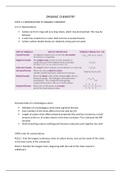
3.3.1.1 Nomenclature
Carbon can form rings and very long chains, which may be branched. This may be
because:
1. C atom has 4 electrons in outer shell so forms 4 covalent bonds
2. Carbon-carbon double bonds are relatively strong and non-polar
Characteristics of a homologous series:
Members of a homologous series have a general formula
Each member of the series differs from the next by CH2
Length of carbon chain affects physical properties.M.p and B.p increase by a small
amount as the no. of carbon atoms in the chain increases. This is because the IMF
increase
Chain branching reduces melting point because molecules pack together less well
IUPAC rules for nomenclature:
RULE 1: Find the longest continuous chain of carbon atoms, and use the name of this chain
as the base name of the compound
RULE 2: Number the longest chain, beginning with the end of the chain nearest a
substituent
,RULE 3: Name the groups attached to the longest chain as alkyl groups. Give the location of
each alkyl group by the number of the main chain carbon atom to which it is attached
3.3.1.2 Reaction mechanisms
Curly arrows-As electrons are negatively charged, they tend to move from areas of
high electron density to more positively charged areas. The movement of pair of
electrons is shown by curly arrow that starts from a lone pair of electrons or from
covalent bond and moves towards a positively charged area of molecule to form a
new bond.
Free radical – Covalent bonds may break in a way that one electron goes to each
atom that originally formed the bond. These fragments of the original molecules
have an unpaired electrons and are called free radicals.
FREE RADICAL SUBSTITUION
3 stages:
1. Initiation-
, UV light provides enough energy to break the Cl-Cl bond.
Bond splits homolytically (equally) and each atom gets to keep one electron
Atom becomes a highly reactive free radical due to its unpaired electrons
2. Propagation:
This takes place in 2 stages.
Cl free radical attacks a methane molecule,leaving a methyle free radical.
Methyl free radical
is reactive and so
reactive with
chlorine The circled elements can
molecule
be used as a template. It
always stays the same in all
reactions.
3. Termination:
This step removes all free radicals to make stable molecules.
3.3.1.3 Isomerism
TOPIC 11-INTRODUCTION TO ORGANIC CHEMISTRY
3.3.1.1 Nomenclature
Carbon can form rings and very long chains, which may be branched. This may be
because:
1. C atom has 4 electrons in outer shell so forms 4 covalent bonds
2. Carbon-carbon double bonds are relatively strong and non-polar
Characteristics of a homologous series:
Members of a homologous series have a general formula
Each member of the series differs from the next by CH2
Length of carbon chain affects physical properties.M.p and B.p increase by a small
amount as the no. of carbon atoms in the chain increases. This is because the IMF
increase
Chain branching reduces melting point because molecules pack together less well
IUPAC rules for nomenclature:
RULE 1: Find the longest continuous chain of carbon atoms, and use the name of this chain
as the base name of the compound
RULE 2: Number the longest chain, beginning with the end of the chain nearest a
substituent
,RULE 3: Name the groups attached to the longest chain as alkyl groups. Give the location of
each alkyl group by the number of the main chain carbon atom to which it is attached
3.3.1.2 Reaction mechanisms
Curly arrows-As electrons are negatively charged, they tend to move from areas of
high electron density to more positively charged areas. The movement of pair of
electrons is shown by curly arrow that starts from a lone pair of electrons or from
covalent bond and moves towards a positively charged area of molecule to form a
new bond.
Free radical – Covalent bonds may break in a way that one electron goes to each
atom that originally formed the bond. These fragments of the original molecules
have an unpaired electrons and are called free radicals.
FREE RADICAL SUBSTITUION
3 stages:
1. Initiation-
, UV light provides enough energy to break the Cl-Cl bond.
Bond splits homolytically (equally) and each atom gets to keep one electron
Atom becomes a highly reactive free radical due to its unpaired electrons
2. Propagation:
This takes place in 2 stages.
Cl free radical attacks a methane molecule,leaving a methyle free radical.
Methyl free radical
is reactive and so
reactive with
chlorine The circled elements can
molecule
be used as a template. It
always stays the same in all
reactions.
3. Termination:
This step removes all free radicals to make stable molecules.
3.3.1.3 Isomerism