
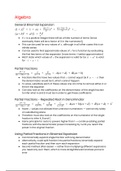
Algebra
General Binomial Expansion
n(n−1) 2 n(n−1)(n−2) 3
(1 + x)n = 1 + nx + 2!
x + 3!
x + ...
(a + b)n = an (1 + ba )n
● If n is a positive integer there will be a finite number of terms (since
eventually there will be a factor of 0 in the numerator)j
● This can be used for any values of n , although in all other cases this is an
infinite series
● Can be used to find approximate values of x for a function by evaluating
the first few terms of the expansion (more terms = better approximation)
● MUST state which values of x the expansion is valid for (ie (1 + a)n is valid
for − 1 < a < 1
Partial Fractions
px + q A B
(ax + b)(cx + d) = ax + b + cx + d = A(cx + d) + B(ax + b)
● Fractions like this have two values that x cannot equal (ie if cx = − d then
the denominator would be 0, which cannot happen
● To solve, substitute each of these values one at a time to remove either A or
B from the equation
● Can also look at the coefficients on the denominator of the single fraction
to infer what A and B must be in order to get these coefficients
Partial Fractions - Repeated Root in Denominator
px + q A B
= (ax+b) + (cx+d) + C 2 = A(ax + b)(cx + d) + B(cx + d) + C
(ax + b)(cx + d)2 (cx+d)
● Fewer x values not allowed than unknown numerators → cannot rely solely
on substituting alone
● Therefore must also look at the coefficients on the numerator of the single
fraction to infer A, B and C
● Same principle for roots to powers higher than 1 → continue adding partial
fractions with the denominator power increasing by 1 until you reach the
power in the original fraction
Using Partial Fractions in Binomial Expansion
● Can binomially expand single fraction with long denominator
● Alternatively, could split fraction into partial fractions, binomially expand
each partial fraction and then sum each expansion
● Second method often easier → rather than multiplying different expansions
you need only sum them, which is more straightforward and less prone to
error
General Binomial Expansion
n(n−1) 2 n(n−1)(n−2) 3
(1 + x)n = 1 + nx + 2!
x + 3!
x + ...
(a + b)n = an (1 + ba )n
● If n is a positive integer there will be a finite number of terms (since
eventually there will be a factor of 0 in the numerator)j
● This can be used for any values of n , although in all other cases this is an
infinite series
● Can be used to find approximate values of x for a function by evaluating
the first few terms of the expansion (more terms = better approximation)
● MUST state which values of x the expansion is valid for (ie (1 + a)n is valid
for − 1 < a < 1
Partial Fractions
px + q A B
(ax + b)(cx + d) = ax + b + cx + d = A(cx + d) + B(ax + b)
● Fractions like this have two values that x cannot equal (ie if cx = − d then
the denominator would be 0, which cannot happen
● To solve, substitute each of these values one at a time to remove either A or
B from the equation
● Can also look at the coefficients on the denominator of the single fraction
to infer what A and B must be in order to get these coefficients
Partial Fractions - Repeated Root in Denominator
px + q A B
= (ax+b) + (cx+d) + C 2 = A(ax + b)(cx + d) + B(cx + d) + C
(ax + b)(cx + d)2 (cx+d)
● Fewer x values not allowed than unknown numerators → cannot rely solely
on substituting alone
● Therefore must also look at the coefficients on the numerator of the single
fraction to infer A, B and C
● Same principle for roots to powers higher than 1 → continue adding partial
fractions with the denominator power increasing by 1 until you reach the
power in the original fraction
Using Partial Fractions in Binomial Expansion
● Can binomially expand single fraction with long denominator
● Alternatively, could split fraction into partial fractions, binomially expand
each partial fraction and then sum each expansion
● Second method often easier → rather than multiplying different expansions
you need only sum them, which is more straightforward and less prone to
error


