1|Page
–
Economics is considered to be a social science as it looks at the behaviour of humans, either as individuals or in
groups to see how people make choices about what to produce, how to produce and whom to produce in a
world with scarce resources and how these can be allocated to maximise and improve human welfare and
happiness.
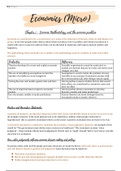
The methodology that economists use is similar to the methodology used by scientists in natural and other
sciences.
Theories developed to create and explain economic Scientific experiments cannot be conducted, so
models models are devised instead. As in the real world, each
changes very fast
The use of simplifying assumptions to limit the Assumption is used to tackle the problem of many
number of variables in an investigation variables in an economy. Economists assume with
the ceteris paribus (all other things remain equal)
Testing theories and models against data and facts Ceteris paribus assume all other factors that would
have effect, are considered to remain the same and
have no effect
The use of empirical data to improve economic Ceteris paribus allows economists to develop
models theories, models and make predictions
Use of economic models to make predictions Science theories are much stronger than the
assumption made economic theories.
A positive statement is an objective statement of fact that can be scientifically tested to see if it is correct or not.
An example would be “if the state pension was to be abolished, a million older people would die of
hypothermia” this is a positive statement which can be tested. A positive statement does not have to be true.
A normative statement is a subjective statement that includes a value judgement (opinion). An example of this
would be “The government must devote more resources to healthcare” This statement contains ‘value
judgment’ – these include ethical/moral judgements. Words such as ‘ought’,’should’,’better’ and ‘worse’ provide
clues that it is normative.
Economics deals with real-life people and some decisions are made by these individuals, firms or governments
and will often be based on opinion and judgement. Some decisions may be based on:
➔ Normative statements (opinion)
➔ Moral view and value judgements (people shouldn’t be in poverty, wealth should be shared)
➔ Political judgements (lowering tuition fees to win votes)
, 2|Page
➔ Short term positive consequence (lowering the tax to win votes, but this will reduce governments
income)
Value judgements influence economic decision making and policy as a value judgement is about if
something is desirable or not – if we were to believe something is more desirable than another thing, we
have made a value judgement. Economics necessarily requires that government ministers make value-
based judgements when deciding on economic policies, this is sometimes done as they may have no choice
for example “Rising unemployment and the recession have been the price that we have had to pay to get
inflation down” but sometimes where new facilities are needed and they are aware they will be strong
opposition, they have no choice to encourage value judgement to encourage people and reduce opposition.
People views contain the best options for them, Politian often tries to capitalise on this and promise in their
policy-making to accomplish the people views. This then shows how people views concern their best option
and are influenced by these positive consequences of different decisions and by moral and political judgements.
For example, the Liberal Democrats promised to abolish tuition fees if elected, however, once they were elected
they completely reversed their policy and the part immediately lost its moral authority over policy-making.
This could then encourage people not to vote for them next time.
Needs and Wants:
The central purpose of economic activity is the production of goods and services to satisfy people needs and
wants. To improve this we need to decide on the key economic decisions, which are: what to produce, how to
produce and who is to benefit from the goods and services produced. To do this, we must use resources,
however, these are scarce:
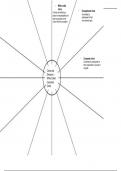
This leads to the basic economic
problem: How can the available
scarce resources be used to satisfy
people infinite needs and wants.
Need – something that is necessary for human survival (food/clothing/warmth/shelter)
Want – something that is desirable but not necessary for human survival (fashionable clothing)
Economic welfare – the economic well-being of an individual, a group within society or an economy
(standard of life)
–
Economics is considered to be a social science as it looks at the behaviour of humans, either as individuals or in
groups to see how people make choices about what to produce, how to produce and whom to produce in a
world with scarce resources and how these can be allocated to maximise and improve human welfare and
happiness.
The methodology that economists use is similar to the methodology used by scientists in natural and other
sciences.
Theories developed to create and explain economic Scientific experiments cannot be conducted, so
models models are devised instead. As in the real world, each
changes very fast
The use of simplifying assumptions to limit the Assumption is used to tackle the problem of many
number of variables in an investigation variables in an economy. Economists assume with
the ceteris paribus (all other things remain equal)
Testing theories and models against data and facts Ceteris paribus assume all other factors that would
have effect, are considered to remain the same and
have no effect
The use of empirical data to improve economic Ceteris paribus allows economists to develop
models theories, models and make predictions
Use of economic models to make predictions Science theories are much stronger than the
assumption made economic theories.
A positive statement is an objective statement of fact that can be scientifically tested to see if it is correct or not.
An example would be “if the state pension was to be abolished, a million older people would die of
hypothermia” this is a positive statement which can be tested. A positive statement does not have to be true.
A normative statement is a subjective statement that includes a value judgement (opinion). An example of this
would be “The government must devote more resources to healthcare” This statement contains ‘value
judgment’ – these include ethical/moral judgements. Words such as ‘ought’,’should’,’better’ and ‘worse’ provide
clues that it is normative.
Economics deals with real-life people and some decisions are made by these individuals, firms or governments
and will often be based on opinion and judgement. Some decisions may be based on:
➔ Normative statements (opinion)
➔ Moral view and value judgements (people shouldn’t be in poverty, wealth should be shared)
➔ Political judgements (lowering tuition fees to win votes)
, 2|Page
➔ Short term positive consequence (lowering the tax to win votes, but this will reduce governments
income)
Value judgements influence economic decision making and policy as a value judgement is about if
something is desirable or not – if we were to believe something is more desirable than another thing, we
have made a value judgement. Economics necessarily requires that government ministers make value-
based judgements when deciding on economic policies, this is sometimes done as they may have no choice
for example “Rising unemployment and the recession have been the price that we have had to pay to get
inflation down” but sometimes where new facilities are needed and they are aware they will be strong
opposition, they have no choice to encourage value judgement to encourage people and reduce opposition.
People views contain the best options for them, Politian often tries to capitalise on this and promise in their
policy-making to accomplish the people views. This then shows how people views concern their best option
and are influenced by these positive consequences of different decisions and by moral and political judgements.
For example, the Liberal Democrats promised to abolish tuition fees if elected, however, once they were elected
they completely reversed their policy and the part immediately lost its moral authority over policy-making.
This could then encourage people not to vote for them next time.
Needs and Wants:
The central purpose of economic activity is the production of goods and services to satisfy people needs and
wants. To improve this we need to decide on the key economic decisions, which are: what to produce, how to
produce and who is to benefit from the goods and services produced. To do this, we must use resources,
however, these are scarce:
This leads to the basic economic
problem: How can the available
scarce resources be used to satisfy
people infinite needs and wants.
Need – something that is necessary for human survival (food/clothing/warmth/shelter)
Want – something that is desirable but not necessary for human survival (fashionable clothing)
Economic welfare – the economic well-being of an individual, a group within society or an economy
(standard of life)