

Gastric Acid Secretion: Regulation
A brief outline of the gross and microscopic anatomy of the stomach
particularly in relation to its functions (see also anatomy and histology
sessions)
A general introduction to the functions of the stomach and its
secretions
A simple demonstration of how gastric acid is made
A description of the control of gastric acid secretion in response to a
mean in terms of the phases (gastric and cephalic) of secretion and the
role of nerves (vagus, hormones (gastrin) and local factors
(somatostatin and histamine)
An outline how gastric acid secretion may become elevated and play a
role in the pathogenesis of duodenal ulcers describing the role of
Helicobacter pylori. The role of non-steroidal anti-inflammatory
(NSAIDs) drugs in the gastric mucosal damage will be
discussed.
The pharmacological basis of the action of anti-secretory drugs acting
on the 'proton' pump (e.g. omeprazole) histamine2 receptors (e.g.
cimetidine, ranitidine) will be discussed in a later lecture
[This stuff likely to come up in exam!!]
The Stomach and Contents of Normal Gastric Juice
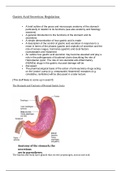
Anatomy of the stomach; the
secretions
are in parentheses
The fundus and body have glands that secrete pepsinogen, mucus and acid.
, Around the cardiac area there are also mucus-secreting cells and around the pyloric
area there are mucus secreting cells.
The antrum is quite thick in terms of muscular structure and secreted mucus,
pepsinogen and gastrin.
The body of the stomach contains chief cells secreting pepsinogen and also parietal
cells release intrinsic factor, which is necessary for vitamin B 12 absorption.
So the gastric juice contains (in fasting state)
-> Cations: Na+, K+, Mg2+, H+ (has a pH of around 3)
-> Anions: Cl-, HPO42-, SO42-
-> Pepsins
->Lipase
->Mucus
-> Intrinsic factor
The gastric juice adds about 2.5L/day of to the intestinal contents,
The Stomach
The upper portion of the stomach is thin-walled (fundus and body) and secretes
mucus, HCl and pepsinogen (these are exocrine secretions of the stomach).
The body has numerous epithelial cells with numerous tubular glands.
Wall of the glands is lined with parietal cells that release HCl and intrinsic factor.
Gastrin increases acid secretion, but to do this it needs to bind to its receptor.
The enterochromaffin-like cells (ECL) secrete paracrine agents e.g. histamine.
How is Gastric Acid Made?
A brief outline of the gross and microscopic anatomy of the stomach
particularly in relation to its functions (see also anatomy and histology
sessions)
A general introduction to the functions of the stomach and its
secretions
A simple demonstration of how gastric acid is made
A description of the control of gastric acid secretion in response to a
mean in terms of the phases (gastric and cephalic) of secretion and the
role of nerves (vagus, hormones (gastrin) and local factors
(somatostatin and histamine)
An outline how gastric acid secretion may become elevated and play a
role in the pathogenesis of duodenal ulcers describing the role of
Helicobacter pylori. The role of non-steroidal anti-inflammatory
(NSAIDs) drugs in the gastric mucosal damage will be
discussed.
The pharmacological basis of the action of anti-secretory drugs acting
on the 'proton' pump (e.g. omeprazole) histamine2 receptors (e.g.
cimetidine, ranitidine) will be discussed in a later lecture
[This stuff likely to come up in exam!!]
The Stomach and Contents of Normal Gastric Juice
Anatomy of the stomach; the
secretions
are in parentheses
The fundus and body have glands that secrete pepsinogen, mucus and acid.
, Around the cardiac area there are also mucus-secreting cells and around the pyloric
area there are mucus secreting cells.
The antrum is quite thick in terms of muscular structure and secreted mucus,
pepsinogen and gastrin.
The body of the stomach contains chief cells secreting pepsinogen and also parietal
cells release intrinsic factor, which is necessary for vitamin B 12 absorption.
So the gastric juice contains (in fasting state)
-> Cations: Na+, K+, Mg2+, H+ (has a pH of around 3)
-> Anions: Cl-, HPO42-, SO42-
-> Pepsins
->Lipase
->Mucus
-> Intrinsic factor
The gastric juice adds about 2.5L/day of to the intestinal contents,
The Stomach
The upper portion of the stomach is thin-walled (fundus and body) and secretes
mucus, HCl and pepsinogen (these are exocrine secretions of the stomach).
The body has numerous epithelial cells with numerous tubular glands.
Wall of the glands is lined with parietal cells that release HCl and intrinsic factor.
Gastrin increases acid secretion, but to do this it needs to bind to its receptor.
The enterochromaffin-like cells (ECL) secrete paracrine agents e.g. histamine.
How is Gastric Acid Made?


