

The Brezhnev era, 1972-85
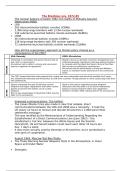
The nuclear balance of power 1962: the reality of Mutually Assured
Destruction (MAD)
USA
- 203 intercontinental ballistic missiles (ICBMs)
- 1,306 long-range bombers with 3,104 nuclear warheads
- 144 submarine-launched ballistic-missile warheads (SLBMs)
USSR
- 36 intercontinental ballistic missiles (ICBMs)
- 138 long-range bombers with 392 nuclear warheads
- 72 submarine-launched ballistic-missile warheads (SLBMs)
How did the superpowers approach to foreign policy change as a
consequence of the CMC?
USA: Kennedy USSR: Khrushchev
Interested in conciliation but faced criticism that he Wated to focus on domestic economic development and
was ‘soft’ on communism. endorsed peaceful coexistence (and was willing therefore
His policies had to reflect a strong anti-communist to compete with the West) but faced criticism from Mao
stance to appease his opposition. that he was not sufficiently revolutionary.
BEFORE
His policies had to demonstrate a strong anti-Western
stance, to maintain Soviet dominance in the communist
world.
The CMC showed that both sides agreed that nuclear war was undesirable and should be avoided at all costs;
this allowed both Kennedy and Khrushchev to shift their countries’ foreign policies to more closely align with their
own preferences.
Openly expressed the goal of reducing nuclear Open to discussions regarding nuclear weapons
weapons and began negotiations with other nuclear reductions and was open to a US-Soviet relationship
powers to prevent the further use of nuclear based on mutual restraint rather than aggression.
AFTER
weapons. Ousted in October 1964, leaving talks to his successor(s).
But he was assassinated in November 1963, leaving
talks to his successor(s).
Improved communications: ‘the hotline’
- The Cuban Missile Crisis also made it clear that reliable, direct
communications between the USA and USSR was a necessity - it took the
US nearly 12 hours to receive and decode Khrushchev’s 3,000-word initial
settlement message!
- This was rectified by the Memorandum of Understanding Regarding the
Establishment of a Direct Communications Line (June 1963) – this
established a ‘hot line’ between the White House and the Kremlin.
Henceforth, US and Soviet leaders could reach each other 24 hours per
day, 7 days a week.
- It was never actually used by Kennedy or Khrushchev, but it symbolised a
new spirit of cooperation.
August 1963: Moscow Test Ban Treaty
The Treaty Banning Nuclear Weapons Tests in the Atmosphere, in Outer
Space and Under Water
Strengths:
,- Effectively recognised the concerns of the millions of people who wanted
to limit the use of nuclear weapons.
- Laid out clear guidelines concerning the testing of weapons on or near
Earth.
Limitations:
- The agreement did not cover underground tests – because:
a. these are difficult to detect, and
b. these cannot easily be distinguished from earthquakes. This effectively
meant that (limited) testing could probably still have been undertaken.
- It was only signed by the USA, the USSR and GB. France and China
refused to sign up – both would continue to test atomic weapons until well
into the 1990s.
Johnson had tried (and failed) to begin a formal process of détente: 23-25th
June 1967 Glassboro, New Jersey
- LBJ met with Alexei Kosygin (Premier of the Soviet Union 1964-1980).
- The generally amicable atmosphere was called the ‘Spirit of Glassboro’.
- They failed to reach agreement on limiting anti-ballistic missile systems
(defensive missiles).
The continuing development of technology
- By the end of the 1960s, Soviet nuclear strength had become comparable
to that of the Americans.
- Anti-ballistic missiles were developed by the end of the 1960s which could
intercept nuclear weapons and prevent them from detonating at their
targeted location.
- The USA responded by developing MIRVs (Multiple Independently
Targetable Re-Entry Vehicles) in which one rocket could deploy multiple
warheads with different targeted locations.
- Soviet ABMs were ineffective against MIRVs as they were not designed to
stop multiple warheads.
July 1968: Nuclear Non-Proliferation Treaty
- Serious discussions upon arms limitations were initiated, in part because
cost was a key issue – both superpowers were finding participation in the
arms race expensive.
- Signatories agreed that they would not transfer nuclear weapons to allies
and proxies.
- Signatories agreed that they would not share their technology with non-
nuclear states, and that non-nuclear states should not seek to acquire the
means to produce nuclear weapons.
- Most countries in the UN signed up between 1968 and 1970.
Motives for the superpowers
The USA and the USSR were keen to limit the nuclear arms race because:
- There was public concern about a nuclear war.
- Of pressure from other countries concerned that nuclear war would have a
far-reaching impact and threaten their own citizens.
,- The mounting cost of the arms race hampered ability to direct funding
towards a domestic agenda.
- The USA were being severely weakened by the Vietnam War which was
costing billions and damaging the USA’s domestic and international
reputation.
- However, discussions were halted after Johnson decided not to run for re-
election and the USSR intervened in Czechoslovakia.
- After Nixon became president in 1969 and the Prague Spring was
resolved, the Strategic Arms Limitations Talks were able to begin.
Détente
- ‘a relaxing of tension’
- The term détente is most often used in reference to a period of general
easing of the geo-political tensions between the Soviet Union and the
United States which began in 1969, as a foreign policy of U.S. presidents
Richard Nixon (1969-74) and Gerald Ford (1974-77), and perhaps Carter
(1977-81).
- Brezhnev in power 1964-82
- Detente was an attempt to reduce international tensions in the light of the
Berlin Crisis 1961, CMC 1962, Prague Spring 1968 and ongoing war in
Vietnam.
- Détente represented a change in the tactics of superpower conflict rather
than an end to the Cold War.
Would the superpowers be able to agree?
Basic principles of avoiding nuclear conflict.
Anti-Ballistic Missile Systems.
- With ABM systems in place the ability to retaliate if hit by a nuclear strike
was uncertain. By limiting ABMs, the deterrence provided by knowing the
other side could strike back would be maintained.
Limiting the number of Intercontinental Ballistic Missiles (ICBMs).
Limiting the number of Submarine-launched Ballistic Missiles (SLBMs).
Multiple Independent Re-Entry Vehicles (MIRVs).
- These missiles were a recent development which could carry multiple
warheads on a single missile. The USA had the advantage in this more
technological side of the nuclear conflict.
The post-World War Two borders of Eastern Europe had not been
recognised by the USA. To recognise them would accept the existence of
the Soviet Bloc in Eastern Europe.
The USA felt the USSR should allow greater freedom of speech within
Soviet-controlled Europe – and allow free movement out of it.
The détente debate
Interpretations of détente:
- Détente was a progressive policy that preserved the peace and within a
longer historical framework gave peaceful change within the Soviet bloc
more of a chance.
, - Détente was a misguided policy that prolonged the Cold War and
compromise the values of the West.
- Détente came from a position of US weakness, not US strength.
Components of détente:
- Superpower détente
- Sino-American détente
- Détente in Europe
- Détente under pressure in the Third world
Kissinger argued that détente ‘defined the rules of the game’, and offered
more stable, predictable relations between the superpowers.
The USA
- Richard Nixon: President 1969-1974.
- Henry Kissinger: Assistant to the President for National Security Affairs
1969-1975. Secretary of State 1973-1977.
Motivations:
- To work with the Soviet Union to prevent superpower differences
exploding into a crisis – i.e. avoid another CMC.
- Create a network of mutually advantageous relationships so US could
‘manage’ (and contain) Soviet power.
- To achieve an exit strategy in Vietnam ‘with honour’.
- Nixon and Kissinger felt that ‘the age of superpowers was drawing to an
end’ (1968).
How influential was Henry Kissinger?
- In 1969, US President Richard Nixon appointed Kissinger as national
security advisor. His guiding philosophy was that foreign policy should
serve the national interest - a pragmatic outlook dubbed 'realpolitik'.
- Kissinger arranged Nixon's two famous summit visits, to China and the
Soviet Union, in 1972. These visits introduced the policy of detente by
which the US sought to defuse tensions with the communist powers.
- In 1973, Kissinger became Secretary of State. He continued to serve as
secretary of state when Ford replaced Nixon as president.
- Kissinger received the 1973 Nobel Peace Prize, along with Le Duc Tho of
North Vietnam, for negotiating an end to the United States' role in the
Vietnam War.
- In 1974, he was credited with the 'shuttle diplomacy' that eased tensions
in the Middle East following the Yom Kippur War of 1973 between Israel
and Egypt, and that led to the 1975 Sinai Accord, in which both sides
agreed to renounce war as a means of settling their differences.
- In 1977, he left office and went to work at Georgetown University. He
returned to government service in 1985, on his selection to President
Ronald Reagan's Foreign Intelligence Advisory Board.
The Soviets
- Leonid Brezhnev: First Secretary of Communist Party from 1964-82.
Brezhnev Doctrine emphasised the right of the USSR to intervene to
The nuclear balance of power 1962: the reality of Mutually Assured
Destruction (MAD)
USA
- 203 intercontinental ballistic missiles (ICBMs)
- 1,306 long-range bombers with 3,104 nuclear warheads
- 144 submarine-launched ballistic-missile warheads (SLBMs)
USSR
- 36 intercontinental ballistic missiles (ICBMs)
- 138 long-range bombers with 392 nuclear warheads
- 72 submarine-launched ballistic-missile warheads (SLBMs)
How did the superpowers approach to foreign policy change as a
consequence of the CMC?
USA: Kennedy USSR: Khrushchev
Interested in conciliation but faced criticism that he Wated to focus on domestic economic development and
was ‘soft’ on communism. endorsed peaceful coexistence (and was willing therefore
His policies had to reflect a strong anti-communist to compete with the West) but faced criticism from Mao
stance to appease his opposition. that he was not sufficiently revolutionary.
BEFORE
His policies had to demonstrate a strong anti-Western
stance, to maintain Soviet dominance in the communist
world.
The CMC showed that both sides agreed that nuclear war was undesirable and should be avoided at all costs;
this allowed both Kennedy and Khrushchev to shift their countries’ foreign policies to more closely align with their
own preferences.
Openly expressed the goal of reducing nuclear Open to discussions regarding nuclear weapons
weapons and began negotiations with other nuclear reductions and was open to a US-Soviet relationship
powers to prevent the further use of nuclear based on mutual restraint rather than aggression.
AFTER
weapons. Ousted in October 1964, leaving talks to his successor(s).
But he was assassinated in November 1963, leaving
talks to his successor(s).
Improved communications: ‘the hotline’
- The Cuban Missile Crisis also made it clear that reliable, direct
communications between the USA and USSR was a necessity - it took the
US nearly 12 hours to receive and decode Khrushchev’s 3,000-word initial
settlement message!
- This was rectified by the Memorandum of Understanding Regarding the
Establishment of a Direct Communications Line (June 1963) – this
established a ‘hot line’ between the White House and the Kremlin.
Henceforth, US and Soviet leaders could reach each other 24 hours per
day, 7 days a week.
- It was never actually used by Kennedy or Khrushchev, but it symbolised a
new spirit of cooperation.
August 1963: Moscow Test Ban Treaty
The Treaty Banning Nuclear Weapons Tests in the Atmosphere, in Outer
Space and Under Water
Strengths:
,- Effectively recognised the concerns of the millions of people who wanted
to limit the use of nuclear weapons.
- Laid out clear guidelines concerning the testing of weapons on or near
Earth.
Limitations:
- The agreement did not cover underground tests – because:
a. these are difficult to detect, and
b. these cannot easily be distinguished from earthquakes. This effectively
meant that (limited) testing could probably still have been undertaken.
- It was only signed by the USA, the USSR and GB. France and China
refused to sign up – both would continue to test atomic weapons until well
into the 1990s.
Johnson had tried (and failed) to begin a formal process of détente: 23-25th
June 1967 Glassboro, New Jersey
- LBJ met with Alexei Kosygin (Premier of the Soviet Union 1964-1980).
- The generally amicable atmosphere was called the ‘Spirit of Glassboro’.
- They failed to reach agreement on limiting anti-ballistic missile systems
(defensive missiles).
The continuing development of technology
- By the end of the 1960s, Soviet nuclear strength had become comparable
to that of the Americans.
- Anti-ballistic missiles were developed by the end of the 1960s which could
intercept nuclear weapons and prevent them from detonating at their
targeted location.
- The USA responded by developing MIRVs (Multiple Independently
Targetable Re-Entry Vehicles) in which one rocket could deploy multiple
warheads with different targeted locations.
- Soviet ABMs were ineffective against MIRVs as they were not designed to
stop multiple warheads.
July 1968: Nuclear Non-Proliferation Treaty
- Serious discussions upon arms limitations were initiated, in part because
cost was a key issue – both superpowers were finding participation in the
arms race expensive.
- Signatories agreed that they would not transfer nuclear weapons to allies
and proxies.
- Signatories agreed that they would not share their technology with non-
nuclear states, and that non-nuclear states should not seek to acquire the
means to produce nuclear weapons.
- Most countries in the UN signed up between 1968 and 1970.
Motives for the superpowers
The USA and the USSR were keen to limit the nuclear arms race because:
- There was public concern about a nuclear war.
- Of pressure from other countries concerned that nuclear war would have a
far-reaching impact and threaten their own citizens.
,- The mounting cost of the arms race hampered ability to direct funding
towards a domestic agenda.
- The USA were being severely weakened by the Vietnam War which was
costing billions and damaging the USA’s domestic and international
reputation.
- However, discussions were halted after Johnson decided not to run for re-
election and the USSR intervened in Czechoslovakia.
- After Nixon became president in 1969 and the Prague Spring was
resolved, the Strategic Arms Limitations Talks were able to begin.
Détente
- ‘a relaxing of tension’
- The term détente is most often used in reference to a period of general
easing of the geo-political tensions between the Soviet Union and the
United States which began in 1969, as a foreign policy of U.S. presidents
Richard Nixon (1969-74) and Gerald Ford (1974-77), and perhaps Carter
(1977-81).
- Brezhnev in power 1964-82
- Detente was an attempt to reduce international tensions in the light of the
Berlin Crisis 1961, CMC 1962, Prague Spring 1968 and ongoing war in
Vietnam.
- Détente represented a change in the tactics of superpower conflict rather
than an end to the Cold War.
Would the superpowers be able to agree?
Basic principles of avoiding nuclear conflict.
Anti-Ballistic Missile Systems.
- With ABM systems in place the ability to retaliate if hit by a nuclear strike
was uncertain. By limiting ABMs, the deterrence provided by knowing the
other side could strike back would be maintained.
Limiting the number of Intercontinental Ballistic Missiles (ICBMs).
Limiting the number of Submarine-launched Ballistic Missiles (SLBMs).
Multiple Independent Re-Entry Vehicles (MIRVs).
- These missiles were a recent development which could carry multiple
warheads on a single missile. The USA had the advantage in this more
technological side of the nuclear conflict.
The post-World War Two borders of Eastern Europe had not been
recognised by the USA. To recognise them would accept the existence of
the Soviet Bloc in Eastern Europe.
The USA felt the USSR should allow greater freedom of speech within
Soviet-controlled Europe – and allow free movement out of it.
The détente debate
Interpretations of détente:
- Détente was a progressive policy that preserved the peace and within a
longer historical framework gave peaceful change within the Soviet bloc
more of a chance.
, - Détente was a misguided policy that prolonged the Cold War and
compromise the values of the West.
- Détente came from a position of US weakness, not US strength.
Components of détente:
- Superpower détente
- Sino-American détente
- Détente in Europe
- Détente under pressure in the Third world
Kissinger argued that détente ‘defined the rules of the game’, and offered
more stable, predictable relations between the superpowers.
The USA
- Richard Nixon: President 1969-1974.
- Henry Kissinger: Assistant to the President for National Security Affairs
1969-1975. Secretary of State 1973-1977.
Motivations:
- To work with the Soviet Union to prevent superpower differences
exploding into a crisis – i.e. avoid another CMC.
- Create a network of mutually advantageous relationships so US could
‘manage’ (and contain) Soviet power.
- To achieve an exit strategy in Vietnam ‘with honour’.
- Nixon and Kissinger felt that ‘the age of superpowers was drawing to an
end’ (1968).
How influential was Henry Kissinger?
- In 1969, US President Richard Nixon appointed Kissinger as national
security advisor. His guiding philosophy was that foreign policy should
serve the national interest - a pragmatic outlook dubbed 'realpolitik'.
- Kissinger arranged Nixon's two famous summit visits, to China and the
Soviet Union, in 1972. These visits introduced the policy of detente by
which the US sought to defuse tensions with the communist powers.
- In 1973, Kissinger became Secretary of State. He continued to serve as
secretary of state when Ford replaced Nixon as president.
- Kissinger received the 1973 Nobel Peace Prize, along with Le Duc Tho of
North Vietnam, for negotiating an end to the United States' role in the
Vietnam War.
- In 1974, he was credited with the 'shuttle diplomacy' that eased tensions
in the Middle East following the Yom Kippur War of 1973 between Israel
and Egypt, and that led to the 1975 Sinai Accord, in which both sides
agreed to renounce war as a means of settling their differences.
- In 1977, he left office and went to work at Georgetown University. He
returned to government service in 1985, on his selection to President
Ronald Reagan's Foreign Intelligence Advisory Board.
The Soviets
- Leonid Brezhnev: First Secretary of Communist Party from 1964-82.
Brezhnev Doctrine emphasised the right of the USSR to intervene to


