intrinsicvalue
Reading 17: Key Concepts mispricing
goingconcernus liquidationvalue
SCHWESERNOTES - BOOK 3
LOS 17.a
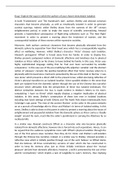
Intrinsic value is the value of an asset or security estimated by someone who has complete understanding of the characteristics of the
asset or issuing firm. To the extent that market prices are not perfectly (informationally) e!cient, they may diverge from intrinsic value.
The di"erence between the analyst's estimate of intrinsic value and the current price is made up of two components: the di"erence
between the actual intrinsic value and the market price, and the di"erence between the actual intrinsic value and the analyst's estimate
of intrinsic value:
IVanalyst − price = (IVactual − price) + (IVanalyst − IVactual) thismisptingcanbeexploitedforpositivereturn
LOS 17.b actual
mispricing valuationem
The going concern assumption is simply the assumption that a company will continue to operate as a business as opposed to going out
of business. The liquidation value is the estimate of what the assets of the firm would bring if sold separately, net of the company's
liabilities.
LOS 17.c
Fair market meant
able buyer.
for of
value is the price at which a hypothetical willing, informed, and able seller would trade an asset to a willing, informed and
sale equityownership
Investment value market
is the value to ashould
price reflect
specific buyer market
after including thisif confident
any additional is acting
value attributable firmis in
investorsinterests
to synergies. Investment value is an
appropriate measure for strategic buyers pursuing acquisitions.
LOS 17.d
Equity valuation is the process of estimating the value of an asset by (1) using a modelnnehgo aF.is
acquisition
based on the variables the analyst believes
influence the fundamental value of the asset or (2) comparing it to the observable market value of "similar" assets. Equity valuation
models are used by analysts in a number of ways. Examples include stock selection, reading the market, projecting the value of
corporate actions, fairness opinions, planning and consulting, communication with analysts and investors, valuation of private business,
and portfolio management.
LOS 17.e
The five elements of industry structure as developed by Professor Michael Porter are:
1. Threat execution
of new entrants
planning in the industry.
2. Threat of substitutes.
3. Bargaining power of buyers.
4. Bargaining power of suppliers.
5. Rivalry among existing competitors.
Quality of earnings issues can be broken down into several categories:
tt
inieHiieeiiion
1
Accelerating or premature recognition of income.
Reclassifying gains and nonoperating income.
Expense recognition and losses.
Amortization, depreciation, and discount rates.
O"–balance-sheet issues.
It may be that these issues are addressed only in the footnotes and disclosures to the financial statements.
LOS 17.f
An absolute valuation model is one that estimates an asset's intrinsic value (e.g., the discounted dividend approach). Relative valuation
highermarketvalue
models estimate an asset's investment characteristics compared to the value of other firms (e.g., comparing P/E ratios to those of other
firms in the industry).
more
transparent
LOS 17.g
Sum-of-the-parts valuation is the process of valuing the individual components of a company and then adding these values together to
obtain the value of the whole company. Conglomerate discount refers to the amount by which market price is lower than the sum-of-
the-parts value. Conglomerate discount is an apparent price reduction applied by the markets to firms that operate in multiple
industries.
4 accountingpractices basisofpresentation
https://www.kaplanlearn.com/education/dashboard/index/603a30d5be4d18486a42cd599e7973d1/course/108321458/node/5352562 13/04/2025, 14:42
Page 1 of 2
, industries.
LOS 17.hirrespective
ofotherfirms comparisonwithother
firms
When selecting an approach for valuing a given company, an analyst should consider whether the model fits the characteristics of the
Divs.Disc.BY OPPcostOFCAPITAL
company, is appropriate based on the quality and availability of input data, and is suitable, given the purpose of the analysis.
Prev When you have finished this page, please Mark it Complete. MARK COMPLETE Next
OR
ÉtImthtvalue
controllinginterest CFmodelastheycansetthedividendpolicy
https://www.kaplanlearn.com/education/dashboard/index/603a30d5be4d18486a42cd599e7973d1/course/108321458/node/5352562 13/04/2025, 14:42
Page 2 of 2
, Dolltgs.mg get
EnDi Pm t.im
sustgrowthrate 151
Reading 18: Key Concepts reqrateofreturn r canbederivedfromthemarket
SCHWESERNOTES - BOOK 3
Hygs 84
Do
Hmodel Dot
g4
LOS 18.a valuation
intrinsic flighty payoff
In stock valuation models, there are three predominant definitions of future cash flows: dividends, free cash flow, and residual income.
Dividends are appropriate when:
The company has a history of dividend payments. firm'sabilitytocreate
value
Titillate4 The dividend policy is clear and related to the earnings of the firm.
The asset is being valued from the position of a minority shareholder.
Free cash flow is appropriate when:
Trust's from
The company does not have a dividend payment history or has a dividendsatellingheta.to
otavianapayout
startingpoint
The free cash flow corresponds with the firm's profitability.
payment history that is not related to earnings.
n
i The asset is being valued from the position of a controlling shareholder.
Residual income is most appropriate for firms that:
Do not have dividend payment histories.
Have negative free cash flow for the foreseeable future.
Have transparent financial reporting and high-quality earnings.
ustiningcaPEx financingdebt
EEI.IE
LOS 18.b
jEEYfaf EEE.jo fIycashaftercapitalreqs
Entitledadf.infoigiaskk9aidentondist.ofces
Stock valuation can be approached using DDMs for single periods, two periods, and multiple holding periods. No matter what the
holding period, the stock price is the present value of the forecasted dividends plus the present value of the estimated terminal value,
discounted at the required return.
difficultwhenthere'slargecapital
regs
LOS 18.c
The Gordon growth model assumes that:
Dividends grow at a constant growth rate.
Is net igiigtiEnPita
Dividend policy is related to earnings.
Required rate of return r is greater than the long-term constant growth rate g:
needeindepthanalysisofaccountingaccruals
D0 ×(1+g) D1
V0 = =
r−g r−g
LOS 18.d
The value of a fixed-rate perpetual preferred stock is equal to the dividend divided by the required return:
Dp
LOS 18.e
is
value of perpetual preferred shares = r t
v p
ri ien Pitt
The GGM has a number of characteristics that make it useful and appropriate for many applications:
Very applicable to stable, mature dividend-paying firms.
CAPM Ri RF BIRMRFI
Usfa
Can be applied to indices very easily.
Easily communicated and explained because of its straightforward approach.
Useful in determining price-implied growthindefinitely
rates, required rates of return, and value of growth opportunities.
Can be added to other more complex valuations.
EEEEEI.la
There are also some characteristics that limit the applications of the Gordon model:
ti tie
Valuations are very sensitive to estimates of growth rates and required rates of return, both of which are di!cult to estimate with
precision.
The model cannot be easily applied to non-dividend-paying stocks.
mentee Ihauntedrate
Unpredictable growth patterns of some firms would make using the model di!cult.
Panattiaout
https://www.kaplanlearn.com/education/dashboard/index/603a30d5be4d18486a42cd599e7973d1/course/108321458/node/5352568 13/04/2025, 14:43
Page 1 of 3
Reading 17: Key Concepts mispricing
goingconcernus liquidationvalue
SCHWESERNOTES - BOOK 3
LOS 17.a
Intrinsic value is the value of an asset or security estimated by someone who has complete understanding of the characteristics of the
asset or issuing firm. To the extent that market prices are not perfectly (informationally) e!cient, they may diverge from intrinsic value.
The di"erence between the analyst's estimate of intrinsic value and the current price is made up of two components: the di"erence
between the actual intrinsic value and the market price, and the di"erence between the actual intrinsic value and the analyst's estimate
of intrinsic value:
IVanalyst − price = (IVactual − price) + (IVanalyst − IVactual) thismisptingcanbeexploitedforpositivereturn
LOS 17.b actual
mispricing valuationem
The going concern assumption is simply the assumption that a company will continue to operate as a business as opposed to going out
of business. The liquidation value is the estimate of what the assets of the firm would bring if sold separately, net of the company's
liabilities.
LOS 17.c
Fair market meant
able buyer.
for of
value is the price at which a hypothetical willing, informed, and able seller would trade an asset to a willing, informed and
sale equityownership
Investment value market
is the value to ashould
price reflect
specific buyer market
after including thisif confident
any additional is acting
value attributable firmis in
investorsinterests
to synergies. Investment value is an
appropriate measure for strategic buyers pursuing acquisitions.
LOS 17.d
Equity valuation is the process of estimating the value of an asset by (1) using a modelnnehgo aF.is
acquisition
based on the variables the analyst believes
influence the fundamental value of the asset or (2) comparing it to the observable market value of "similar" assets. Equity valuation
models are used by analysts in a number of ways. Examples include stock selection, reading the market, projecting the value of
corporate actions, fairness opinions, planning and consulting, communication with analysts and investors, valuation of private business,
and portfolio management.
LOS 17.e
The five elements of industry structure as developed by Professor Michael Porter are:
1. Threat execution
of new entrants
planning in the industry.
2. Threat of substitutes.
3. Bargaining power of buyers.
4. Bargaining power of suppliers.
5. Rivalry among existing competitors.
Quality of earnings issues can be broken down into several categories:
tt
inieHiieeiiion
1
Accelerating or premature recognition of income.
Reclassifying gains and nonoperating income.
Expense recognition and losses.
Amortization, depreciation, and discount rates.
O"–balance-sheet issues.
It may be that these issues are addressed only in the footnotes and disclosures to the financial statements.
LOS 17.f
An absolute valuation model is one that estimates an asset's intrinsic value (e.g., the discounted dividend approach). Relative valuation
highermarketvalue
models estimate an asset's investment characteristics compared to the value of other firms (e.g., comparing P/E ratios to those of other
firms in the industry).
more
transparent
LOS 17.g
Sum-of-the-parts valuation is the process of valuing the individual components of a company and then adding these values together to
obtain the value of the whole company. Conglomerate discount refers to the amount by which market price is lower than the sum-of-
the-parts value. Conglomerate discount is an apparent price reduction applied by the markets to firms that operate in multiple
industries.
4 accountingpractices basisofpresentation
https://www.kaplanlearn.com/education/dashboard/index/603a30d5be4d18486a42cd599e7973d1/course/108321458/node/5352562 13/04/2025, 14:42
Page 1 of 2
, industries.
LOS 17.hirrespective
ofotherfirms comparisonwithother
firms
When selecting an approach for valuing a given company, an analyst should consider whether the model fits the characteristics of the
Divs.Disc.BY OPPcostOFCAPITAL
company, is appropriate based on the quality and availability of input data, and is suitable, given the purpose of the analysis.
Prev When you have finished this page, please Mark it Complete. MARK COMPLETE Next
OR
ÉtImthtvalue
controllinginterest CFmodelastheycansetthedividendpolicy
https://www.kaplanlearn.com/education/dashboard/index/603a30d5be4d18486a42cd599e7973d1/course/108321458/node/5352562 13/04/2025, 14:42
Page 2 of 2
, Dolltgs.mg get
EnDi Pm t.im
sustgrowthrate 151
Reading 18: Key Concepts reqrateofreturn r canbederivedfromthemarket
SCHWESERNOTES - BOOK 3
Hygs 84
Do
Hmodel Dot
g4
LOS 18.a valuation
intrinsic flighty payoff
In stock valuation models, there are three predominant definitions of future cash flows: dividends, free cash flow, and residual income.
Dividends are appropriate when:
The company has a history of dividend payments. firm'sabilitytocreate
value
Titillate4 The dividend policy is clear and related to the earnings of the firm.
The asset is being valued from the position of a minority shareholder.
Free cash flow is appropriate when:
Trust's from
The company does not have a dividend payment history or has a dividendsatellingheta.to
otavianapayout
startingpoint
The free cash flow corresponds with the firm's profitability.
payment history that is not related to earnings.
n
i The asset is being valued from the position of a controlling shareholder.
Residual income is most appropriate for firms that:
Do not have dividend payment histories.
Have negative free cash flow for the foreseeable future.
Have transparent financial reporting and high-quality earnings.
ustiningcaPEx financingdebt
EEI.IE
LOS 18.b
jEEYfaf EEE.jo fIycashaftercapitalreqs
Entitledadf.infoigiaskk9aidentondist.ofces
Stock valuation can be approached using DDMs for single periods, two periods, and multiple holding periods. No matter what the
holding period, the stock price is the present value of the forecasted dividends plus the present value of the estimated terminal value,
discounted at the required return.
difficultwhenthere'slargecapital
regs
LOS 18.c
The Gordon growth model assumes that:
Dividends grow at a constant growth rate.
Is net igiigtiEnPita
Dividend policy is related to earnings.
Required rate of return r is greater than the long-term constant growth rate g:
needeindepthanalysisofaccountingaccruals
D0 ×(1+g) D1
V0 = =
r−g r−g
LOS 18.d
The value of a fixed-rate perpetual preferred stock is equal to the dividend divided by the required return:
Dp
LOS 18.e
is
value of perpetual preferred shares = r t
v p
ri ien Pitt
The GGM has a number of characteristics that make it useful and appropriate for many applications:
Very applicable to stable, mature dividend-paying firms.
CAPM Ri RF BIRMRFI
Usfa
Can be applied to indices very easily.
Easily communicated and explained because of its straightforward approach.
Useful in determining price-implied growthindefinitely
rates, required rates of return, and value of growth opportunities.
Can be added to other more complex valuations.
EEEEEI.la
There are also some characteristics that limit the applications of the Gordon model:
ti tie
Valuations are very sensitive to estimates of growth rates and required rates of return, both of which are di!cult to estimate with
precision.
The model cannot be easily applied to non-dividend-paying stocks.
mentee Ihauntedrate
Unpredictable growth patterns of some firms would make using the model di!cult.
Panattiaout
https://www.kaplanlearn.com/education/dashboard/index/603a30d5be4d18486a42cd599e7973d1/course/108321458/node/5352568 13/04/2025, 14:43
Page 1 of 3