
CARBOHYDRATES
Key Terms
Monomers
3.1 BIOLOGICAL MOLECULES Polymers
Condensation reaction
MISSESTRUCH 2020
Hydrolysis reaction
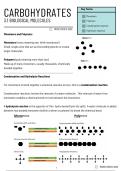
Monomers and Polymers
Monomers (mono meaning one, think monobrow!)
Small, single units that act as the building blocks to create
larger molecules.
Polymers (poly meaning more than two)
Made up of many monomers, usually thousands, chemically
bonded together.
Condensation and Hydrolysis Reactions
For monomers to bond together a chemical reaction occurs; this is a condensation reaction.
Condensation reactions involve the removal of a water molecule. This removal of water from
monomers enables a chemical bond to form between the monomers.
A hydrolysis reaction is the opposite of this- hydro (water) lysis (to split). A water molecule is added
between two bonded monomers (within a dimer or polymer) to break the chemical bond.
1 MISSESTRUCH 2020
,CARBOHYDRATES
Key Terms
Monosaccharides
3.1 BIOLOGICAL MOLECULES Disaccharides
Polysaccharides
MISSESTRUCH 2020
Glucose
Carbohydrates Galactose
Fructose
Carbohydrates are key biological molecules that store energy
and can provide structural support to plant cells.
Carbohydrates can be classified into three groups determined by how many units they are made of,
as seen in the flow diagram below.
Fructose
Larger carbohydrates, such as sucrose and starch, are made from monosaccharides.
The monomers of carbohydrates are known as monosaccharides and glucose, galactose and
fructose are three common examples. Monosaccharides are sugars and are soluble in water.
Their function is either to provide energy or to be a building block to create larger molecules.
All carbohydrates contain three elements: carbon, hydrogen and oxygen (CHO).
The general formula for a monosaccharide is CnH 2nOn, where n = the number of carbon atoms it
contains.
2 MISSESTRUCH 2020
,CARBOHYDRATES
Key Terms
Monosaccharides
3.1 BIOLOGICAL MOLECULES Glucose
Isomer
MISSESTRUCH 2020
α glucose
Glucose β glucose
Glucose, C 6H12O6 , is a very important monosaccharide that can
provide energy or be polymerised to form a structural support
molecule (cellulose) or energy storage molecule (glycogen and
starch).
Glucose has two structural isomers. Isomers are
compounds that have the same formula, but the
atoms are arranged differently.
The diagram on the left shows the isomer α
glucose.
β glucose is the second isomer. There is only one difference in the structural arrangement
between these isomers. The hydrogen (H) and hydroxyl group (OH) on carbon 1 swap position.
α glucose β glucose
This small change has a significant impact on the bonding and final structure of the polymers
that they form.
3 MISSESTRUCH 2020
,CARBOHYDRATES
Key Terms
Monosaccharides
3.1 BIOLOGICAL MOLECULES Disaccharides
Glycosidic Bond
MISSESTRUCH 2020
Maltose
Disaccharides
Lactose
Disaccharides are two monosaccharides bonded together by Sucrose
a glycosidic bond, that is formed by a condensation reaction.
There are three key disaccharides that you need to remember, and these are made from the three
key monosaccharides you learned.
glucose + glucose --> maltose
glucose + galactose --> lactose
glucose + fructose --> sucrose
Condensation and Hydrolysis Reactions
The diagram below demonstrates how a condensation reaction creates a disaccharide. A water
molecule is being removed (highlighted in red) from the hydroxyl group (OH) on carbon 1 and carbon
4 on the two monosaccharides. The bond that forms is known as a glycosidic bond (highlighted in
blue). This diagram shows a 1-4, glycosidic bond because it is located between carbon 1 and
carbon 4.
Disaccharides can be broken down back into monosaccharides via a hydrolysis reaction. Hydrolysis
is when a water molecule is added in to break a bond, as shown in the diagram below.
MISSESTRUCH 2020
4
,CARBOHYDRATES
Key Terms
Polysaccharides
3.1 BIOLOGICAL MOLECULES Condensation reaction
Energy store
MISSESTRUCH 2020
Structural support
Polysaccharides
Starch
Polysaccharides are polymers made up of many Glycosidic bonds
monosaccharides. A polysaccharide is created in the same way
as a disaccharide, via condensation reactions. There are three
key polysaccharides that you need to learn the structure and
function of: starch, glycogen and cellulose.
Starch and glycogen are both energy stores, whereas cellulose provides structural support.
Starch
Starch is found in plants, not in animal cells, and it is the major carbohydrate store. Starch is made
from the excess glucose created during photosynthesis. Glucose is used in respiration, but if more
glucose is created in photosynthesis than is needed, it is converted into the polymer starch for
storage.
Structure of starch
Starch is a polymer made up of α-glucose. These α-glucose monomers are joined together via
condensation reactions and are held in place by 1,4 and 1,6 - glycosidic bonds (The numbers refer
to which carbon atoms the bond forms between).
5
MISSESTRUCH 2020
,CARBOHYDRATES
Key Terms
Starch
3.1 BIOLOGICAL MOLECULES Amylose
Amylopectin
MISSESTRUCH 2020
Glycosidic bonds
Structure of Starch
Spiral
Starch is made up of two polymers; amylose and amylopectin. Branched
Amylose is the name of the structure in starch in which the glucose monomers are all joined
together by 1,4 - glycosidic bonds. This results in a spiral-shaped polymer, see diagram below.
Amylopectin is the name given to the other structure in
starch in which the glucose monomers are joined by a
combination of 1,4 and 1,6 - glycosidic bonds. The 1,6 -
glycosidic bonds result in branches, as seen in the diagram
to the right.
Properties of Starch
Starch is insoluble due to the fact it is a large molecule. This is an advantage as it means it can
be stored within cells and not dissolve. Therefore it will not change the water potential of a cell
and nor cause osmosis to occur.
As amylose is spiral-shaped, it can be readily compacted.
As amylopectin is branched, it provides a larger surface area for enzymes to attach to.
This means that starch is readily hydrolysed back into glucose when plant cells are running low
on glucose for respiration.
6 MISSESTRUCH 2020
, CARBOHYDRATES
Key Terms
Glycogen
3.1 BIOLOGICAL MOLECULES Glycosidic bonds
Highly branched
MISSESTRUCH 2020
Glycogen Metabolic rate
Liver
Glycogen is the major carbohydrate storage molecule found in Muscles
animal cells. The main cells glycogen is stored in are liver and
muscle cells.
Glycogen is made from the excess glucose that has been eaten and absorbed into the bloodstream.
Glucose is used in respiration, but if more glucose is eaten than the cells need for respiration it is
converted into the polymer glycogen and stored. As liver cells are responsible for removing toxins
and muscles are responsible for movement, glycogen is mainly stored in these cells to ensure they
always have access to glucose to respire and release energy.
Structure of Glycogen
Glycogen is a polymer made up of α-glucose and is very similar in structure
to amylopectin in starch. The α-glucose monomers are joined together via
condensation reactions and are held in place by 1,4 and 1,6 - glycosidic
bonds. The key difference between the structure of glycogen and starch is
that glycogen contains more 1,6 - glycosidic bonds and is, therefore, a more
branched structure.
Properties of Glycogen
Glycogen is insoluble due to the fact it is a large molecule. This is an advantage as it means it can
be stored within cells and not dissolve. Therefore it will not change the water potential of a cell
nor cause osmosis, which would otherwise cause cell lysis.
The fact that glycogen is a highly branched molecule means it has a larger surface area for
enzymes to attach. This means that it is readily hydrolysed into glucose when cells are running
low on glucose. Glycogen is even more branched than starch, therefore it is hydrolysed back into
glucose more rapidly. This is essential for animals because they have a higher metabolic rate and
therefore need more glucose. For example, they may need this glucose to provide energy to run
from a predator.
7
MISSESTRUCH
Key Terms
Monomers
3.1 BIOLOGICAL MOLECULES Polymers
Condensation reaction
MISSESTRUCH 2020
Hydrolysis reaction
Monomers and Polymers
Monomers (mono meaning one, think monobrow!)
Small, single units that act as the building blocks to create
larger molecules.
Polymers (poly meaning more than two)
Made up of many monomers, usually thousands, chemically
bonded together.
Condensation and Hydrolysis Reactions
For monomers to bond together a chemical reaction occurs; this is a condensation reaction.
Condensation reactions involve the removal of a water molecule. This removal of water from
monomers enables a chemical bond to form between the monomers.
A hydrolysis reaction is the opposite of this- hydro (water) lysis (to split). A water molecule is added
between two bonded monomers (within a dimer or polymer) to break the chemical bond.
1 MISSESTRUCH 2020
,CARBOHYDRATES
Key Terms
Monosaccharides
3.1 BIOLOGICAL MOLECULES Disaccharides
Polysaccharides
MISSESTRUCH 2020
Glucose
Carbohydrates Galactose
Fructose
Carbohydrates are key biological molecules that store energy
and can provide structural support to plant cells.
Carbohydrates can be classified into three groups determined by how many units they are made of,
as seen in the flow diagram below.
Fructose
Larger carbohydrates, such as sucrose and starch, are made from monosaccharides.
The monomers of carbohydrates are known as monosaccharides and glucose, galactose and
fructose are three common examples. Monosaccharides are sugars and are soluble in water.
Their function is either to provide energy or to be a building block to create larger molecules.
All carbohydrates contain three elements: carbon, hydrogen and oxygen (CHO).
The general formula for a monosaccharide is CnH 2nOn, where n = the number of carbon atoms it
contains.
2 MISSESTRUCH 2020
,CARBOHYDRATES
Key Terms
Monosaccharides
3.1 BIOLOGICAL MOLECULES Glucose
Isomer
MISSESTRUCH 2020
α glucose
Glucose β glucose
Glucose, C 6H12O6 , is a very important monosaccharide that can
provide energy or be polymerised to form a structural support
molecule (cellulose) or energy storage molecule (glycogen and
starch).
Glucose has two structural isomers. Isomers are
compounds that have the same formula, but the
atoms are arranged differently.
The diagram on the left shows the isomer α
glucose.
β glucose is the second isomer. There is only one difference in the structural arrangement
between these isomers. The hydrogen (H) and hydroxyl group (OH) on carbon 1 swap position.
α glucose β glucose
This small change has a significant impact on the bonding and final structure of the polymers
that they form.
3 MISSESTRUCH 2020
,CARBOHYDRATES
Key Terms
Monosaccharides
3.1 BIOLOGICAL MOLECULES Disaccharides
Glycosidic Bond
MISSESTRUCH 2020
Maltose
Disaccharides
Lactose
Disaccharides are two monosaccharides bonded together by Sucrose
a glycosidic bond, that is formed by a condensation reaction.
There are three key disaccharides that you need to remember, and these are made from the three
key monosaccharides you learned.
glucose + glucose --> maltose
glucose + galactose --> lactose
glucose + fructose --> sucrose
Condensation and Hydrolysis Reactions
The diagram below demonstrates how a condensation reaction creates a disaccharide. A water
molecule is being removed (highlighted in red) from the hydroxyl group (OH) on carbon 1 and carbon
4 on the two monosaccharides. The bond that forms is known as a glycosidic bond (highlighted in
blue). This diagram shows a 1-4, glycosidic bond because it is located between carbon 1 and
carbon 4.
Disaccharides can be broken down back into monosaccharides via a hydrolysis reaction. Hydrolysis
is when a water molecule is added in to break a bond, as shown in the diagram below.
MISSESTRUCH 2020
4
,CARBOHYDRATES
Key Terms
Polysaccharides
3.1 BIOLOGICAL MOLECULES Condensation reaction
Energy store
MISSESTRUCH 2020
Structural support
Polysaccharides
Starch
Polysaccharides are polymers made up of many Glycosidic bonds
monosaccharides. A polysaccharide is created in the same way
as a disaccharide, via condensation reactions. There are three
key polysaccharides that you need to learn the structure and
function of: starch, glycogen and cellulose.
Starch and glycogen are both energy stores, whereas cellulose provides structural support.
Starch
Starch is found in plants, not in animal cells, and it is the major carbohydrate store. Starch is made
from the excess glucose created during photosynthesis. Glucose is used in respiration, but if more
glucose is created in photosynthesis than is needed, it is converted into the polymer starch for
storage.
Structure of starch
Starch is a polymer made up of α-glucose. These α-glucose monomers are joined together via
condensation reactions and are held in place by 1,4 and 1,6 - glycosidic bonds (The numbers refer
to which carbon atoms the bond forms between).
5
MISSESTRUCH 2020
,CARBOHYDRATES
Key Terms
Starch
3.1 BIOLOGICAL MOLECULES Amylose
Amylopectin
MISSESTRUCH 2020
Glycosidic bonds
Structure of Starch
Spiral
Starch is made up of two polymers; amylose and amylopectin. Branched
Amylose is the name of the structure in starch in which the glucose monomers are all joined
together by 1,4 - glycosidic bonds. This results in a spiral-shaped polymer, see diagram below.
Amylopectin is the name given to the other structure in
starch in which the glucose monomers are joined by a
combination of 1,4 and 1,6 - glycosidic bonds. The 1,6 -
glycosidic bonds result in branches, as seen in the diagram
to the right.
Properties of Starch
Starch is insoluble due to the fact it is a large molecule. This is an advantage as it means it can
be stored within cells and not dissolve. Therefore it will not change the water potential of a cell
and nor cause osmosis to occur.
As amylose is spiral-shaped, it can be readily compacted.
As amylopectin is branched, it provides a larger surface area for enzymes to attach to.
This means that starch is readily hydrolysed back into glucose when plant cells are running low
on glucose for respiration.
6 MISSESTRUCH 2020
, CARBOHYDRATES
Key Terms
Glycogen
3.1 BIOLOGICAL MOLECULES Glycosidic bonds
Highly branched
MISSESTRUCH 2020
Glycogen Metabolic rate
Liver
Glycogen is the major carbohydrate storage molecule found in Muscles
animal cells. The main cells glycogen is stored in are liver and
muscle cells.
Glycogen is made from the excess glucose that has been eaten and absorbed into the bloodstream.
Glucose is used in respiration, but if more glucose is eaten than the cells need for respiration it is
converted into the polymer glycogen and stored. As liver cells are responsible for removing toxins
and muscles are responsible for movement, glycogen is mainly stored in these cells to ensure they
always have access to glucose to respire and release energy.
Structure of Glycogen
Glycogen is a polymer made up of α-glucose and is very similar in structure
to amylopectin in starch. The α-glucose monomers are joined together via
condensation reactions and are held in place by 1,4 and 1,6 - glycosidic
bonds. The key difference between the structure of glycogen and starch is
that glycogen contains more 1,6 - glycosidic bonds and is, therefore, a more
branched structure.
Properties of Glycogen
Glycogen is insoluble due to the fact it is a large molecule. This is an advantage as it means it can
be stored within cells and not dissolve. Therefore it will not change the water potential of a cell
nor cause osmosis, which would otherwise cause cell lysis.
The fact that glycogen is a highly branched molecule means it has a larger surface area for
enzymes to attach. This means that it is readily hydrolysed into glucose when cells are running
low on glucose. Glycogen is even more branched than starch, therefore it is hydrolysed back into
glucose more rapidly. This is essential for animals because they have a higher metabolic rate and
therefore need more glucose. For example, they may need this glucose to provide energy to run
from a predator.
7
MISSESTRUCH



