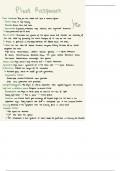
sychologist names =Red
P
Statistics =Purple
Examples =Green
Important terminology/ information =Orange
Contents page
Memory
1) Discuss the multi-store model of memory. Refer to research evidence in your answer (16)
2) Discuss research on duration (8)
3) Discuss research on coding (8)
4) Discuss research on capacity (8)
5) Describe and evaluate types of long‐term memory. (16)
6) D
iscuss what psychological research has shown about working memory. In your answer, refer to theory and/or
evidence. (16)
7) Describe and evaluate how interference leads to forgetting. (16)
8) Describe and evaluate how retrieval failure due to the absence of cues leads to forgetting. (16)
9) D
iscuss research into the effects of misleading information on the accuracy of eyewitness testimony. (16
marks)
10) Outline and evaluate research into the effects of anxiety on the accuracy of eyewitness testimony. (16)
11) Discuss the use of the cognitive interview as a means of improving the accuracy of eyewitness testimony. (16)
Social Influence
12) Discuss explanations of conformity (16)
, 13) Discuss factors that can affect conformity. Refer to variations of Asch’s experiment in your answer. (16)
14) Outline and evaluate research into conformity to social roles, with reference to Zimbardo. (16)
15) Discuss research into obedience as investigated by Milgram (situational variables) (16)
16) Discuss agentic state and legitimacy of authority as a (situational) explanation of obedience (16)
17) Outline and evaluate the authoritarian personality as a dispositional explanation for obedience. (16)
18) Outline and evaluate two explanations of resistance to social influence. (16)
19) Outline and evaluate research into minority influence. (16)
20) Outline and evaluate the role of social influence processes in social change. (16)
Attachment
21) With reference to reciprocity and interactional synchrony, discuss infant-caregiver interactions. (16)
22) Discuss the stages of attachment identified by Schaffer (& Emerson - not mentioned in the specification) (16)
23) Outline and evaluate the role of the father in the development of attachment. (16)
24) Outline and evaluate animal studies of attachment. (16 marks)
25) Outline and evaluate the learning theory as an explanation of attachment. (16)
26) Outline and evaluate Bowlby’s monotropic explanation of attachment. (16)
27) Outline and evaluate Bowlby’s maternal explanation of attachment. (16)
28) Discuss the strange situation as a way of assessing types of attachment. (16)
29) Outline and evaluate research into cultural variations in attachment. (16)
, 30) Outline and evaluate research into the effects of institutionalisation. (16)
31) Outline and evaluate research into the influence of early attachment on childhood and adult relationships. (16)
Psychopathology
32) Characteristics of phobia
33) Characteristics of depression
34) Characteristics of OCD
35) Outline and evaluate two or more definitions of abnormality. (16)
36) Outline and evaluate the behavioural approach to explaining phobias. (16)
37) Outline and evaluate the behavioural approach to treating phobias. (16)
38) Outline and evaluate the cognitive approach to explaining depression. (16)
39) Outline and evaluate the cognitive approach to treating depression. (16)
40) Discuss the biological approach to explaining OCD. (16)
41) Outline and evaluate the biological approach to treating OCD. (16)
Biopsychology
42) Discuss research into localisation of the brain (16)
43) Discuss research into hemispheric lateralisation of the brain (16)
44) Discuss research into plasticity of the brain, including functional recovery (16)
45) Discuss ways of studying the brain (16)
, 46) Discuss research into circadian rhythms (16)
47) Discuss research into ultradian and infradian rhythms (16)
48) Discuss research into endogenous pacemakers and exogenous zeitgebers (16)
Approaches in psychology
49) Outline and evaluate the behaviourist approach (16)
50) Outline and evaluate social learning theory (16)
51) Outline and evaluate the cognitive approach (16)
52) Outline and evaluate the biological approach (16)
53) Outline and evaluate the psychodynamic approach (16)
54) Outline and evaluate the humanistic approach (16)
Issues and Debates
55) Discuss how gender bias has been presented in psychology (16)
56) Discuss how cultural bias has been presented in psychology (16)
57) Discuss free will and determinism in psychology (16)
58) Discuss the nature-nurture debate in psychology (16)
59) Discuss holism and reductionism in psychology (16)
60) Discuss idiographic and nomothetic approaches in psychology (16)
, 61) Discuss ethical implications in psychology. Refer to psychological research you have studied (16)
Relationships
62) Describe and evaluate the evolutionary explanation for partner preferences (16)
63) Describe and evaluate physical attraction being a factor of attraction (16)
64) Describe and evaluate self-disclosure being a factor of attraction (16)
65) Describe and evaluate filter theory as a factor of attraction (16)
66) Describe and evaluate the social exchange theory (16)
67) Describe and evaluate the equity theory (16)
68) Describe and evaluate the Rusbult’s Investment Model (16)
69) Describe and evaluate Duck’s Phase Model (16)
70) Discuss what psychological research has told us about virtual relationships in social media (16)
71) Discuss what gating in virtual relationships in social media (8)
72) Discuss what psychological research has told us about parasocial relationships (16)
Aggression
73) Outline and evaluate the role of neural and/or hormonal mechanisms in aggression. (16)
74) Discuss the role of genetic factors in aggression. (16)
75) Outline and evaluate the ethological explanation of aggression (16)
76) Outline and evaluate evolutionary explanations of aggression. (16)
, 77) Describe and evaluate the frustration-aggression hypothesis of human aggression (16)
78) Describe and evaluate the social learning theory of human aggression (16)
79) Describe and evaluate the de-individuation of human aggression (16)
80) Discuss explanations of institutional aggression (16)
81) Discuss media influences on aggression, refer to computer games (16)
82) Discuss desensitisation, disinhibition and cognitive priming as explanations of media influences (16)
Schizophrenia
83) Outline the clinical characteristics of schizophrenia
84) O
utline and evaluate issues surrounding the classification and diagnosis of schizophrenia, including reliability
and validity (16)
85) O
utline and evaluate biological explanations for schizophrenia: genetics, the dopamine hypothesis and neural
correlates (16)
86) O
utline and evaluate psychological explanations for schizophrenia: family dysfunction and cognitive
explanations, including dysfunctional thought processing (16)
87) Outline and evaluate drug therapies for treating schizophrenia: typical and atypical antipsychotics (16)
88) Outline and evaluate psychological therapies for schizophrenia (16)
89) Outline and evaluate token economies used in the management of schizophrenia (16)
90) O
utline and evaluate the importance of an interactionist approach in explaining and treating schizophrenia
(16)
Paper 1 contents
, Memory
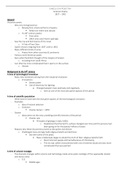
1) Discuss the multi-store model of memory. Refer to research evidence in your answer (16)
A01 ulti store
M - tkinson and Shiffrinproposed the multi-store model
A
model - The model describes how information flows through the memory system
Sensory register - ll stimuli from the environment pass through the sensory register
A
- It recieves information from all our senses, the sensory register has a huge capacity
- Information will only pass from the sensory register to the short-term memory store if
we pay attention
S hort term - as acapacity of 7+/-2(Miller)
H
memory - STM isacoustically encoded(Baddeley)
- Duration of 18-30 seconds(Peterson & Peterson)
- Limited capacity store as it can only contain a certain number of things before forgetting
- Maintenance rehearsaloccurs when we repeat new informationto ourselves
- Prolonged maintenance rehearsalallows informationto pass into LTM
L ong term - escribed assemantically encoded
D
memory - Theoretically unlimited capacity
- Very long duration (48 years, shown byBahrick)
- In order to remember, retrieval must occur - information is transferred back into STM
- Continue to pass throughmaintenance loopafterwards
A03 S upporting - SM acknowledges the qualitative differences between STM and LTM by representing
M
studies separate stores.
, - S TM is stored acoustically whereas LTM is encoded semantically.
- MSM portrays an accurate view of the differences between the two types of memory
and is supported byBaddeley, Bahrick and Miller.
L acks ecological - espite the research support fromBaddeley and Peterson,much of its use in
D
validity generalising to everyday life is questionable.
- Baddeley and Peterson & Petersonuse letters/ listsof words, some of which had no
meaning.
- In real life we use all sorts of things to aid our memory so MSM a might not be valid
model of how memory working our everyday life
esearch
R - enry Molaisonunderwent surgery for epilepsy.
H
supporting - A part of his brain called the hippocampus was removed from both sides of his brain, we
differences understand that this is critical for memory function.
between STM - He could not form any long-term memories but could perform well on tests in
and LTM -Henry immediate memory.
Molaison - Thus demonstrating there are 2 qualitatively different areas of STM and LTM and
supports MSM.
SM is an
M - ccording to MSM, the more you rehearse something, the more likely it is to transfer to
A
inadequate LTM (prolonged rehearsal).
explanation for - However,Craik and Watkinsfound that the type ofrehearsal is more important than
how LTM works the amount.
-Craik and - They suggestelaborative rehearsal(linking informationto your existing knowledge),
Watkins instead ofprolonged rehearsal, is needed to transferSTM into LTM.
- This means the model fails to adequately explain how long term storage works and it
might be a complete explanation of memory.
2) Discuss research on duration (8)
A01 eterson and
P - 4 undergraduates
2
Peterson- STM - Found that the increasing retention intervals(from3-18 seconds)decreased the
accuracy of recall of consonants
- They were given nonsense triagrams and told to count backwards to prevent mental
rehearsal
- After 3 seconds, recall was 80%, after 18 seconds about 3%Peterson and Peterson's
- Findings suggest thatSTM duration may be 18 secondsunless we repeat the
information over and over (verbal rehearsal)
A03 High control - eterson & Peterson's study of artificial trigrams can be standardised to establish a
P
comparison between the groups and therefore cause and effect.
eaningless
M - ecalling consonant syllables does not reflect most everyday memory activities.
R
stimuli - Therefore, the study lacks external validity.
- However, we sometimes remember meaningless material such as phone numbers.
A01 Bahrick- LTM - S tudied 392 American ppts
- Using high school yearbooks, recall of names were tested
- There were two conditions:
- Photo-recognition test of photos using the high school year book
- Free call test where ppts recalled all the names of their graduating class
- Ppts tested within15 years of graduation were 90%accurate in photo recognition
- After45 years, recall declined to about 70% for photorecognition
- Free recall was less accurate than recognition,60%after 15 years dropping to 30% after
48 years
- This shows that LTM may last up to a lifetime for some material
A03 High external - They investigated meaningful memories (e.g. names and faces).
P
Statistics =Purple
Examples =Green
Important terminology/ information =Orange
Contents page
Memory
1) Discuss the multi-store model of memory. Refer to research evidence in your answer (16)
2) Discuss research on duration (8)
3) Discuss research on coding (8)
4) Discuss research on capacity (8)
5) Describe and evaluate types of long‐term memory. (16)
6) D
iscuss what psychological research has shown about working memory. In your answer, refer to theory and/or
evidence. (16)
7) Describe and evaluate how interference leads to forgetting. (16)
8) Describe and evaluate how retrieval failure due to the absence of cues leads to forgetting. (16)
9) D
iscuss research into the effects of misleading information on the accuracy of eyewitness testimony. (16
marks)
10) Outline and evaluate research into the effects of anxiety on the accuracy of eyewitness testimony. (16)
11) Discuss the use of the cognitive interview as a means of improving the accuracy of eyewitness testimony. (16)
Social Influence
12) Discuss explanations of conformity (16)
, 13) Discuss factors that can affect conformity. Refer to variations of Asch’s experiment in your answer. (16)
14) Outline and evaluate research into conformity to social roles, with reference to Zimbardo. (16)
15) Discuss research into obedience as investigated by Milgram (situational variables) (16)
16) Discuss agentic state and legitimacy of authority as a (situational) explanation of obedience (16)
17) Outline and evaluate the authoritarian personality as a dispositional explanation for obedience. (16)
18) Outline and evaluate two explanations of resistance to social influence. (16)
19) Outline and evaluate research into minority influence. (16)
20) Outline and evaluate the role of social influence processes in social change. (16)
Attachment
21) With reference to reciprocity and interactional synchrony, discuss infant-caregiver interactions. (16)
22) Discuss the stages of attachment identified by Schaffer (& Emerson - not mentioned in the specification) (16)
23) Outline and evaluate the role of the father in the development of attachment. (16)
24) Outline and evaluate animal studies of attachment. (16 marks)
25) Outline and evaluate the learning theory as an explanation of attachment. (16)
26) Outline and evaluate Bowlby’s monotropic explanation of attachment. (16)
27) Outline and evaluate Bowlby’s maternal explanation of attachment. (16)
28) Discuss the strange situation as a way of assessing types of attachment. (16)
29) Outline and evaluate research into cultural variations in attachment. (16)
, 30) Outline and evaluate research into the effects of institutionalisation. (16)
31) Outline and evaluate research into the influence of early attachment on childhood and adult relationships. (16)
Psychopathology
32) Characteristics of phobia
33) Characteristics of depression
34) Characteristics of OCD
35) Outline and evaluate two or more definitions of abnormality. (16)
36) Outline and evaluate the behavioural approach to explaining phobias. (16)
37) Outline and evaluate the behavioural approach to treating phobias. (16)
38) Outline and evaluate the cognitive approach to explaining depression. (16)
39) Outline and evaluate the cognitive approach to treating depression. (16)
40) Discuss the biological approach to explaining OCD. (16)
41) Outline and evaluate the biological approach to treating OCD. (16)
Biopsychology
42) Discuss research into localisation of the brain (16)
43) Discuss research into hemispheric lateralisation of the brain (16)
44) Discuss research into plasticity of the brain, including functional recovery (16)
45) Discuss ways of studying the brain (16)
, 46) Discuss research into circadian rhythms (16)
47) Discuss research into ultradian and infradian rhythms (16)
48) Discuss research into endogenous pacemakers and exogenous zeitgebers (16)
Approaches in psychology
49) Outline and evaluate the behaviourist approach (16)
50) Outline and evaluate social learning theory (16)
51) Outline and evaluate the cognitive approach (16)
52) Outline and evaluate the biological approach (16)
53) Outline and evaluate the psychodynamic approach (16)
54) Outline and evaluate the humanistic approach (16)
Issues and Debates
55) Discuss how gender bias has been presented in psychology (16)
56) Discuss how cultural bias has been presented in psychology (16)
57) Discuss free will and determinism in psychology (16)
58) Discuss the nature-nurture debate in psychology (16)
59) Discuss holism and reductionism in psychology (16)
60) Discuss idiographic and nomothetic approaches in psychology (16)
, 61) Discuss ethical implications in psychology. Refer to psychological research you have studied (16)
Relationships
62) Describe and evaluate the evolutionary explanation for partner preferences (16)
63) Describe and evaluate physical attraction being a factor of attraction (16)
64) Describe and evaluate self-disclosure being a factor of attraction (16)
65) Describe and evaluate filter theory as a factor of attraction (16)
66) Describe and evaluate the social exchange theory (16)
67) Describe and evaluate the equity theory (16)
68) Describe and evaluate the Rusbult’s Investment Model (16)
69) Describe and evaluate Duck’s Phase Model (16)
70) Discuss what psychological research has told us about virtual relationships in social media (16)
71) Discuss what gating in virtual relationships in social media (8)
72) Discuss what psychological research has told us about parasocial relationships (16)
Aggression
73) Outline and evaluate the role of neural and/or hormonal mechanisms in aggression. (16)
74) Discuss the role of genetic factors in aggression. (16)
75) Outline and evaluate the ethological explanation of aggression (16)
76) Outline and evaluate evolutionary explanations of aggression. (16)
, 77) Describe and evaluate the frustration-aggression hypothesis of human aggression (16)
78) Describe and evaluate the social learning theory of human aggression (16)
79) Describe and evaluate the de-individuation of human aggression (16)
80) Discuss explanations of institutional aggression (16)
81) Discuss media influences on aggression, refer to computer games (16)
82) Discuss desensitisation, disinhibition and cognitive priming as explanations of media influences (16)
Schizophrenia
83) Outline the clinical characteristics of schizophrenia
84) O
utline and evaluate issues surrounding the classification and diagnosis of schizophrenia, including reliability
and validity (16)
85) O
utline and evaluate biological explanations for schizophrenia: genetics, the dopamine hypothesis and neural
correlates (16)
86) O
utline and evaluate psychological explanations for schizophrenia: family dysfunction and cognitive
explanations, including dysfunctional thought processing (16)
87) Outline and evaluate drug therapies for treating schizophrenia: typical and atypical antipsychotics (16)
88) Outline and evaluate psychological therapies for schizophrenia (16)
89) Outline and evaluate token economies used in the management of schizophrenia (16)
90) O
utline and evaluate the importance of an interactionist approach in explaining and treating schizophrenia
(16)
Paper 1 contents
, Memory
1) Discuss the multi-store model of memory. Refer to research evidence in your answer (16)
A01 ulti store
M - tkinson and Shiffrinproposed the multi-store model
A
model - The model describes how information flows through the memory system
Sensory register - ll stimuli from the environment pass through the sensory register
A
- It recieves information from all our senses, the sensory register has a huge capacity
- Information will only pass from the sensory register to the short-term memory store if
we pay attention
S hort term - as acapacity of 7+/-2(Miller)
H
memory - STM isacoustically encoded(Baddeley)
- Duration of 18-30 seconds(Peterson & Peterson)
- Limited capacity store as it can only contain a certain number of things before forgetting
- Maintenance rehearsaloccurs when we repeat new informationto ourselves
- Prolonged maintenance rehearsalallows informationto pass into LTM
L ong term - escribed assemantically encoded
D
memory - Theoretically unlimited capacity
- Very long duration (48 years, shown byBahrick)
- In order to remember, retrieval must occur - information is transferred back into STM
- Continue to pass throughmaintenance loopafterwards
A03 S upporting - SM acknowledges the qualitative differences between STM and LTM by representing
M
studies separate stores.
, - S TM is stored acoustically whereas LTM is encoded semantically.
- MSM portrays an accurate view of the differences between the two types of memory
and is supported byBaddeley, Bahrick and Miller.
L acks ecological - espite the research support fromBaddeley and Peterson,much of its use in
D
validity generalising to everyday life is questionable.
- Baddeley and Peterson & Petersonuse letters/ listsof words, some of which had no
meaning.
- In real life we use all sorts of things to aid our memory so MSM a might not be valid
model of how memory working our everyday life
esearch
R - enry Molaisonunderwent surgery for epilepsy.
H
supporting - A part of his brain called the hippocampus was removed from both sides of his brain, we
differences understand that this is critical for memory function.
between STM - He could not form any long-term memories but could perform well on tests in
and LTM -Henry immediate memory.
Molaison - Thus demonstrating there are 2 qualitatively different areas of STM and LTM and
supports MSM.
SM is an
M - ccording to MSM, the more you rehearse something, the more likely it is to transfer to
A
inadequate LTM (prolonged rehearsal).
explanation for - However,Craik and Watkinsfound that the type ofrehearsal is more important than
how LTM works the amount.
-Craik and - They suggestelaborative rehearsal(linking informationto your existing knowledge),
Watkins instead ofprolonged rehearsal, is needed to transferSTM into LTM.
- This means the model fails to adequately explain how long term storage works and it
might be a complete explanation of memory.
2) Discuss research on duration (8)
A01 eterson and
P - 4 undergraduates
2
Peterson- STM - Found that the increasing retention intervals(from3-18 seconds)decreased the
accuracy of recall of consonants
- They were given nonsense triagrams and told to count backwards to prevent mental
rehearsal
- After 3 seconds, recall was 80%, after 18 seconds about 3%Peterson and Peterson's
- Findings suggest thatSTM duration may be 18 secondsunless we repeat the
information over and over (verbal rehearsal)
A03 High control - eterson & Peterson's study of artificial trigrams can be standardised to establish a
P
comparison between the groups and therefore cause and effect.
eaningless
M - ecalling consonant syllables does not reflect most everyday memory activities.
R
stimuli - Therefore, the study lacks external validity.
- However, we sometimes remember meaningless material such as phone numbers.
A01 Bahrick- LTM - S tudied 392 American ppts
- Using high school yearbooks, recall of names were tested
- There were two conditions:
- Photo-recognition test of photos using the high school year book
- Free call test where ppts recalled all the names of their graduating class
- Ppts tested within15 years of graduation were 90%accurate in photo recognition
- After45 years, recall declined to about 70% for photorecognition
- Free recall was less accurate than recognition,60%after 15 years dropping to 30% after
48 years
- This shows that LTM may last up to a lifetime for some material
A03 High external - They investigated meaningful memories (e.g. names and faces).