
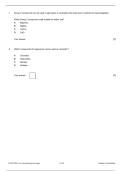
1 Group 2 compounds can be used in agriculture to neutralise acid soils and in medicine to treat indigestion.
Which Group 2 compound is not suitable for either use?
A Mg(OH)2
B MgSO4
C CaCO3
D CaO
Your answer [1]
2 Which compounds of magnesium can be used as ‘antacids’?
A Chlorides
B Hydroxides
C Nitrates
D Sulfates
Your answer [1]
© OCR 2025. You may photocopy this page. 1 of 32 Created in ExamBuilder
, 3 This question is about periodicity and the reaction of some Group 2 metals.
Periodicity is the repeating trend in properties of elements across different periods in the periodic table.
i. Complete the table below with the electron configurations and blocks.
Group 2 Group 17 (7)
Period 2 Be F
1s2 ........................................................ 1s2 ........................................................
Period 3 Mg Cl
1s2 ........................................................ 1s2 ........................................................
Block ............................. .............................
[3]
ii. Use your answers to (i) to explain why electron configuration is an example of a periodic trend.
[2]
iii. Mg forms 2+ ions but Cl usually forms 1– ions in their reactions. Explain why.
[2]
iv. Magnesium reacts with oxygen in the air.
Write the equation for this reaction.
[1]
© OCR 2025. You may photocopy this page. 2 of 32 Created in ExamBuilder
, 4 The flowchart shows some reactions of barium and its compounds.
• Write balanced equations for Reaction 1 and Reaction 2.
• Identify the type of reaction in Reaction 3.
Reaction 1: equation
Reaction 2: equation
Reaction 3: type of reaction [3]
© OCR 2025. You may photocopy this page. 3 of 32 Created in ExamBuilder
, 5 The reaction between calcium and hydrochloric acid is a redox reaction.
Ca(s) + 2HCl(aq) → CaCl2(aq) + H2(g) Equation 2.1
i. Explain, in terms of electron transfer, why the reaction shown in equation 2.1 is a redox reaction.
[2]
ii. A student plans to add 0.0100 mol of Ca to 120 cm3 of 0.100 mol dm–3 HCl (aq).
When the student carries out this reaction, they are surprised that all the calcium reacts, despite being in
excess of the HCl(aq).
• Show by calculation that calcium is in excess of the HCl(aq).
• Suggest a reason for this unexpected result.
[3]
© OCR 2025. You may photocopy this page. 4 of 32 Created in ExamBuilder


