
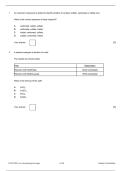
1 An unknown compound is tested to identify whether it contains sulfate, carbonate or halide ions.
What is the correct sequence of tests required?
A carbonate, halide, sulfate
B carbonate, sulfate, halide
C halide, carbonate, sulfate
D sulfate, carbonate, halide
Your answer [1]
2 A student analyses a solution of a salt.
The results are shown below.
Test Observation
Reaction with NaOH(aq) Green precipitate
Reaction with Ba(NO3)2(aq) White precipitate
What is the formula of the salt?
A CuCl2
B CuSO4
C FeCl2
D FeSO4
Your answer [1]
© OCR 2025. You may photocopy this page. 1 of 28 Created in ExamBuilder
, 3 Solid ammonia, NH3, contains hydrogen bonds.
i. Suggest why solid ammonia has a lower melting point than ice.
[2]
ii. When ammonia dissolves in water, ammonium ions, NH4+, are formed.
Draw a ‘dot-and-cross’ diagram to show the bonding in an NH4+ ion.
Show outer electrons only.
[2]
iii. Outline how you would test for the presence of NH4+ ions in a solution.
Your answer should include observations.
[2]
4 Tutton’s salts are ‘double salts’ with the formula X 2 Y(ZO4)2 • 6H2O.
A Tutton’s salt contains two cations: X + and Y 2+.
• X + can be an ion of the Group 1 elements K, Rb, Cs or Fr, or an ammonium ion.
• Y 2+ can be a 2+ ion of magnesium or an ion of most of the transition elements in Period 4.
• Z can be S or Cr.
© OCR 2025. You may photocopy this page. 2 of 28 Created in ExamBuilder
, (NH4)2Cu(SO4)2 • 6H2O is an example of a Tutton’s salt.
The student dissolves their Tutton’s salt in water. A pale blue solution forms.
The student carries out two tests on this aqueous solution.
i. The student adds an excess of aqueous ammonia to their aqueous solution of Tutton’s salt. A deep blue
solution forms.
The complex ion responsible for the deep blue solution has a molar mass of 167.5 g mol–1.
Suggest the formula of this complex ion.
[1]
ii. The student adds NaOH(aq) to the aqueous solution of Tutton’s salt and warms the mixture.
A precipitate and a gas are formed.
Write the formulae of the precipitate and gas and suggest a test that could confirm the identity of the gas.
Formula of precipitate
Formula of gas
Test to confirm the identity of the gas
[3]
iii. How could the student carry out a test-tube test to confirm the anion in the Tutton’s salt?
[2]
© OCR 2025. You may photocopy this page. 3 of 28 Created in ExamBuilder


