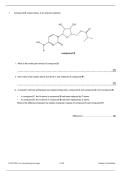
1 Compound B, shown below, is an antiviral medicine
i. What is the molecular formula of compound B
[1]
ii. How many chiral carbon atoms are there in one molecule of compound B?
[1]
iii. A research chemist synthesises two related compounds, compound C and compound D, from compound B.
• In compound C, the N atoms in compound B had been replaced by P atoms.
• In compound D, the O atoms in compound B had been replaced by S atoms.
What is the difference between the relative molecular masses of compound C and compound D?
difference = ................................................... [2]
© OCR 2025. You may photocopy this page. 1 of 68 Created in ExamBuilder
, 2 α-Amino acids have the general formula RCH(NH2)COOH.
The R group in an α-amino acid contains C and H only.
This R group has a molar mass of 91 g mol–1.
A polymer is formed from 500 molecules of this α-amino acid.
Determine the molar mass of this polymer.
Give your answer to the nearest whole number.
molar mass of polymer = .............................................. g mol–1 [3]
3 1.35 g of ethylamine gas, CH3CH2NH2 (Mr = 45.0), is reacted with 20 cm3 of 2.0 mol dm–3 hydrochloric acid
forming a solution of ethylammonium chloride.
CH3CH2NH2(g) + HCl(aq) → CH3CH2NH3+(aq) + Cl–(aq)
What is the concentration of ethylammonium chloride in mol dm–3?
A 0.03
B 0.67
C 1.50
D 2.00
Your answer [1]
© OCR 2025. You may photocopy this page. 2 of 68 Created in ExamBuilder
, 4 This question is about iron.
A sample of iron is isolated from a meteorite and analysed by mass spectrometry.
The mass spectrum shows peaks with the relative abundances below.
54 56 57 58
Isotope Fe Fe Fe Fe
Relative abundance 78.54% 8.88% 5.10% 7.48%
Calculate the relative atomic mass of the iron in the sample.
Give your answer to 2 decimal places.
relative atomic mass = ......................................................... [2]
5 Which row shows the atomic structure of 25Mg2+?
Protons Neutrons Electrons
A 10 12 13
B 10 15 12
C 12 13 10
D 12 13 14
Your answer [1]
© OCR 2025. You may photocopy this page. 3 of 68 Created in ExamBuilder
, 6 This question is about periodicity and the reaction of some Group 2 metals.
Periodicity is the repeating trend in properties of elements across different periods in the periodic table.
i. Complete the table below with the electron configurations and blocks.
Group 2 Group 17 (7)
Period 2 Be F
1s2 ........................................................ 1s2 ........................................................
Period 3 Mg Cl
1s2 ........................................................ 1s2 ........................................................
Block ............................. .............................
[3]
ii. Use your answers to (i) to explain why electron configuration is an example of a periodic trend.
[2]
iii. Mg forms 2+ ions but Cl usually forms 1– ions in their reactions. Explain why.
[2]
iv. Magnesium reacts with oxygen in the air.
Write the equation for this reaction.
[1]
© OCR 2025. You may photocopy this page. 4 of 68 Created in ExamBuilder
, 7 A mixture of concentrated nitric and hydrochloric acid is called ‘aqua regia’. Aqua regia can dissolve gold.
The reaction of aqua regia with gold is a redox reaction which forms chlorauric acid, HAuCl4.
i. Balance the half-equation for the oxidation process in this reaction.
Au + ........HCl → ........H+ + AuCl4 – + ........e–
[1]
ii. In the reduction process in this reaction, HNO3 and H+ react together to form 2 oxides:
X (Mr = 30) and Z (Mr = 18).
Determine the formulae of X and Z and write the half-equation for this reduction.
X = ......................
Z = ......................
half-equation
[3]
8 This question is about alkenes.
A mixture of alkenes is produced when water is eliminated from alcohol A.
i. What is the systematic name of alcohol A?
[1]
© OCR 2025. You may photocopy this page. 5 of 68 Created in ExamBuilder
, ii. Alcohol A is refluxed with an acid catalyst.
• A mixture of alkene isomers B, C and D is formed.
• Alkenes B and C show E/Z isomerism but alkene D does not.
Construct the equation for the formation of alkene D from alcohol A.
Show the structure of the organic product.
[2]
iii. The skeletal formulae of alkenes B and C are shown below.
Alkene B Alkene C
Skeletal formula
Isomer Z E
Use the Cahn-Ingold-Prelog priority rules to explain why alkene B is the Z isomer.
[2]
9 This question is about titanium (atomic number 22) and its compounds.
Titanium exists as a mixture of five isotopes.
A chemist analyses a sample of titanium using mass spectrometry.
The results are shown in the table below.
Isotope Abundance (%)
© OCR 2025. You may photocopy this page. 6 of 68 Created in ExamBuilder
, 46
Ti 8.30
47
Ti 7.40
48
Ti 73.70
49
Ti 5.40
50
Ti 5.20
i. Calculate the relative atomic mass of titanium in the sample.
Give your answer to 2 decimal places.
relative atomic mass = ......................................................... [2]
ii. Complete the electron configuration of a titanium atom.
1s2 [1]
iii. Complete the table to show the number of protons, neutrons and electrons in a 48Ti2+ ion.
Protons Neutrons Electrons
48
Ti2+ ion
[1]
© OCR 2025. You may photocopy this page. 7 of 68 Created in ExamBuilder
, 10(a) This question is about atomic structure and formulae.
The relative atomic mass of a sample of osmium can be determined from its mass spectrum, shown below.
Calculate the relative atomic mass of osmium in the sample.
Give your answer to two decimal places.
relative atomic mass = ......................................................... [2]
(b) Complete the table for an atom and an ion of two different elements.
Element Mass number Protons Neutrons Electron configuration Charge
................... ................... 28 34 ............................................ 0
................... 33 ................... ................... 1s22s22p63s23p6 3-
[2]
© OCR 2025. You may photocopy this page. 8 of 68 Created in ExamBuilder
, 11 Brass is an alloy of copper and zinc.
The mass spectrum of a sample of brass is shown below.
The peaks at m/z = 63 and m/z = 65 are from the 63Cu and 65Cu isotopes of copper.
The remaining four peaks are from isotopes of zinc.
i. What are the percentage compositions of copper and zinc in the brass sample?
Cu = ............. % Zn = ............. % [1]
ii. Calculate the relative atomic mass of zinc in the sample of brass.
Give your answer to 2 decimal places.
relative atomic mass = .......................................................... [2]
© OCR 2025. You may photocopy this page. 9 of 68 Created in ExamBuilder
, 12(a) This question is about atomic structure.
Selenium, Se, has the atomic number 34.
76
Se and 82Se are two isotopes of selenium.
Complete the table to show the numbers of protons, neutrons and electrons in these two isotopes.
Protons Neutrons Electrons
76
Se ................ ................ ................
82
Se ................ ................ ................
[1]
(b) The relative atomic mass of an element can be determined from its mass spectrum.
The table shows the results of a mass spectrum of a sample of sulfur, S.
Isotope Abundance (%)
32
S 94.93
33
S 0.78
34
S 4.29
Calculate the relative atomic mass of the sample of sulfur.
Give your answer to 3 decimal places.
relative atomic mass = ......................................................... [2]
© OCR 2025. You may photocopy this page. 10 of 68 Created in ExamBuilder
i. What is the molecular formula of compound B
[1]
ii. How many chiral carbon atoms are there in one molecule of compound B?
[1]
iii. A research chemist synthesises two related compounds, compound C and compound D, from compound B.
• In compound C, the N atoms in compound B had been replaced by P atoms.
• In compound D, the O atoms in compound B had been replaced by S atoms.
What is the difference between the relative molecular masses of compound C and compound D?
difference = ................................................... [2]
© OCR 2025. You may photocopy this page. 1 of 68 Created in ExamBuilder
, 2 α-Amino acids have the general formula RCH(NH2)COOH.
The R group in an α-amino acid contains C and H only.
This R group has a molar mass of 91 g mol–1.
A polymer is formed from 500 molecules of this α-amino acid.
Determine the molar mass of this polymer.
Give your answer to the nearest whole number.
molar mass of polymer = .............................................. g mol–1 [3]
3 1.35 g of ethylamine gas, CH3CH2NH2 (Mr = 45.0), is reacted with 20 cm3 of 2.0 mol dm–3 hydrochloric acid
forming a solution of ethylammonium chloride.
CH3CH2NH2(g) + HCl(aq) → CH3CH2NH3+(aq) + Cl–(aq)
What is the concentration of ethylammonium chloride in mol dm–3?
A 0.03
B 0.67
C 1.50
D 2.00
Your answer [1]
© OCR 2025. You may photocopy this page. 2 of 68 Created in ExamBuilder
, 4 This question is about iron.
A sample of iron is isolated from a meteorite and analysed by mass spectrometry.
The mass spectrum shows peaks with the relative abundances below.
54 56 57 58
Isotope Fe Fe Fe Fe
Relative abundance 78.54% 8.88% 5.10% 7.48%
Calculate the relative atomic mass of the iron in the sample.
Give your answer to 2 decimal places.
relative atomic mass = ......................................................... [2]
5 Which row shows the atomic structure of 25Mg2+?
Protons Neutrons Electrons
A 10 12 13
B 10 15 12
C 12 13 10
D 12 13 14
Your answer [1]
© OCR 2025. You may photocopy this page. 3 of 68 Created in ExamBuilder
, 6 This question is about periodicity and the reaction of some Group 2 metals.
Periodicity is the repeating trend in properties of elements across different periods in the periodic table.
i. Complete the table below with the electron configurations and blocks.
Group 2 Group 17 (7)
Period 2 Be F
1s2 ........................................................ 1s2 ........................................................
Period 3 Mg Cl
1s2 ........................................................ 1s2 ........................................................
Block ............................. .............................
[3]
ii. Use your answers to (i) to explain why electron configuration is an example of a periodic trend.
[2]
iii. Mg forms 2+ ions but Cl usually forms 1– ions in their reactions. Explain why.
[2]
iv. Magnesium reacts with oxygen in the air.
Write the equation for this reaction.
[1]
© OCR 2025. You may photocopy this page. 4 of 68 Created in ExamBuilder
, 7 A mixture of concentrated nitric and hydrochloric acid is called ‘aqua regia’. Aqua regia can dissolve gold.
The reaction of aqua regia with gold is a redox reaction which forms chlorauric acid, HAuCl4.
i. Balance the half-equation for the oxidation process in this reaction.
Au + ........HCl → ........H+ + AuCl4 – + ........e–
[1]
ii. In the reduction process in this reaction, HNO3 and H+ react together to form 2 oxides:
X (Mr = 30) and Z (Mr = 18).
Determine the formulae of X and Z and write the half-equation for this reduction.
X = ......................
Z = ......................
half-equation
[3]
8 This question is about alkenes.
A mixture of alkenes is produced when water is eliminated from alcohol A.
i. What is the systematic name of alcohol A?
[1]
© OCR 2025. You may photocopy this page. 5 of 68 Created in ExamBuilder
, ii. Alcohol A is refluxed with an acid catalyst.
• A mixture of alkene isomers B, C and D is formed.
• Alkenes B and C show E/Z isomerism but alkene D does not.
Construct the equation for the formation of alkene D from alcohol A.
Show the structure of the organic product.
[2]
iii. The skeletal formulae of alkenes B and C are shown below.
Alkene B Alkene C
Skeletal formula
Isomer Z E
Use the Cahn-Ingold-Prelog priority rules to explain why alkene B is the Z isomer.
[2]
9 This question is about titanium (atomic number 22) and its compounds.
Titanium exists as a mixture of five isotopes.
A chemist analyses a sample of titanium using mass spectrometry.
The results are shown in the table below.
Isotope Abundance (%)
© OCR 2025. You may photocopy this page. 6 of 68 Created in ExamBuilder
, 46
Ti 8.30
47
Ti 7.40
48
Ti 73.70
49
Ti 5.40
50
Ti 5.20
i. Calculate the relative atomic mass of titanium in the sample.
Give your answer to 2 decimal places.
relative atomic mass = ......................................................... [2]
ii. Complete the electron configuration of a titanium atom.
1s2 [1]
iii. Complete the table to show the number of protons, neutrons and electrons in a 48Ti2+ ion.
Protons Neutrons Electrons
48
Ti2+ ion
[1]
© OCR 2025. You may photocopy this page. 7 of 68 Created in ExamBuilder
, 10(a) This question is about atomic structure and formulae.
The relative atomic mass of a sample of osmium can be determined from its mass spectrum, shown below.
Calculate the relative atomic mass of osmium in the sample.
Give your answer to two decimal places.
relative atomic mass = ......................................................... [2]
(b) Complete the table for an atom and an ion of two different elements.
Element Mass number Protons Neutrons Electron configuration Charge
................... ................... 28 34 ............................................ 0
................... 33 ................... ................... 1s22s22p63s23p6 3-
[2]
© OCR 2025. You may photocopy this page. 8 of 68 Created in ExamBuilder
, 11 Brass is an alloy of copper and zinc.
The mass spectrum of a sample of brass is shown below.
The peaks at m/z = 63 and m/z = 65 are from the 63Cu and 65Cu isotopes of copper.
The remaining four peaks are from isotopes of zinc.
i. What are the percentage compositions of copper and zinc in the brass sample?
Cu = ............. % Zn = ............. % [1]
ii. Calculate the relative atomic mass of zinc in the sample of brass.
Give your answer to 2 decimal places.
relative atomic mass = .......................................................... [2]
© OCR 2025. You may photocopy this page. 9 of 68 Created in ExamBuilder
, 12(a) This question is about atomic structure.
Selenium, Se, has the atomic number 34.
76
Se and 82Se are two isotopes of selenium.
Complete the table to show the numbers of protons, neutrons and electrons in these two isotopes.
Protons Neutrons Electrons
76
Se ................ ................ ................
82
Se ................ ................ ................
[1]
(b) The relative atomic mass of an element can be determined from its mass spectrum.
The table shows the results of a mass spectrum of a sample of sulfur, S.
Isotope Abundance (%)
32
S 94.93
33
S 0.78
34
S 4.29
Calculate the relative atomic mass of the sample of sulfur.
Give your answer to 3 decimal places.
relative atomic mass = ......................................................... [2]
© OCR 2025. You may photocopy this page. 10 of 68 Created in ExamBuilder