Genetic Technology
Genetic Engineering
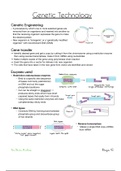
• A procedure by which one or more selected genes are
removed from an organisms and inserted into another so
that the receiving organism expresses the gene to make
the desired protein
• New organism is ‘transgenic’ or a ‘genetically modified
organism’ with recombinant DNA (rDNA)
Gene transfer
⇾ Identify desired gene and get a copy by cutting it from the chromosome using a restriction enzyme
then using reverse transcriptase, make it from mRNA using nucleotides
⇾ Make multiple copies of the gene using polymerase chain reaction
⇾ Insert the gene into a vector for delivery into new organism
⇾ The cells that have taken in the new gene from vector are identified and cloned
Enzymes used
⚬ Restriction endonuclease enzymes
- Bind to a specific site (sequence
of bases commonly palindromic)
on DNA and cut the sugar
phosphate backbone
- Cut can be straight or staggered →
produces sticky ends which have short
unpaired bases that easily form H bonds
- Using the same restriction enzymes will make
complementary sticky ends
⚬ DNA ligase
- Connects DNA by forming bond between
phosphate group and deoxyribose group
of two strands
⚬ Reverse transcriptase
- Makes a single DNA copy (cDNA)
from mRNA
SxTeri Notes Page 43
, Getting Desired Gene
1. Use restriction enzyme to cut DNA into many segments
• Run the many DNA fragments using gel electrophoresis
• Use a gene probe to identify the correct segment and make multiple copies of it using PCR
2. Synthesise DNA artificially
• Choose the codons for the amino acid sequence requires
• Use a computer to direct the synthesis of short DMA fragments then join them together
3. Use reverse transcriptase to make cDNA from mRNA
• Then make a double stranded DNA molecule using DNA
polymerase and free nucleotides
Vectors
Plasmid: small circular pieces of double stranded DNA found in bacteria
→ exchanged by ‘conjugation’
Retrovirus: used to deliver DNA in gene therapy
Why plasmids are useful vectors:
• Occur naturally in bacteria
• Contain antibiotic resistant genes used as marker genes to identify cells (recombinants)
• Small with lower molecular mass for better uptake by bacteria
• Self-replicate so can make many copies
• Many target sites for different restriction enzymes → many genes can be inserted
• Have promoters so gene can be expressed
• Circular so more stable/do not interfere with host DNA
• Can be modified to be improved
Marker Genes
↬ Code for an identifiable substance marker to identify cells that have been genetically modified
⟹ Antibiotic resistance gene
⟹ GFP (green fluorescent protein from jellyfish): look for bacteria which fluoresce under UV light
⟹ GUS (Enzyme B-glucuronidase): cells create enzyme that converts a colourless substance into a
blue fluorescent one
Old Method
1. Insert gene into the middle of an antibiotic
gene on the plasmid ex. tetracycline
resistance
2. The transgenic bacteria will lose resistance
since the resistance gene has been
disrupted
3. Bacteria is grown on agar then transferred to
antibiotic agar. The transgenic baster will not
survive so can be identified
Concern of using antibiotic resistance as gene marker → plasmids are transferred to other
bacteria by conjugation so antibiotic resistance can be passed onto pathogenic bacteria
SxTeri Notes Page 44
Genetic Engineering
• A procedure by which one or more selected genes are
removed from an organisms and inserted into another so
that the receiving organism expresses the gene to make
the desired protein
• New organism is ‘transgenic’ or a ‘genetically modified
organism’ with recombinant DNA (rDNA)
Gene transfer
⇾ Identify desired gene and get a copy by cutting it from the chromosome using a restriction enzyme
then using reverse transcriptase, make it from mRNA using nucleotides
⇾ Make multiple copies of the gene using polymerase chain reaction
⇾ Insert the gene into a vector for delivery into new organism
⇾ The cells that have taken in the new gene from vector are identified and cloned
Enzymes used
⚬ Restriction endonuclease enzymes
- Bind to a specific site (sequence
of bases commonly palindromic)
on DNA and cut the sugar
phosphate backbone
- Cut can be straight or staggered →
produces sticky ends which have short
unpaired bases that easily form H bonds
- Using the same restriction enzymes will make
complementary sticky ends
⚬ DNA ligase
- Connects DNA by forming bond between
phosphate group and deoxyribose group
of two strands
⚬ Reverse transcriptase
- Makes a single DNA copy (cDNA)
from mRNA
SxTeri Notes Page 43
, Getting Desired Gene
1. Use restriction enzyme to cut DNA into many segments
• Run the many DNA fragments using gel electrophoresis
• Use a gene probe to identify the correct segment and make multiple copies of it using PCR
2. Synthesise DNA artificially
• Choose the codons for the amino acid sequence requires
• Use a computer to direct the synthesis of short DMA fragments then join them together
3. Use reverse transcriptase to make cDNA from mRNA
• Then make a double stranded DNA molecule using DNA
polymerase and free nucleotides
Vectors
Plasmid: small circular pieces of double stranded DNA found in bacteria
→ exchanged by ‘conjugation’
Retrovirus: used to deliver DNA in gene therapy
Why plasmids are useful vectors:
• Occur naturally in bacteria
• Contain antibiotic resistant genes used as marker genes to identify cells (recombinants)
• Small with lower molecular mass for better uptake by bacteria
• Self-replicate so can make many copies
• Many target sites for different restriction enzymes → many genes can be inserted
• Have promoters so gene can be expressed
• Circular so more stable/do not interfere with host DNA
• Can be modified to be improved
Marker Genes
↬ Code for an identifiable substance marker to identify cells that have been genetically modified
⟹ Antibiotic resistance gene
⟹ GFP (green fluorescent protein from jellyfish): look for bacteria which fluoresce under UV light
⟹ GUS (Enzyme B-glucuronidase): cells create enzyme that converts a colourless substance into a
blue fluorescent one
Old Method
1. Insert gene into the middle of an antibiotic
gene on the plasmid ex. tetracycline
resistance
2. The transgenic bacteria will lose resistance
since the resistance gene has been
disrupted
3. Bacteria is grown on agar then transferred to
antibiotic agar. The transgenic baster will not
survive so can be identified
Concern of using antibiotic resistance as gene marker → plasmids are transferred to other
bacteria by conjugation so antibiotic resistance can be passed onto pathogenic bacteria
SxTeri Notes Page 44