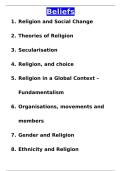
Beliefs
1. Religion and Social Change
2. Theories of Religion
3. Secularisation
4. Religion, and choice
5. Religion in a Global Context –
Fundamentalism
6. Organisations, movements and
members
7. Gender and Religion
8. Ethnicity and Religion
, 9. Ideology and Science
Religion and Social Change
Key Words:
Calvinism – A form of Protestantism which believes in
predestination and living an ascetic life.
Modern capitalism – The rational pursuit of profit for its own
sake. Not for the gains of luxury consumption. Or Spirit of
Capitalism.
Predestination – The belief that God has already decided who
is saved (going to heaven).
Salvation panic – The worry and loneliness the Calvinists felt
because they could not know whether they were saved, or do
anything about it. Aided by their prosperity/success but their
fate is not changed.
This Worldly Asceticism – Refraining from luxuries, living a
simple life of discipline and self-denial.
Other-worldly asceticism – Renouncing everyday life – e.g.
joining a convent or monastery.
This-worldly asceticism – Glorifying God through work –
having an occupation and working very hard.
The Black civil rights movement – Trying to end racial
segregation in the southern states of the US in the 1950s and
1960s.
Religion as an ideological resource – Beliefs and practices
which backed up the message of the civil rights protesters.
Protestant fundamentalist morality – Strong traditional
right-wing Christian views on abortion, sex, homosexuality,
gender roles and creationism: a desire to impose these views on
US society, and get laws passed in favour of them.
,New Christian Right – A fundamentalist movement, such as
the Westboro Baptist Church, which failed to cause significant
social change.
Liberal and democratic ideas – Key values in US society,
supporting the separation of religion and the state.
Relative autonomy – Having partial independence – e.g.
religion not being controlled by the state/ruling class.
Liberation Theology – A Catholic movement in Latin America
with a strong commitment to the poor and anti-military
dictatorships. Combines Christianity with some Marxist ideas.
Caused democracy in Latin America.
Pentecostalism – A more recent Christian movement often
associated with black Christians. Natural social change and
people getting themselves out of poverty through their hard
work/efforts, compared to liberation theology, which is a
collective political movement.
Millenarian movements – Movements that hope for
supernatural intervention to create a heaven on earth – often
popular with the poor.
Organic intellectuals and religion – Religion can help the
workers see through their false class consciousness by giving a
vision of a better society. Priests can help people see what a
better society would look like/utopia, allowing them to rebel and
cause social change.
Key People:
Weber – Calvinism and hard work caused social change/natural
capitalism to be created.
Bruce – Religion is an ideological resource that can promote
social change through beliefs and practices – the American
Civil Rights Movement and Martin Luther King.
, The New Christian Right is an example of religion failing to
cause social change.
Bloch – The principle of hope – People having ideas of a
utopia/perfect world, causing them to question current society
and cause social change.
Gramsci believes that the ruling class use ideas of religion,
‘Hegemony’, a way of maintaining control in society and
causing ideological domination.
Weber: Religion as a force for social change –
Change Caused
Weber argues that the religious beliefs of Calvinism help bring
about large social change. This is shown through the growth
of Pentecostalism in Latin America
- He believed that previous capitalism was greed for wealth,
which was spent inconsiderately and irrationally on luxury
consumption.
However, modern capitalism, which was brought out
partly by Calvinism, is the rational pursuit of profit for the
sake of doing it, not for consumption. This is called the
spirit of capitalism. The social change from Calvinism
was unintentional.
Calvinists believed in…
Predestination – God had predetermined which people
would be saved and go to heaven. So, no one had control
over their fate, they could not do anything to aid
themselves in being saved.
This Worldly Asceticism – Self-discipline, working hard
and being strict on themselves. This resulted in this-
worldly benefits, often through prosperity. This is
because Calvinists would continue to reinvest in their
businesses and not consume for their benefit, but for the
1. Religion and Social Change
2. Theories of Religion
3. Secularisation
4. Religion, and choice
5. Religion in a Global Context –
Fundamentalism
6. Organisations, movements and
members
7. Gender and Religion
8. Ethnicity and Religion
, 9. Ideology and Science
Religion and Social Change
Key Words:
Calvinism – A form of Protestantism which believes in
predestination and living an ascetic life.
Modern capitalism – The rational pursuit of profit for its own
sake. Not for the gains of luxury consumption. Or Spirit of
Capitalism.
Predestination – The belief that God has already decided who
is saved (going to heaven).
Salvation panic – The worry and loneliness the Calvinists felt
because they could not know whether they were saved, or do
anything about it. Aided by their prosperity/success but their
fate is not changed.
This Worldly Asceticism – Refraining from luxuries, living a
simple life of discipline and self-denial.
Other-worldly asceticism – Renouncing everyday life – e.g.
joining a convent or monastery.
This-worldly asceticism – Glorifying God through work –
having an occupation and working very hard.
The Black civil rights movement – Trying to end racial
segregation in the southern states of the US in the 1950s and
1960s.
Religion as an ideological resource – Beliefs and practices
which backed up the message of the civil rights protesters.
Protestant fundamentalist morality – Strong traditional
right-wing Christian views on abortion, sex, homosexuality,
gender roles and creationism: a desire to impose these views on
US society, and get laws passed in favour of them.
,New Christian Right – A fundamentalist movement, such as
the Westboro Baptist Church, which failed to cause significant
social change.
Liberal and democratic ideas – Key values in US society,
supporting the separation of religion and the state.
Relative autonomy – Having partial independence – e.g.
religion not being controlled by the state/ruling class.
Liberation Theology – A Catholic movement in Latin America
with a strong commitment to the poor and anti-military
dictatorships. Combines Christianity with some Marxist ideas.
Caused democracy in Latin America.
Pentecostalism – A more recent Christian movement often
associated with black Christians. Natural social change and
people getting themselves out of poverty through their hard
work/efforts, compared to liberation theology, which is a
collective political movement.
Millenarian movements – Movements that hope for
supernatural intervention to create a heaven on earth – often
popular with the poor.
Organic intellectuals and religion – Religion can help the
workers see through their false class consciousness by giving a
vision of a better society. Priests can help people see what a
better society would look like/utopia, allowing them to rebel and
cause social change.
Key People:
Weber – Calvinism and hard work caused social change/natural
capitalism to be created.
Bruce – Religion is an ideological resource that can promote
social change through beliefs and practices – the American
Civil Rights Movement and Martin Luther King.
, The New Christian Right is an example of religion failing to
cause social change.
Bloch – The principle of hope – People having ideas of a
utopia/perfect world, causing them to question current society
and cause social change.
Gramsci believes that the ruling class use ideas of religion,
‘Hegemony’, a way of maintaining control in society and
causing ideological domination.
Weber: Religion as a force for social change –
Change Caused
Weber argues that the religious beliefs of Calvinism help bring
about large social change. This is shown through the growth
of Pentecostalism in Latin America
- He believed that previous capitalism was greed for wealth,
which was spent inconsiderately and irrationally on luxury
consumption.
However, modern capitalism, which was brought out
partly by Calvinism, is the rational pursuit of profit for the
sake of doing it, not for consumption. This is called the
spirit of capitalism. The social change from Calvinism
was unintentional.
Calvinists believed in…
Predestination – God had predetermined which people
would be saved and go to heaven. So, no one had control
over their fate, they could not do anything to aid
themselves in being saved.
This Worldly Asceticism – Self-discipline, working hard
and being strict on themselves. This resulted in this-
worldly benefits, often through prosperity. This is
because Calvinists would continue to reinvest in their
businesses and not consume for their benefit, but for the