

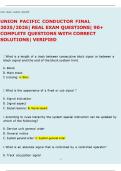
UNION PACIFIC CONDUCTOR FINAL 2025/2026 REAL EXAM QUESTIONS 90+ COMPLETE QUESTIONS WITH CORRECT SOLUTIONS VERIFIED
1. What is a length of a track between consecutive block signal or between a block signal and the end of the block system limit. A. Block B. Main track C crossing: A. Block 2. What is the appearance of a fixed or cab signal ? A. Signal indication B. Signal aspect C. Signal reasons: B. Signal aspect 3. According to rules hierarchy the system special instruction can be updated by which of the following? A. Service unit general order B. General notice C. System general order: C. System general order 4. What is an absolute signal that is controlled by a controlled operator? A. Track occupation signal B. Stop and proceed signal C. Controlled signal: C. Controlled signal 5. Your duties require you to cross through a train or a standing cut of cars. After proper protection is provided and before crossing over from one side of the equipment to the other side, you should? A. Choose equipment carefully, using cars equipped with a crossover platform and handholds (when available). B. On equipment where crossover platforms and handholds are not available, use end of car structural bracing to maintain 3-point contact, il sate to do so. C. Both answers are correct.: C. Both answers are correct 6. What is a system of tracks, other than main tracks and sidings, that is used for making up trains, storng cars, and other purposes? A. Siding B. Main track C. Yard: C. Yard 7. To enter an area between two adjacent tracks is the glossary definition of ? A. Breach B. Crossing Through C. Red Zone: A. Breach 8. Employees must not get on or off cars and engines (whether standing or moving) except when required in the performance of duty, and only when it can be done safely. When getting off standing equipment: A. Let go with both hands before your feet touch the ground or other support. B. Retain a grip with both hands on the handhold until both feet are firmly placed on the ground or other support. C. Place one foot on the ground, then let go with one hand and place the other foot on the ground before letting go.: B.Retain a grip with both hands on the handhold until both feet are firmly placed on the ground or other support. 9. Employees must be careful to prevent injuring themselves or others. They must be when performing their dutics and plan their work to avoid injury. A. Alert and Attentive B. Responsive and Activel C. Organized and Permissive: A. Alert and attentive 10. When an engine, train or cars are left unattended, what must you do to secure them?. A. Apply air brakes to hold the train in place. B. Make a full-service reduction and place the train in emergency. C. Apply a suflicient number of hand brakes to prevent movement.: C. Apply a suflicient number of hand brakes to prevent movement. 11. How may rules be issued, canceled or modified? A. General Notices B. Track Bulletins, Gencral Orders, or Special Instructions C. Issuing new GCOR, Air Brake, or Safety rules is the only way to change or modity the rules.: B. Track Bulletins, Gencral Orders, or Special Instructions 12. Your engineer notices there is a revision to the timetable. Where will this information be contained?. A. Work Order Reporting B. Locomotive Consist Report C. Subdivision General Order: C. Subdivision General Order 13. Where can the "Explanation of Characters" table be found? A. System Special Instructions. Item 1 B. Inside front cover of the timetable and the back cover of the SSI C. Timetable subdivision page, Section SI-23, as defined by CFR242: B. Inside front cover of the timetable and the back cover of the SSI 14. When you are near a passing train, where should you stand? A. On the adjacent track so you can see defects on passing cars B. Away from the track to avoid being struck by car doors or protruding/falling articles C. With your back to the train to avoid airborne materials getting in your eyes: B. Away from the track to avoid being struck by car doors or protruding/falling articles 15. When must employees expect the movement of trains, engines, cars, or other movable equipment? A. Only in the direction of current of traffic! B. At any time, on any track, and in either direction. C. Only when working within yard limits.: B. At any time, on any track, and in either direction.
Document information
- Uploaded on
- September 25, 2025
- Number of pages
- 26
- Written in
- 2025/2026
- Type
- Exam (elaborations)
- Contains
- Questions & answers


