Androgyny and the BSRI
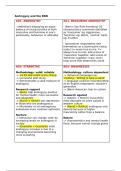
AO1- ANDROGYNY AO1- MEASURING ANDROGYNY
- (definition) displaying an equal - (Bem’s Sex Role Inventory) 20
balance of characteristics of both characteristics commonly identified
masculine and feminine in one’s as ‘masculine’ eg. Aggressive,
personality, behaviour or attitudes ‘feminine’ eg. Warm, ‘neutral’ traits
eg. Truthful
- (procedure) respondents rate
themselves on a seven-point rating
scale (1= never true to me, 7=
always true to me), add scores of
‘masculine’ together, add scores of
‘feminine’ together, masc.-fem=
total score that determines result
AO3- STRENGTHS AO3- WEAKNESSES
Methodology- valid/ reliable Methodology- culture dependent
-> +0.93 test-retest score strong -> (American language) eg.
-> successful pilot study ‘Yielding’, ‘Willing to take a stand’
-> demonstrates a valid measure of -> language could be misinterpreted
androgyny as an English respondent, shouldn’t
generalise
Research support -> (Bem) American, bias to culture
-> (Bem) high androgyny positive
for mental health, more successful Research against
and adaptable -> (Adams + Sherer) masculinity
-> (Burch + Serbin) less depression most desirable as more valued in
in those who are androgynous western culture
-> (Norlander et al) androgynous -> (Nevid + Rathus) androgyny only
individuals more creative/ optimistic desired because of higher
masculinity rather than a balance
Nurture
-> behaviour can change, seen by Nature
increasing levels on androgyny in -> characteristics and mental health
society fixed, because cannot change genes
-> (Guastello + Guastello) male
androgyny increase is due to a
changing environment becoming
more accepting
, Role of chromosomes and hormones in development of gender
AO1- CHROMOSOMES AO1- HORMONES
- 23 pairs, last pair determines sex, =produced prenatally and in puberty
contains instructions on physical and - (testosterone) steroid that
behavioural characteristics stimulates secondary male
- (male) (XY) Y chromosome releases characteristics eg. beard
androgen causing development of -> (effect on brain) masculinised brain,
testes in the womb and testosterone BStc twice as big as females,
release resulting in external genitalia= hypothalamus and areas linked to
penis, internal= testes spatial skills
- (female) (XX) external genitalia= -> (effect on gender) competitiveness,
vagina, internal= ovaries aggression not in humans (Nanne Van
- how sex is genetically acquired, De Polle) female rats injected with
people may feel more ‘masculine’ or testosterone experience increased
‘feminine’ depending on their genitalia physical and sexual aggression
AO1- HORMONE IMBALANCE - (oestrogen) family of steroids that
- (androgen insensitivity imbalance) promotes female characteristics
genetically born male appears -> (effect on brain) feminises brain,
physically female at birth due to not connections more distributed
enough testosterone exposure in the -> (effect on gender) linked to PMT
womb, (Batista Boys) appear female at (anxiety, irrationality, emotionality),
birth, raised as female, hormonal sensitivity, co-operation
changes at puberty turn into males, -(oxytocin) polypeptide hormone and
treated as males NT produced in brain and body,
- (congenital adrenal hyperplasia) combines with oestrogen to enhance
genetic female exposed to too much each other's effects
testosterone in the womb, genitalia -> (effect on gender) social behaviour,
appear swollen, may act more mate choice, monogamy, nurturing,
masculine acceptance, protection of offspring
- changing levels of hormones doesn’t
necessarily change gender behaviour
AO3- STRENGTHS AO3- WEAKNESSES
Chromosomes David Reimer
-> (David Reimer) all masculine ‘parts’ -> abnormal case, multiple surgeries,
removed except XY chromosomes, still shouldn’t generalise
wanted to be male -> can’t separate nature/nurture, had
Testosterone a twin so could’ve been a drive to be
-> (Young) female monkeys exposed to male (nurture)
testosterone in the womb became more Testosterone
aggressive -> (Tricker et al) double blind
Oestrogen experiment, 43 men given either extra
-> (Fitch + Denenberg) taking out rats' testosterone or placebo, found no
ovaries increase corpus collosum in difference
brain as an adult, oestrogen treatment Animal studies
reduces the effect -> (Young) (Fitch + Denenberg) (Van
AO1- ANDROGYNY AO1- MEASURING ANDROGYNY
- (definition) displaying an equal - (Bem’s Sex Role Inventory) 20
balance of characteristics of both characteristics commonly identified
masculine and feminine in one’s as ‘masculine’ eg. Aggressive,
personality, behaviour or attitudes ‘feminine’ eg. Warm, ‘neutral’ traits
eg. Truthful
- (procedure) respondents rate
themselves on a seven-point rating
scale (1= never true to me, 7=
always true to me), add scores of
‘masculine’ together, add scores of
‘feminine’ together, masc.-fem=
total score that determines result
AO3- STRENGTHS AO3- WEAKNESSES
Methodology- valid/ reliable Methodology- culture dependent
-> +0.93 test-retest score strong -> (American language) eg.
-> successful pilot study ‘Yielding’, ‘Willing to take a stand’
-> demonstrates a valid measure of -> language could be misinterpreted
androgyny as an English respondent, shouldn’t
generalise
Research support -> (Bem) American, bias to culture
-> (Bem) high androgyny positive
for mental health, more successful Research against
and adaptable -> (Adams + Sherer) masculinity
-> (Burch + Serbin) less depression most desirable as more valued in
in those who are androgynous western culture
-> (Norlander et al) androgynous -> (Nevid + Rathus) androgyny only
individuals more creative/ optimistic desired because of higher
masculinity rather than a balance
Nurture
-> behaviour can change, seen by Nature
increasing levels on androgyny in -> characteristics and mental health
society fixed, because cannot change genes
-> (Guastello + Guastello) male
androgyny increase is due to a
changing environment becoming
more accepting
, Role of chromosomes and hormones in development of gender
AO1- CHROMOSOMES AO1- HORMONES
- 23 pairs, last pair determines sex, =produced prenatally and in puberty
contains instructions on physical and - (testosterone) steroid that
behavioural characteristics stimulates secondary male
- (male) (XY) Y chromosome releases characteristics eg. beard
androgen causing development of -> (effect on brain) masculinised brain,
testes in the womb and testosterone BStc twice as big as females,
release resulting in external genitalia= hypothalamus and areas linked to
penis, internal= testes spatial skills
- (female) (XX) external genitalia= -> (effect on gender) competitiveness,
vagina, internal= ovaries aggression not in humans (Nanne Van
- how sex is genetically acquired, De Polle) female rats injected with
people may feel more ‘masculine’ or testosterone experience increased
‘feminine’ depending on their genitalia physical and sexual aggression
AO1- HORMONE IMBALANCE - (oestrogen) family of steroids that
- (androgen insensitivity imbalance) promotes female characteristics
genetically born male appears -> (effect on brain) feminises brain,
physically female at birth due to not connections more distributed
enough testosterone exposure in the -> (effect on gender) linked to PMT
womb, (Batista Boys) appear female at (anxiety, irrationality, emotionality),
birth, raised as female, hormonal sensitivity, co-operation
changes at puberty turn into males, -(oxytocin) polypeptide hormone and
treated as males NT produced in brain and body,
- (congenital adrenal hyperplasia) combines with oestrogen to enhance
genetic female exposed to too much each other's effects
testosterone in the womb, genitalia -> (effect on gender) social behaviour,
appear swollen, may act more mate choice, monogamy, nurturing,
masculine acceptance, protection of offspring
- changing levels of hormones doesn’t
necessarily change gender behaviour
AO3- STRENGTHS AO3- WEAKNESSES
Chromosomes David Reimer
-> (David Reimer) all masculine ‘parts’ -> abnormal case, multiple surgeries,
removed except XY chromosomes, still shouldn’t generalise
wanted to be male -> can’t separate nature/nurture, had
Testosterone a twin so could’ve been a drive to be
-> (Young) female monkeys exposed to male (nurture)
testosterone in the womb became more Testosterone
aggressive -> (Tricker et al) double blind
Oestrogen experiment, 43 men given either extra
-> (Fitch + Denenberg) taking out rats' testosterone or placebo, found no
ovaries increase corpus collosum in difference
brain as an adult, oestrogen treatment Animal studies
reduces the effect -> (Young) (Fitch + Denenberg) (Van