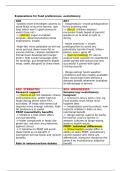
Explanations for food preferences- evolutionary
AO1 AO1
-(sweet) more immediate calories so - (neophobia)= innate predisposition
more likely to survive famine, ripe to try anything new
food which won’t upset stomach/ -> (Birch) children explore/
vomit (lose cal.) encounter foods based of parents’
-> (Steiner) sugar on babies’ guidance as to what is right or
tongues, observed positive facial wrong
expressions, innate
- (taste aversion) = innate
-(high-fat) more palatable so will eat predisposition to avoid any
more and put down more fat so potentially harmful foods, bitter=
survive famine, calories needed for poison, sour= gone off
frontal brain development (larger -> (Garcia/ Koelling) CC rats to
brain= high social/ language skills acquire taste aversion to sweetened
for hunting), gut designed to digest water paired with poison but less
meat, teeth designed to chew meat successful if paired with light/
clicking sounds
- (binge eating) harsh-weather
conditions and less readily available
food, would take food without a
delayed benefit whenever available,
an advantage in famine
AO3- STRENGTHS AO3- WEAKNESSES
Research support Genome lag/ evolutionary
-> (Torres et al) link between stress/ hangover
eating behaviour, prefer high fat -> survival is less a worry now, eg.
foods during stress when f/f is Food outlets must follow strict
activated, f/f helps with stress but hygiene laws
requires more energy/ calories, high- -> (neophobia) used to protect, now
fat preference is useful restricts children’s diets so less
PROP insensitivity benefits nutritional benefit
-> linked to a trait which offers -> (binge eating) used to be useful
survival benefits for famine, now no famine in
-> bitter compounds in foods like western cultures so binge eating
green tea, red wine are protective leads to health issues
against cancer PROP- individual differences
-> if sensitive to PROP will avoid -> (Drewnowski) people differ in
these foods so no benefit, if ability to taste PROP, evolutionary
insensitive will eat foods and receive cannot explain why there are
benefits differences, everyone should be the
same if an evolutionary/ adaptive
Role in nature/nurture debate benefit
, -> nature= pass down genetics and Reductionistic
traits which allow survival eg. Taste -> ignores other factors eg. Culture
aversion -> (Cashdan) culture plays a major
-> nurture= food preference is role in food preference eg. Jewish
dependent on what is in the Kosher household reject foods like
environment eg. If animals in prawn cocktail
environment= umami, fruits/
berries= sweet preference
Explanations for food preferences- the role of learning
AO1 AO1- SLT
-(OC) reinforced by eg. Parents for -> (Birch) peers, groups= carrots/
food preferences eg. Eating peas (food preference), sat with
chocolate, you receive a hug or eg. opposite preference and formed
More accepted preference for opposite food
-> culture, more availability of fast-
-(CC) learning food preferences food means will eat more high-fat
through association eg. Associating foods (Islam) prohibits pork, alcohol,
yoghurt/ coffee/ tea with pleasure beef but accept milk products, (Idiot
after pairing it with sweetness abroad) finds foods in different
(innate pleasure) or eg. Raised with cultures inappropriate
foods associate with seasons/ days -> (Stoneman + Brody) media,
children select food advertised by
-(SLT) observe/ imitate role models people of similar race
-> (Shutts) modelling/ imitation, -> (Brown + Ogden) family,
without modelling children don’t try consistent correlations between
new foods parent and children’s snack food
intake, eating motivations, body
dissatisfaction
AO3- STRENGTHS AO3- WEAKNESSES
Research support- SLT Contradictory evidence
-> (Bryant + Dundes) Spanish/ USA -> (Baeyens) sweet taste and
students asked about attitudes to food previously untried foods, control
convenience, nutritional value= valued
group uses neutral flavour
by Spanish, convenience= valued by
USA, 50% Spanish negative to
(tasteless), no differences in
establishments eg. McDonalds but only preferences, shows how CC
20% USA explanation only explains aversive
-> (Jansen + Tenney) children take learning
either energy dense/ energy dilute
yoghurt drink, most preferred= energy Follow-up study- Hare- Bruun
dense when teacher is tasting at the -> 6yrs later, weaker link between
same time/ showing signs of enjoyment food preferences and tv, ST only
Research support- CC -> perhaps other factors are
-> (Baeyens) ‘Tween’ chemical paired stronger eg. Peers
with previously untried foods,
AO1 AO1
-(sweet) more immediate calories so - (neophobia)= innate predisposition
more likely to survive famine, ripe to try anything new
food which won’t upset stomach/ -> (Birch) children explore/
vomit (lose cal.) encounter foods based of parents’
-> (Steiner) sugar on babies’ guidance as to what is right or
tongues, observed positive facial wrong
expressions, innate
- (taste aversion) = innate
-(high-fat) more palatable so will eat predisposition to avoid any
more and put down more fat so potentially harmful foods, bitter=
survive famine, calories needed for poison, sour= gone off
frontal brain development (larger -> (Garcia/ Koelling) CC rats to
brain= high social/ language skills acquire taste aversion to sweetened
for hunting), gut designed to digest water paired with poison but less
meat, teeth designed to chew meat successful if paired with light/
clicking sounds
- (binge eating) harsh-weather
conditions and less readily available
food, would take food without a
delayed benefit whenever available,
an advantage in famine
AO3- STRENGTHS AO3- WEAKNESSES
Research support Genome lag/ evolutionary
-> (Torres et al) link between stress/ hangover
eating behaviour, prefer high fat -> survival is less a worry now, eg.
foods during stress when f/f is Food outlets must follow strict
activated, f/f helps with stress but hygiene laws
requires more energy/ calories, high- -> (neophobia) used to protect, now
fat preference is useful restricts children’s diets so less
PROP insensitivity benefits nutritional benefit
-> linked to a trait which offers -> (binge eating) used to be useful
survival benefits for famine, now no famine in
-> bitter compounds in foods like western cultures so binge eating
green tea, red wine are protective leads to health issues
against cancer PROP- individual differences
-> if sensitive to PROP will avoid -> (Drewnowski) people differ in
these foods so no benefit, if ability to taste PROP, evolutionary
insensitive will eat foods and receive cannot explain why there are
benefits differences, everyone should be the
same if an evolutionary/ adaptive
Role in nature/nurture debate benefit
, -> nature= pass down genetics and Reductionistic
traits which allow survival eg. Taste -> ignores other factors eg. Culture
aversion -> (Cashdan) culture plays a major
-> nurture= food preference is role in food preference eg. Jewish
dependent on what is in the Kosher household reject foods like
environment eg. If animals in prawn cocktail
environment= umami, fruits/
berries= sweet preference
Explanations for food preferences- the role of learning
AO1 AO1- SLT
-(OC) reinforced by eg. Parents for -> (Birch) peers, groups= carrots/
food preferences eg. Eating peas (food preference), sat with
chocolate, you receive a hug or eg. opposite preference and formed
More accepted preference for opposite food
-> culture, more availability of fast-
-(CC) learning food preferences food means will eat more high-fat
through association eg. Associating foods (Islam) prohibits pork, alcohol,
yoghurt/ coffee/ tea with pleasure beef but accept milk products, (Idiot
after pairing it with sweetness abroad) finds foods in different
(innate pleasure) or eg. Raised with cultures inappropriate
foods associate with seasons/ days -> (Stoneman + Brody) media,
children select food advertised by
-(SLT) observe/ imitate role models people of similar race
-> (Shutts) modelling/ imitation, -> (Brown + Ogden) family,
without modelling children don’t try consistent correlations between
new foods parent and children’s snack food
intake, eating motivations, body
dissatisfaction
AO3- STRENGTHS AO3- WEAKNESSES
Research support- SLT Contradictory evidence
-> (Bryant + Dundes) Spanish/ USA -> (Baeyens) sweet taste and
students asked about attitudes to food previously untried foods, control
convenience, nutritional value= valued
group uses neutral flavour
by Spanish, convenience= valued by
USA, 50% Spanish negative to
(tasteless), no differences in
establishments eg. McDonalds but only preferences, shows how CC
20% USA explanation only explains aversive
-> (Jansen + Tenney) children take learning
either energy dense/ energy dilute
yoghurt drink, most preferred= energy Follow-up study- Hare- Bruun
dense when teacher is tasting at the -> 6yrs later, weaker link between
same time/ showing signs of enjoyment food preferences and tv, ST only
Research support- CC -> perhaps other factors are
-> (Baeyens) ‘Tween’ chemical paired stronger eg. Peers
with previously untried foods,