

Stats Help
1. Quadrant Order:
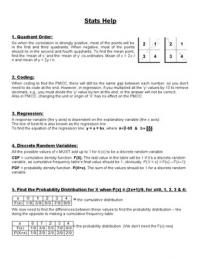
So when the correlation is strongly positive, most of the points will be
in the first and third quadrants. When negative, most of the points
should lie in the second and fourth quadrants. To find the mean point,
find the ‘mean of x’ and the ‘mean of y’ co-ordinates. Mean of x = Σx /
n and mean of y = Σy / n.
2. Coding:
When coding to find the PMCC, there will still be the same gap between each number, so you don’t
need to de-code at the end. However, in regression, if you multiplied all the ‘y’ values by 10 to remove
decimals, e.g., you must divide the ‘y’ value by ten at the end, or the answer will not be correct.
Also in PMCC, changing the unit or origin of ‘X’ has no effect on the PMCC.
3. Regression:
A response variable (the y axis) is dependent on the explanatory variable (the x axis).
The line of best fit is also known as the regression line.
To find the equation of the regression line: y = a + bx, where
4. Discrete Random Variables:
All the possible values of x MUST add up to 1 for it (x) to be a discrete random variable.
CDF = cumulative density function. F(X). The last value in the table will be 1 if it’s a discrete random
variable, as cumulative frequency table’s final value should be 1, obviously. P(X = x) = F(x) – F(x–1).
PDF = probability density function. P(X=x). The sum of the values should be 1 for a discrete random
variable.
5. Find the Probability Distribution for X when F(x) = (2x+1)/9, for x=0, 1, 2, 3 & 4:
= the cumulative distribution
We now need to find the differences between these values to find the probability distribution – like
doing the opposite to making a cumulative frequency table.
= the probability distribution. (We don’t need the F(x) row)
, 6. Expected Value:
μ (mu) is another way of writing the mean, used in finding an expected value.
Expected value is written as E.
To find the mean for all the x values, use μ = Σfx / Σf
To find the expected value of X, use E(x)=ΣxP(X=x). i.e., multiply each value in P(X=x) by its x value,
add these all together and you have your expected value of x. This is basically the same as finding
the mean, so μ = E(x) = ΣxP(X=x).
7. Finding the expected value of a function of X. Say in this case, for y=2X – 1:
so instead of e.g. we now have
Notice that the values do not change, as when you find the expected values, you will multiplying them
all by the function of X, which has already changed. So the expected value would now be E(2X - 1),
which is the same as 2E(X) – 1
8. Variance:
This is how close the values are to the mean. Again, the mean (μ) = E(X) = ExP(X=x)
var(x) = Ex2P(X=x) - μ2. So basically it’s the x2 multiplied by their P(X=x) values, then add the new
values up together and take away the mean.
X 1 2 3 The mean = 1/3 + 2/2 + 3/6 = 11/6
2
P(X=x) 1/3 1/2 1/6 The variance = 1/3 + 4/2 + 9/6 = 23/6. 23/6 - (11/6 ) = 17/36
1/3 2/2 3/6 To do these, obviously, you need to make the denominators the same.
X P(X=x) 1/3 4/2 9/6 Variance = the spread of values. Mean = the mean value of x.
2
9. The Equation for Variance, Expected Values and Probability Distributions:
E(a) = a
E(aX) = aE(X)
E(aX + b) = aE(X)+b Where a and b are constants and f
E(f(X) + g(X)) = E(f(X)) + E(g(X)) and g are functions of X
Var(a) = 0
Var(aX) = a2Var(X)
Var(aX + b) = a2Var(X) E(X2) DOES NOT EQUAL (E(X))2
10. Examples of Variance and Mean Questions
X has a mean of μ and a SD of σ. In terms of μ and σ, Find:
1. E(3X) = 3μ
2. E(2X + 3) = 2μ + 3
3. E(3 – 2X) = 3 - 2μ
4. Var(2X + 3) = Var(aX + b) = a2Var(X) = 4Var(X) = 4σ2 (As Var(X) is the same as σ2)
1. Quadrant Order:
So when the correlation is strongly positive, most of the points will be
in the first and third quadrants. When negative, most of the points
should lie in the second and fourth quadrants. To find the mean point,
find the ‘mean of x’ and the ‘mean of y’ co-ordinates. Mean of x = Σx /
n and mean of y = Σy / n.
2. Coding:
When coding to find the PMCC, there will still be the same gap between each number, so you don’t
need to de-code at the end. However, in regression, if you multiplied all the ‘y’ values by 10 to remove
decimals, e.g., you must divide the ‘y’ value by ten at the end, or the answer will not be correct.
Also in PMCC, changing the unit or origin of ‘X’ has no effect on the PMCC.
3. Regression:
A response variable (the y axis) is dependent on the explanatory variable (the x axis).
The line of best fit is also known as the regression line.
To find the equation of the regression line: y = a + bx, where
4. Discrete Random Variables:
All the possible values of x MUST add up to 1 for it (x) to be a discrete random variable.
CDF = cumulative density function. F(X). The last value in the table will be 1 if it’s a discrete random
variable, as cumulative frequency table’s final value should be 1, obviously. P(X = x) = F(x) – F(x–1).
PDF = probability density function. P(X=x). The sum of the values should be 1 for a discrete random
variable.
5. Find the Probability Distribution for X when F(x) = (2x+1)/9, for x=0, 1, 2, 3 & 4:
= the cumulative distribution
We now need to find the differences between these values to find the probability distribution – like
doing the opposite to making a cumulative frequency table.
= the probability distribution. (We don’t need the F(x) row)
, 6. Expected Value:
μ (mu) is another way of writing the mean, used in finding an expected value.
Expected value is written as E.
To find the mean for all the x values, use μ = Σfx / Σf
To find the expected value of X, use E(x)=ΣxP(X=x). i.e., multiply each value in P(X=x) by its x value,
add these all together and you have your expected value of x. This is basically the same as finding
the mean, so μ = E(x) = ΣxP(X=x).
7. Finding the expected value of a function of X. Say in this case, for y=2X – 1:
so instead of e.g. we now have
Notice that the values do not change, as when you find the expected values, you will multiplying them
all by the function of X, which has already changed. So the expected value would now be E(2X - 1),
which is the same as 2E(X) – 1
8. Variance:
This is how close the values are to the mean. Again, the mean (μ) = E(X) = ExP(X=x)
var(x) = Ex2P(X=x) - μ2. So basically it’s the x2 multiplied by their P(X=x) values, then add the new
values up together and take away the mean.
X 1 2 3 The mean = 1/3 + 2/2 + 3/6 = 11/6
2
P(X=x) 1/3 1/2 1/6 The variance = 1/3 + 4/2 + 9/6 = 23/6. 23/6 - (11/6 ) = 17/36
1/3 2/2 3/6 To do these, obviously, you need to make the denominators the same.
X P(X=x) 1/3 4/2 9/6 Variance = the spread of values. Mean = the mean value of x.
2
9. The Equation for Variance, Expected Values and Probability Distributions:
E(a) = a
E(aX) = aE(X)
E(aX + b) = aE(X)+b Where a and b are constants and f
E(f(X) + g(X)) = E(f(X)) + E(g(X)) and g are functions of X
Var(a) = 0
Var(aX) = a2Var(X)
Var(aX + b) = a2Var(X) E(X2) DOES NOT EQUAL (E(X))2
10. Examples of Variance and Mean Questions
X has a mean of μ and a SD of σ. In terms of μ and σ, Find:
1. E(3X) = 3μ
2. E(2X + 3) = 2μ + 3
3. E(3 – 2X) = 3 - 2μ
4. Var(2X + 3) = Var(aX + b) = a2Var(X) = 4Var(X) = 4σ2 (As Var(X) is the same as σ2)


