
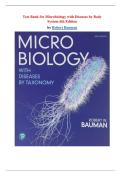
Test Bank for Microbiology with Diseases by Body
System 6th Edition
by Robert Bauman
, Test Bank - Microbiology with Diseases by Body System, 6e (Bauman, 2023)
Microbiology with Diseases by Body System, 6e (Bauman)
Chapter 1 A Brief History of Microbiology
Multiple Choice Questions
1) Antoni van Leeuwenhoek was the first person in history to
A) use a magnifying glass.
B) develop a taxonomic system.
C) view microorganisms and record these observations.
D) disprove spontaneous generation.
E) use the germ theory of
disease. Answer: C
Bloom's Taxonomy: Knowledge
Section: The Early Years of
Microbiology Learning Outcome: 1.1
2) The microbes commonly known as are single-celled eukaryotes that are
generally motile.
A) archaea
B) bacteria
C) fungi
D) protozoa
E) viruses
Answer: D
Bloom's Taxonomy: Comprehension
Section: The Early Years of
Microbiology Learning Outcome: 1.3
3) Which of the following are prokaryotes?
A) algae
B) molds
C) protozoa
D) archaea
E) worms
Answer: D
Bloom's Taxonomy: Comprehension
Section: The Early Years of
Microbiology Learning Outcome: 1.5
1|Page
, Test Bank - Microbiology with Diseases by Body System, 6e (Bauman, 2023)
4) Louis Pasteur demonstrated that fermentation to produce alcohol is caused by
A) aerobes.
B) facultative anaerobes.
C) obligate parasites.
D) archaea.
E) prokaryote
s. Answer: B
Bloom's Taxonomy: Knowledge
Section: The Golden Age of
Microbiology Learning Outcome: 1.6
5) Which of the following scientists provided evidence in favor of the concept of
spontaneous generation?
A) Pasteur
B) Needham
C) Redi
D) Buchner
E) Spallanza
ni Answer: B
Bloom's Taxonomy: Knowledge
Section: The Golden Age of
Microbiology Learning Outcome: 1.7
6) Pasteur's experiments on fermentation laid the foundation for
A) industrial microbiology.
B) epidemiology.
C) immunology.
D) abiogenesis.
E) antisepsi
s. Answer:
A
Bloom's Taxonomy: Comprehension
Section: The Golden Age of
Microbiology Learning Outcome: 1.10
7) Which of the following statements about fungi is FALSE?
A) Fungi are eukaryotes.
B) Molds are multicellular.
C) Fungi have a cell wall.
D) Fungi are photosynthetic.
E) Yeasts are
unicellular.
Answer: D
Bloom's Taxonomy: Comprehension
Section: The Early Years of
Microbiology Learning Outcome: 1.3
2|Page
, Test Bank - Microbiology with Diseases by Body System, 6e (Bauman, 2023)
8) Which of the following contribute to the successful application of Koch's postulates?
A) the development of the compound microscope
B) the theory of abiogenesis
C) the ability to record the appearance of bacteria photographically
D) the development of simple bacterial staining techniques
E) the development of techniques for sterile transfer of
bacteria Answer: E
Bloom's Taxonomy: Application
Section: The Golden Age of
Microbiology Learning Outcome: 1.13
9) Which of the following individuals pioneered the use of chemicals to reduce the
incidence of infections during surgery?
A) Nightingale
B) Snow
C) Ehrlich
D) Lister
E) Semmelwei
s Answer: D
Bloom's Taxonomy: Comprehension
Section: The Golden Age of
Microbiology Learning Outcome: 1.16
10) The technique developed by Hans Christian Gram is important for bacterial
A) etiology.
B) identification.
C) classification.
D) isolation.
E) epidemiolog
y.
Answer: B
Bloom's Taxonomy: Knowledge
Section: The Golden Age of
Microbiology Learning Outcome: 1.15
11) The use of chemical agents to harm or kill microbes is
A) immunology.
B) chemotherapy.
C) epidemiology.
D) serology.
E) biotechnolog
y.
Answer: B
Bloom's Taxonomy: Knowledge
Section: The Golden Age of
Microbiology Learning Outcome: 1.18
3|Page
System 6th Edition
by Robert Bauman
, Test Bank - Microbiology with Diseases by Body System, 6e (Bauman, 2023)
Microbiology with Diseases by Body System, 6e (Bauman)
Chapter 1 A Brief History of Microbiology
Multiple Choice Questions
1) Antoni van Leeuwenhoek was the first person in history to
A) use a magnifying glass.
B) develop a taxonomic system.
C) view microorganisms and record these observations.
D) disprove spontaneous generation.
E) use the germ theory of
disease. Answer: C
Bloom's Taxonomy: Knowledge
Section: The Early Years of
Microbiology Learning Outcome: 1.1
2) The microbes commonly known as are single-celled eukaryotes that are
generally motile.
A) archaea
B) bacteria
C) fungi
D) protozoa
E) viruses
Answer: D
Bloom's Taxonomy: Comprehension
Section: The Early Years of
Microbiology Learning Outcome: 1.3
3) Which of the following are prokaryotes?
A) algae
B) molds
C) protozoa
D) archaea
E) worms
Answer: D
Bloom's Taxonomy: Comprehension
Section: The Early Years of
Microbiology Learning Outcome: 1.5
1|Page
, Test Bank - Microbiology with Diseases by Body System, 6e (Bauman, 2023)
4) Louis Pasteur demonstrated that fermentation to produce alcohol is caused by
A) aerobes.
B) facultative anaerobes.
C) obligate parasites.
D) archaea.
E) prokaryote
s. Answer: B
Bloom's Taxonomy: Knowledge
Section: The Golden Age of
Microbiology Learning Outcome: 1.6
5) Which of the following scientists provided evidence in favor of the concept of
spontaneous generation?
A) Pasteur
B) Needham
C) Redi
D) Buchner
E) Spallanza
ni Answer: B
Bloom's Taxonomy: Knowledge
Section: The Golden Age of
Microbiology Learning Outcome: 1.7
6) Pasteur's experiments on fermentation laid the foundation for
A) industrial microbiology.
B) epidemiology.
C) immunology.
D) abiogenesis.
E) antisepsi
s. Answer:
A
Bloom's Taxonomy: Comprehension
Section: The Golden Age of
Microbiology Learning Outcome: 1.10
7) Which of the following statements about fungi is FALSE?
A) Fungi are eukaryotes.
B) Molds are multicellular.
C) Fungi have a cell wall.
D) Fungi are photosynthetic.
E) Yeasts are
unicellular.
Answer: D
Bloom's Taxonomy: Comprehension
Section: The Early Years of
Microbiology Learning Outcome: 1.3
2|Page
, Test Bank - Microbiology with Diseases by Body System, 6e (Bauman, 2023)
8) Which of the following contribute to the successful application of Koch's postulates?
A) the development of the compound microscope
B) the theory of abiogenesis
C) the ability to record the appearance of bacteria photographically
D) the development of simple bacterial staining techniques
E) the development of techniques for sterile transfer of
bacteria Answer: E
Bloom's Taxonomy: Application
Section: The Golden Age of
Microbiology Learning Outcome: 1.13
9) Which of the following individuals pioneered the use of chemicals to reduce the
incidence of infections during surgery?
A) Nightingale
B) Snow
C) Ehrlich
D) Lister
E) Semmelwei
s Answer: D
Bloom's Taxonomy: Comprehension
Section: The Golden Age of
Microbiology Learning Outcome: 1.16
10) The technique developed by Hans Christian Gram is important for bacterial
A) etiology.
B) identification.
C) classification.
D) isolation.
E) epidemiolog
y.
Answer: B
Bloom's Taxonomy: Knowledge
Section: The Golden Age of
Microbiology Learning Outcome: 1.15
11) The use of chemical agents to harm or kill microbes is
A) immunology.
B) chemotherapy.
C) epidemiology.
D) serology.
E) biotechnolog
y.
Answer: B
Bloom's Taxonomy: Knowledge
Section: The Golden Age of
Microbiology Learning Outcome: 1.18
3|Page


