Traffic Psychology & Sustained Mobility
Lecture 1: Theories & Models, 09-09-2024
Traffic psychology → behavior in traffic
1. Social psychology
2. Clinical psychology
3. Neuropsychology
4. Developmental psychology
5. Experimental psychology
A good psychological theory/model should be descrip1ve, and it should predict (testable)
Lot of boxology in psychology → flowcharts with lots of arrows
- What is the central aspect of the model
- What are the weaknesses
- What are the strengths
Driving is just another human behavior → a transport behavior that requires sustained
aOenPon, hazard idenPficaPon and motor-coordinaPon
Driving has a mulPtude of models, none of which are widely accepted
Skill models
- Crashes occur when Task Demands exceed Driver Skills
A driver’s percepPon and motor skills are what make them safe → reacPon Pme, vision, level
of driver training
Young people are more involved in traffic accidents, older people are more likely to die in
traffic accidents
Skill models are too simplisPc → just the skills show a weak relaPonship to the amount of
accidents
- Psychomotor & perceptual variables were considerably less important than
biographical and exposure factors
- Marital status, mileage, traffic convicPon record and socioeconomic status most
significant
A=tude theories
Theory of Planned Behavior (TPB) consists of mulPple factors
- A[tude: what I say I think about something
- SubjecPve norm: what I think others think about something
- Perceived control: = how much control I think I have over my behaviour
- IntenPon: what I say I will do
- Behavior: what I actually do
,What we have as an intenPon is different from our behavior. TPB explains intenPon, so not
necessarily behavior
“The results so far indicate that drivers find it easier to adapt their behavior than to adapt
their a[tudes. Fortunately, accidents are not caused by risky a[tudes but by risky behavior”
It is very popular because it is easy to examine → large sample sizes
IntenPons are only significantly related to behavior when habit is weak
U?lity theories: maximize gain and minimalize loss, weigh the pros and cons
- UPlity maximizaPon
- SubjecPve expected uPlity
- Peltzman’s Driving Intensity theory UPlity
theories do not always work → unpaid blood
donor give more/beOer quality blood
Risk/mo?va?onal theories: takes moPves into
account (why do we do what we do)
- Risk Homeostasis Theory (Wilde)
- Risk Allostasis Theory (Fuller)
- Zero-Risk Theory (Näätänen & Summala)
- Risk/Threat Avoidance Theory (Fuller)
- The Safety Margin Model (Summala)
, Risk Homeostasis Theory (RHT) → we always have a target risk level that we want to
experience at every Pme, if we don’t experience enough, we will move towards the risk
The is a target level both at individual level and at societal level
If experienced risk does not equal target risk, then acPon is taken
ABS brake system → more risk taken without ABS
RTH does not make full testable predicPons, relies on constant (accurate) percepPon of risk,
therefore, it is very difficult (impossible) to falsify
Risk Allostasis Theory (RAT) → Feeling of Risk the central moPvator, feeling of Risk is an
indicator of perceived task difficulty, preferred range of Feeling of Risk compared to
perceived level (not fixed but range)
- SomaPc Marker Theory → sPmuli are ‘marked’ with emoPons, body states
- People who lack emoPon should be irraPonal then, but can perform well in tests
RAT → Task demand and (perceived) task difficulty
Allostasis versus homeostasis
Allostasis → beOer representaPon of changing moPvaPonal influences on the driver, more
dynamic
Homeostasis → posits a fixed target level of task difficulty or risk.
There is a threshold
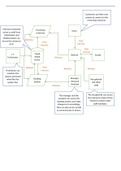
Zero-Risk Theory: Argues that risk is hardly ever experienced, when it is it acts as a warning
Lecture 1: Theories & Models, 09-09-2024
Traffic psychology → behavior in traffic
1. Social psychology
2. Clinical psychology
3. Neuropsychology
4. Developmental psychology
5. Experimental psychology
A good psychological theory/model should be descrip1ve, and it should predict (testable)
Lot of boxology in psychology → flowcharts with lots of arrows
- What is the central aspect of the model
- What are the weaknesses
- What are the strengths
Driving is just another human behavior → a transport behavior that requires sustained
aOenPon, hazard idenPficaPon and motor-coordinaPon
Driving has a mulPtude of models, none of which are widely accepted
Skill models
- Crashes occur when Task Demands exceed Driver Skills
A driver’s percepPon and motor skills are what make them safe → reacPon Pme, vision, level
of driver training
Young people are more involved in traffic accidents, older people are more likely to die in
traffic accidents
Skill models are too simplisPc → just the skills show a weak relaPonship to the amount of
accidents
- Psychomotor & perceptual variables were considerably less important than
biographical and exposure factors
- Marital status, mileage, traffic convicPon record and socioeconomic status most
significant
A=tude theories
Theory of Planned Behavior (TPB) consists of mulPple factors
- A[tude: what I say I think about something
- SubjecPve norm: what I think others think about something
- Perceived control: = how much control I think I have over my behaviour
- IntenPon: what I say I will do
- Behavior: what I actually do
,What we have as an intenPon is different from our behavior. TPB explains intenPon, so not
necessarily behavior
“The results so far indicate that drivers find it easier to adapt their behavior than to adapt
their a[tudes. Fortunately, accidents are not caused by risky a[tudes but by risky behavior”
It is very popular because it is easy to examine → large sample sizes
IntenPons are only significantly related to behavior when habit is weak
U?lity theories: maximize gain and minimalize loss, weigh the pros and cons
- UPlity maximizaPon
- SubjecPve expected uPlity
- Peltzman’s Driving Intensity theory UPlity
theories do not always work → unpaid blood
donor give more/beOer quality blood
Risk/mo?va?onal theories: takes moPves into
account (why do we do what we do)
- Risk Homeostasis Theory (Wilde)
- Risk Allostasis Theory (Fuller)
- Zero-Risk Theory (Näätänen & Summala)
- Risk/Threat Avoidance Theory (Fuller)
- The Safety Margin Model (Summala)
, Risk Homeostasis Theory (RHT) → we always have a target risk level that we want to
experience at every Pme, if we don’t experience enough, we will move towards the risk
The is a target level both at individual level and at societal level
If experienced risk does not equal target risk, then acPon is taken
ABS brake system → more risk taken without ABS
RTH does not make full testable predicPons, relies on constant (accurate) percepPon of risk,
therefore, it is very difficult (impossible) to falsify
Risk Allostasis Theory (RAT) → Feeling of Risk the central moPvator, feeling of Risk is an
indicator of perceived task difficulty, preferred range of Feeling of Risk compared to
perceived level (not fixed but range)
- SomaPc Marker Theory → sPmuli are ‘marked’ with emoPons, body states
- People who lack emoPon should be irraPonal then, but can perform well in tests
RAT → Task demand and (perceived) task difficulty
Allostasis versus homeostasis
Allostasis → beOer representaPon of changing moPvaPonal influences on the driver, more
dynamic
Homeostasis → posits a fixed target level of task difficulty or risk.
There is a threshold
Zero-Risk Theory: Argues that risk is hardly ever experienced, when it is it acts as a warning