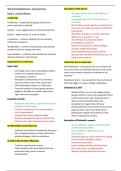
AQA Psychology Revision – Topic Summary Evaluations of NSI and ISI:
Paper 1 – Social Influence - NSI supported by Asch’s study, follow up
interviews
Conformity:
- ISI supported by Asch’s study, follow up
Conformity – complying with group social norms interviews
either implicitly or explicitly - NSI and ISI can work together as dual process,
they want to be right so people will like them
Implicit – a law suggested but not directly expressed (usefulness)
Explicit – stated clearly, no room for doubt - Alternative theories or reasons, individual
differences e.g. gender or race
Compliance – conforms publicly but not privately, - Non-affiliates less impacted by NSI
shallowest, temporary (contradictory evidence)
Identification – conforms both publicly and privately, - Research conducted in artificial settings,
temporary and can change over time question validity (testability)
- Social identity theory, people conform
Internalisation – conforms both publicly and privately, because they identify themselves as part of a
deepest, behaviour is permanent group (other theories)
Explanations for Conformity: Conformity due to social roles:
Asch’s 1951 Deindividuation – the process that occurs when one
loses one’s sense of individual identity so that social,
- Line length test, to see if participants yield to
moral, and societal constraints on behaviour are
conform to a majority influence in
loosened
unambiguous situations
- Participants conformed to the unanimous Situational factors – any variable for the environment
incorrect answer 32% of the critical trials that may trigger or cause a change in behaviour
- 74% conformed at least once, 26% never
- They will conform to strong group pressure, Zimbardo et al 1973
appear to be different reasons, want to be - Stanford Prison, to see how rapidly people
right, want to be accepted would conform to new roles assigned to them
Evaluations of Asch - Conformed to their roles, finished early 6
days, prisoners rebelled, distressed
- Replicated many times, increases validity and breakdowns, hunger strike, left early
reliability of the findings - Situational factors of the prison environment
- Only male participants, not representative, played a major role in the conformity of
can’t be generalised participants, people will conform to roles
- Artificial task, lacks ecological validity they’re expected to conform
- Demand characteristics due to artificial task
- Ethical issues, lacks informed consent, stress Evaluations of Zimbardo’s research
NSI (Normative Social Influence): - Can be applied to explain why Nazi soldiers
conformed during WW2
- Conforms to be liked or accepted by the group - Can be applied to Aby Ghraib prison
- May change behaviour or views publicly but - Ethical issues
privately disagree, links to compliance - Zimbardo was part of the experiment, played
a role himself, investigator effects
ISI (Informational Social Influence):
- Demand characteristics
- Conforms wanting to be correct - Lacks ecological validity, artificial prison
- Follow majority who seem liked they know - Only males used, not generalisable
what their doing, tends to lead to - Research ignored dispositional factors
internalisation
Paper 1 – Social Influence - NSI supported by Asch’s study, follow up
interviews
Conformity:
- ISI supported by Asch’s study, follow up
Conformity – complying with group social norms interviews
either implicitly or explicitly - NSI and ISI can work together as dual process,
they want to be right so people will like them
Implicit – a law suggested but not directly expressed (usefulness)
Explicit – stated clearly, no room for doubt - Alternative theories or reasons, individual
differences e.g. gender or race
Compliance – conforms publicly but not privately, - Non-affiliates less impacted by NSI
shallowest, temporary (contradictory evidence)
Identification – conforms both publicly and privately, - Research conducted in artificial settings,
temporary and can change over time question validity (testability)
- Social identity theory, people conform
Internalisation – conforms both publicly and privately, because they identify themselves as part of a
deepest, behaviour is permanent group (other theories)
Explanations for Conformity: Conformity due to social roles:
Asch’s 1951 Deindividuation – the process that occurs when one
loses one’s sense of individual identity so that social,
- Line length test, to see if participants yield to
moral, and societal constraints on behaviour are
conform to a majority influence in
loosened
unambiguous situations
- Participants conformed to the unanimous Situational factors – any variable for the environment
incorrect answer 32% of the critical trials that may trigger or cause a change in behaviour
- 74% conformed at least once, 26% never
- They will conform to strong group pressure, Zimbardo et al 1973
appear to be different reasons, want to be - Stanford Prison, to see how rapidly people
right, want to be accepted would conform to new roles assigned to them
Evaluations of Asch - Conformed to their roles, finished early 6
days, prisoners rebelled, distressed
- Replicated many times, increases validity and breakdowns, hunger strike, left early
reliability of the findings - Situational factors of the prison environment
- Only male participants, not representative, played a major role in the conformity of
can’t be generalised participants, people will conform to roles
- Artificial task, lacks ecological validity they’re expected to conform
- Demand characteristics due to artificial task
- Ethical issues, lacks informed consent, stress Evaluations of Zimbardo’s research
NSI (Normative Social Influence): - Can be applied to explain why Nazi soldiers
conformed during WW2
- Conforms to be liked or accepted by the group - Can be applied to Aby Ghraib prison
- May change behaviour or views publicly but - Ethical issues
privately disagree, links to compliance - Zimbardo was part of the experiment, played
a role himself, investigator effects
ISI (Informational Social Influence):
- Demand characteristics
- Conforms wanting to be correct - Lacks ecological validity, artificial prison
- Follow majority who seem liked they know - Only males used, not generalisable
what their doing, tends to lead to - Research ignored dispositional factors
internalisation