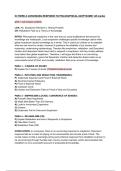
IS THERE A CONVINCING RESPONSE TO PHILOSOPHICAL SCEPTICISM? (25 marks)
(pink = out of spec content)
LOA: No, Scepticism Remains a Strong Problem
CR: Reliabilism Fails as a Theory of Knowledge
INTRO: Philosophical scepticism is the view that our usual justifications that amount to
knowledge are inadequate. Local scepticism challenges specific knowledge claims while
global scepticism doubts knowledge as a whole. This is useful as it allows us to establish
what we can know for certain, however it questions the reliability of our senses and
reasoning, undermining epistemology. Theories like empiricism, reliabilism, and Descartes’
intuition and deduction thesis have tried to respond to scepticism, but they mostly address
local rather than global scepticism. Therefore, I will argue that there is no convincing
response to scepticism, given that Descartes’ intuition and deduction thesis relies on an
unsuccessful proof of God, and crucially, reliabilism fails as an account of knowledge.
PARA 1 - 3 WAVES OF DOUBT:
P) Explain the 3 waves of doubt + Putnam's brain-in-a-vat
PARA 2 - INTUITION AND DEDUCTION (TRADEMARK):
P) Trademark Argument and Proof of External World
A) Assumes Causal Adequacy
P) Proof of External World
A) Cartesian Circle
E) Intuition and Deduction Fails on Proof of God and Circularity
PARA 3 - EMPIRICISM (LOCKE): COHERENCE OF SENSES:
A) Russell’s Best Hypothesis
C) Weak (Not Better Than Evil Demon)
A) Locke’s Involuntary Experience
C) Dreams
E) Empiricists Fail to Overcome Scepticism
PARA 4 - RELIABILISM (CR):
P) Explain Reliabilism and How it Responds to Scepticism
A) Fake Barn County
E) Reliabilism Fails (CR)
CONCLUSION: In conclusion, there is no convincing response to scepticism. Descare’s
response fails as a result of relying on his unsuccessful and circular proof of God. The
crucial reason is that a seemingly strong and coherent response from reliabilism is shown to
be unconvincing through the fake barn county counter example, which demonstrates that
reliabilism is not a successful account of propositional knowledge.
(pink = out of spec content)
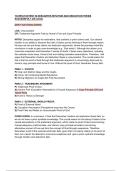
LOA: No, Scepticism Remains a Strong Problem
CR: Reliabilism Fails as a Theory of Knowledge
INTRO: Philosophical scepticism is the view that our usual justifications that amount to
knowledge are inadequate. Local scepticism challenges specific knowledge claims while
global scepticism doubts knowledge as a whole. This is useful as it allows us to establish
what we can know for certain, however it questions the reliability of our senses and
reasoning, undermining epistemology. Theories like empiricism, reliabilism, and Descartes’
intuition and deduction thesis have tried to respond to scepticism, but they mostly address
local rather than global scepticism. Therefore, I will argue that there is no convincing
response to scepticism, given that Descartes’ intuition and deduction thesis relies on an
unsuccessful proof of God, and crucially, reliabilism fails as an account of knowledge.
PARA 1 - 3 WAVES OF DOUBT:
P) Explain the 3 waves of doubt + Putnam's brain-in-a-vat
PARA 2 - INTUITION AND DEDUCTION (TRADEMARK):
P) Trademark Argument and Proof of External World
A) Assumes Causal Adequacy
P) Proof of External World
A) Cartesian Circle
E) Intuition and Deduction Fails on Proof of God and Circularity
PARA 3 - EMPIRICISM (LOCKE): COHERENCE OF SENSES:
A) Russell’s Best Hypothesis
C) Weak (Not Better Than Evil Demon)
A) Locke’s Involuntary Experience
C) Dreams
E) Empiricists Fail to Overcome Scepticism
PARA 4 - RELIABILISM (CR):
P) Explain Reliabilism and How it Responds to Scepticism
A) Fake Barn County
E) Reliabilism Fails (CR)
CONCLUSION: In conclusion, there is no convincing response to scepticism. Descare’s
response fails as a result of relying on his unsuccessful and circular proof of God. The
crucial reason is that a seemingly strong and coherent response from reliabilism is shown to
be unconvincing through the fake barn county counter example, which demonstrates that
reliabilism is not a successful account of propositional knowledge.