
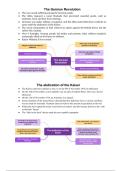
The German Revolution
● The war caused suffering among the German people
● The Allies imposed a naval blockade that prevented essential goods, such as
medicine, food, and fuel, from entering.
● Germany was under military occupation, and the Allies stated that there would be no
peace until the abdication of the Kaiser.
● The naval commanders at Kiel ordered an attack against the British forces, but the
sailors led a mutiny.
● Over a fortnight, German people led strikes and protests, other soldiers mutinied,
and people called on the Kaiser to abdicate.
● Kaiser Wilhelm II lost control.
The abdication of the Kaiser
● The Kaiser could not continue to rule, so on the 9th of November 1918, he abdicated.
● On the 10th of November, a new republic was set up by Friedrich Ebert, who was a Social
Democrat.
● On the 11th of November 1918, an Armistice was signed
● Senior members of the armed forces claimed that they had been close to victory, and there
was no need for surrender. Germans chose to believe this and not accept defeat in the war
● Politicians who signed the treaty were known as traitors, and this became known as the ‘stab
in the back’ theory
● The ‘Stab in the back’ theory made the new republic unpopular
, The New Republic
● The new system of government was called a republic and was known as ‘The Weimar
Republic’.
● The new constitution was called the ‘Weimar Constitution’
● It was a parliamentary democracy where people elected representatives to a parliament to
make the laws.
● The chancellor was elected every 7 years
● The country's senior figures did not like the new democratic republic
● Many Germans wanted the Kaiser to return
● People who were influenced by the Russian Revolution in 1917 wanted a communist
revolution
● Ebert wanted to:
○ Reassured that the new government will not take private properties
○ Reduce working hours to 8 hours
○ Keeping civil servants from the previous government
The strengths and weaknesses of the new Weimar
Constitution
Strengths:
● Men and women over 20 could vote
● A President was elected every 7 years and could appoint a chancellor
● The Reichstag (parliament) was elected every 4 years, and it passed or rejected changes to the
laws
● All Germans had freedom of speech, religion, and civil rights were protected
● The number of votes won by a party directly determined the number of seats in the Reichstag
Weaknesses :
● Article 48 - In an emergency, the president could take action without the approval of the
Reichstag, which gave the president too much power.
● Proportional representation made it difficult for a party to have a majority; this made the
parties have to form short-lived coalition governments.
● Proportional representation also allowed small extremist parties to win seats in the Reichstag.
, The Treaty of Versailles, June 1919
The Terms of the Treaty:
● Germany lost 13% of its European territory
● 50% of its iron and 15% of its coal reserves were taken in Alsace-Lorraine and the Saar
● Germany had to accept full blame for the war
● Reparations were sent for Germany to pay, a total of 136 million marks, to be paid annually
● Its army had 100,000 soldiers
● 15,000 men in the Navy
● No tanks, submarines, or air force
The German reaction to the Treaty of Versailles
● The German government was shocked by the harshness of the Treaty, as they couldn’t attend
the negotiations.
● The German government was threatened to sign it or else the war would restart
● The German government called it a ‘shameful diktat’ because it was humiliating Germany by
having to accept full blame for the war,
● The German government felt that the responsibility was shared by all nations.
● Germans felt that the reparation payments were too high and that they would damage the
economy.
● The military restrictions made the Germans feel insecure and that the Allies wanted to weaken
them.
● Taking the industrial resources made the Germans feel robbed, and they said that it would
undermine the economy even further.
● The Germans called the politicians who signed the treaty ‘November Criminals’ because it
made Germany worse than it already was
● A myth began that Germany was stabbed in the back by its government, and it spread among
the senior members of the army.
, The Spartacist Uprising (Left wing), January 1919
● The Spartacus League, led by Rosa Luxemburg and Karl Liebknecht, tried to set up a
communist government on the 5 of January 1919
● Spatatcists took over the Telegraph and the newspaper offices
● The revolution was poorly planned, and in the end, people did not join the revolt
● The government had to rely on volunteer soldiers called Freikorps
● The Freikorps restored order and killed Rosa Luxemburg and Karl Liebknecht
The Kapp Putsch (Right-wing), March 1920
● When the Treaty of Versailles was signed, the army went from 650,000 to 100,000, and many
ex-soldiers were unable to adjust, so they joined the Freikorps.
● After the Freikorps disbanded, they refused to give up their weapons, and they attempted to
take over Berlin, declaring Dr Wolfgang Kapp as their leader.
● Most of the army felt sympathy for the soldiers, so they refused to fire, and some joined the
putsch.
● Ebert had to move away because of the Putsch, and he encouraged the people to go on a
general strike.
● People refused to cooperate with Kapp and essential supplies like gas, Water, and Electricity,
so he was unable to govern
● The Putsch only lasted 4 days.
● This showed that the new government had poor military power, but it did seem to have the
support of most of the Germans when faced with a right-wing menace.



