These materials are the intellectual property of Lotus Mohammad and are for personal use only. Any reproduction,
distribution, or sharing without explicit written permission is strictly prohibited.
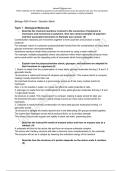
Biology AQA A level - Question Bank
Topic 1 - Biological Molecules
- Describe the chemical reactions involved in the conversion of polymers to
monomers and monomers to polymers. Give two named examples of polymers
and their associated monomers to illustrate your answer. (5)
Condensation reactions join monomers together to form polymers and produce a water
om
molecule
For example, starch is a polymer (polysaccharide) formed from the condensation of many alpha
glucose monomers (monosaccharides)
Hydrolysis reactions break down polymers to monomers by using a water molecule
l.c
For example, multiple polypeptide chains are polymers which when hydrolysed, produce many
amino acids which are the repeating units of monomers which form polypeptide chains
ai
- Explain how the polysaccharides starch, glycogen, and cellulose are adapted for
their functions in organisms (6)
1. Starch is made from the condensation of many alpha glucose molecules forming 1,6 and 1,4
gm
glycosidic bonds.
Its structure is coiled and formed of amylose and amylopectin. This means starch is compact,
making it easily stored for later use
@
Its branched structure makes it a good energy source as it has many contact points for
hydrolysis.
Also, it is not soluble in water, so it does not affect the water potential of cells
72
2. Glycogen is made from the condensation of many alpha glucose molecules forming 1,6 and
1,4 glycosidic bonds.
Its structure is coiled. This means starch is compact, making it easily stored for later use
ct
Iits branched structure makes it a good energy source as it has many contact points for
hydrolysis.
3. Cellulose is made from the condensation of many beta glucose molecules forming 1,4
so
glycosidic bonds.
Its structure is straight and easily layered due to the alternating OH groups bonded together.
tu
The layers form hydrogen bonds which produce fibrils, so it provides strength
This allows it to provide support and rigidity in plant cell walls, preventing lysis
lo
- Describe the induced-fit model of enzyme action and how an enzyme acts as a
catalyst. (4)
A substrate will bind to the active site and form an enzyme-substrate complex
The active site’s tertiary structure will alter to become more complementary to the substrate
The enzyme will act as a catalyst by lowering the activation energy of the reaction
- Describe how the structure of a protein depends on the amino acids it contains.
(5)
distribution, or sharing without explicit written permission is strictly prohibited.
Biology AQA A level - Question Bank
Topic 1 - Biological Molecules
- Describe the chemical reactions involved in the conversion of polymers to
monomers and monomers to polymers. Give two named examples of polymers
and their associated monomers to illustrate your answer. (5)
Condensation reactions join monomers together to form polymers and produce a water
om
molecule
For example, starch is a polymer (polysaccharide) formed from the condensation of many alpha
glucose monomers (monosaccharides)
Hydrolysis reactions break down polymers to monomers by using a water molecule
l.c
For example, multiple polypeptide chains are polymers which when hydrolysed, produce many
amino acids which are the repeating units of monomers which form polypeptide chains
ai
- Explain how the polysaccharides starch, glycogen, and cellulose are adapted for
their functions in organisms (6)
1. Starch is made from the condensation of many alpha glucose molecules forming 1,6 and 1,4
gm
glycosidic bonds.
Its structure is coiled and formed of amylose and amylopectin. This means starch is compact,
making it easily stored for later use
@
Its branched structure makes it a good energy source as it has many contact points for
hydrolysis.
Also, it is not soluble in water, so it does not affect the water potential of cells
72
2. Glycogen is made from the condensation of many alpha glucose molecules forming 1,6 and
1,4 glycosidic bonds.
Its structure is coiled. This means starch is compact, making it easily stored for later use
ct
Iits branched structure makes it a good energy source as it has many contact points for
hydrolysis.
3. Cellulose is made from the condensation of many beta glucose molecules forming 1,4
so
glycosidic bonds.
Its structure is straight and easily layered due to the alternating OH groups bonded together.
tu
The layers form hydrogen bonds which produce fibrils, so it provides strength
This allows it to provide support and rigidity in plant cell walls, preventing lysis
lo
- Describe the induced-fit model of enzyme action and how an enzyme acts as a
catalyst. (4)
A substrate will bind to the active site and form an enzyme-substrate complex
The active site’s tertiary structure will alter to become more complementary to the substrate
The enzyme will act as a catalyst by lowering the activation energy of the reaction
- Describe how the structure of a protein depends on the amino acids it contains.
(5)