

Aldehydes and Ketones
Aldehydes contain a carbonyl group at the end of the carbon chain and are
formed from the oxidation of primary alcohols
o Readily oxidise further in the presence of acidified potassium
dichromate to form carboxylic acids
o Tested for using Tollen’s reagent or Fehling’s solution
Ketones contain a carbonyl group within the carbon chain and are formed
from the oxidation of secondary alcohols
o No further oxidation and have no visible change with Tollen’s reagent
or Fehling’s solution
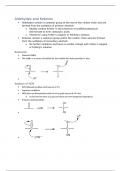
Reduction
Aqueous NaBH4
The NaBH4 is a source of hydride (H- ions) whilst the water provides H+ ions
Addition of HCN
KCN followed by dilute acid (source of H +)
Aqueous conditions
HCN does not disassociate easily so not a good source of CN - ions
o Is also hard to store as a gas and reacts to form dangerous byproducts
Produces hydroxynitriles
Aldehydes contain a carbonyl group at the end of the carbon chain and are
formed from the oxidation of primary alcohols
o Readily oxidise further in the presence of acidified potassium
dichromate to form carboxylic acids
o Tested for using Tollen’s reagent or Fehling’s solution
Ketones contain a carbonyl group within the carbon chain and are formed
from the oxidation of secondary alcohols
o No further oxidation and have no visible change with Tollen’s reagent
or Fehling’s solution
Reduction
Aqueous NaBH4
The NaBH4 is a source of hydride (H- ions) whilst the water provides H+ ions
Addition of HCN
KCN followed by dilute acid (source of H +)
Aqueous conditions
HCN does not disassociate easily so not a good source of CN - ions
o Is also hard to store as a gas and reacts to form dangerous byproducts
Produces hydroxynitriles


