

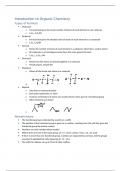
Introduction to Organic Chemistry
Types of Formula
Molecular
o Formula that gives the actual number of atoms of each element in one molecule
o C4H10, C2H5OH
Empirical
o Formula that gives the simplest ratio of atoms of each element in a compound
o C2H5, C2H5OH
General
o Shows the number of atoms of each element in a substance which has n carbon atoms
o All molecules in a homologous series have the same general formula
o CnH2n+2, CnH2n+1OH
Structural
o Shows how the atoms are joined together in a molecule
o CH3CH2CH2CH3, CH3CH2OH
Displayed
o Shows all the bonds and atoms in a molecule
o
Skeletal
o Uses lines to represent bonds
o Each point represents a C atom
o H atoms and bonds to H atoms not usually shown unless part of a functional group
o Other elements are shown
o
Nomenclature
The functional group is indicated by a prefix or a suffix
The position of the functional group is given by a number, counting from the end that gives the
functional group the lowest number
Numbers are only included when needed
Where there are two of the same group, di-, tri-, tetra-, penta-, hexa-, etc. are used
If there is more than one functional group, numbers are separated by commas and the groups
are listed in alphabetical order (ignoring di-, tri-, etc.)
The suffix for alkenes can go in front of other suffices
Types of Formula
Molecular
o Formula that gives the actual number of atoms of each element in one molecule
o C4H10, C2H5OH
Empirical
o Formula that gives the simplest ratio of atoms of each element in a compound
o C2H5, C2H5OH
General
o Shows the number of atoms of each element in a substance which has n carbon atoms
o All molecules in a homologous series have the same general formula
o CnH2n+2, CnH2n+1OH
Structural
o Shows how the atoms are joined together in a molecule
o CH3CH2CH2CH3, CH3CH2OH
Displayed
o Shows all the bonds and atoms in a molecule
o
Skeletal
o Uses lines to represent bonds
o Each point represents a C atom
o H atoms and bonds to H atoms not usually shown unless part of a functional group
o Other elements are shown
o
Nomenclature
The functional group is indicated by a prefix or a suffix
The position of the functional group is given by a number, counting from the end that gives the
functional group the lowest number
Numbers are only included when needed
Where there are two of the same group, di-, tri-, tetra-, penta-, hexa-, etc. are used
If there is more than one functional group, numbers are separated by commas and the groups
are listed in alphabetical order (ignoring di-, tri-, etc.)
The suffix for alkenes can go in front of other suffices


