

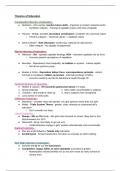
Theories of Education
Functionalist theories of education -
● Durkheim - Mini society, teaches future skills - important in modern industrial world
○ Durkheim critiques - Passing of capitalist values and class inequality
● Parsons - Bridge, provides secondary socialisation, socialises into universal values
○ Parsons critiques - ‘Universal values’ = capitalist values
● Davis & Moore - Role allocation, meritocracy, right job for right person
○ D&M critiques - No equality of opportunity
Marxist theories of education -
● Althusser - ISA - spreads capitalist ideology, RSA - maintains capitalist rule by force
○ Assumes passive acceptance of capitalism
● Bourdieu - Reproduces class inequality, r/c habitus on system - cultural capital
○ Not all w/c perform poorly
● Bowles & Gintis - Reproduce labour force, correspondence principle - school
mirrored in workplace, hidden curriculum - informal teachings of N&Vs
○ Assumes students accept the behaviours taught through HC
Feminist theories of education -
● Heaton & Lawson - HC transmits patriarchal values in 5 ways -
1. Sexist textbooks 2. Girls made uncomfortable in subjects
3. Teachers - girls made to clean up 4. Boy’s subjects more recognised
5. Less women in senior jobs
Difference Feminists -
● Marxfems - consider class with gender, w/c girls perform worse than m/c girls
● Walby - Triple System Theory - gender, class, ethnicity to understand girl’s
education
○ Don't consider w/c boys
Liberal Feminists -
● Sharpe - 90s vs 70s study - 90s girls more focused on career, likely due to Sex
Discrimination Act 1975
● Stanworth - Boys more likely to get uni recs
○ Underestimates change in girls’ position educationally and economically
Radical Feminists -
● Men are a bad influence, female only education
● Kat Barnyard - Sexual harassment not taken as seriously as other bullying
New Right theories of education -
● Schools should be run like businesses
● Competition, league tables to raise standards and improve grades
○ Marketisation mainly benefits m/c as w/c don’t have as many schools to
choose from
, Material and Cultural Factors on Educational Achievement
Material Factors -
● Housing
- Overcrowding, temporary accommodation, cold/damp = difficulty to
study/sleep, disruption, ill health
● Diet/Health
- Less vitamins/energy = absence (Howard), poor more likely to have
behavioural issues (Wilkinson)
● Cost of education
- Equipment, uniform, transport costs are a burden on poor, results in
cheaper resources = bullying (Tanner et al)
● Fear of debt
- W/C 5x less likely to go to university (Callender)
Cultural Factors -
● Language codes (Bernstein)
- Restricted code = Used by w/c
- Elaborated code = Used by m/c and education system
● Parents’ education
- Educated parents = high expectations, discipline, support
- Recognition of value of school trips
- Rapport with teachers
● Use of income
- M/C have higher income - buy into education
- W/C have lower income - lack of resources
● W/C subcultures (Sugarman)
- W/C suffer from cultural deprivation
- Subcultures include:
● Fatalism
● Collectivism - Value being in a group rather than independent success
● Immediate gratification
Functionalist theories of education -
● Durkheim - Mini society, teaches future skills - important in modern industrial world
○ Durkheim critiques - Passing of capitalist values and class inequality
● Parsons - Bridge, provides secondary socialisation, socialises into universal values
○ Parsons critiques - ‘Universal values’ = capitalist values
● Davis & Moore - Role allocation, meritocracy, right job for right person
○ D&M critiques - No equality of opportunity
Marxist theories of education -
● Althusser - ISA - spreads capitalist ideology, RSA - maintains capitalist rule by force
○ Assumes passive acceptance of capitalism
● Bourdieu - Reproduces class inequality, r/c habitus on system - cultural capital
○ Not all w/c perform poorly
● Bowles & Gintis - Reproduce labour force, correspondence principle - school
mirrored in workplace, hidden curriculum - informal teachings of N&Vs
○ Assumes students accept the behaviours taught through HC
Feminist theories of education -
● Heaton & Lawson - HC transmits patriarchal values in 5 ways -
1. Sexist textbooks 2. Girls made uncomfortable in subjects
3. Teachers - girls made to clean up 4. Boy’s subjects more recognised
5. Less women in senior jobs
Difference Feminists -
● Marxfems - consider class with gender, w/c girls perform worse than m/c girls
● Walby - Triple System Theory - gender, class, ethnicity to understand girl’s
education
○ Don't consider w/c boys
Liberal Feminists -
● Sharpe - 90s vs 70s study - 90s girls more focused on career, likely due to Sex
Discrimination Act 1975
● Stanworth - Boys more likely to get uni recs
○ Underestimates change in girls’ position educationally and economically
Radical Feminists -
● Men are a bad influence, female only education
● Kat Barnyard - Sexual harassment not taken as seriously as other bullying
New Right theories of education -
● Schools should be run like businesses
● Competition, league tables to raise standards and improve grades
○ Marketisation mainly benefits m/c as w/c don’t have as many schools to
choose from
, Material and Cultural Factors on Educational Achievement
Material Factors -
● Housing
- Overcrowding, temporary accommodation, cold/damp = difficulty to
study/sleep, disruption, ill health
● Diet/Health
- Less vitamins/energy = absence (Howard), poor more likely to have
behavioural issues (Wilkinson)
● Cost of education
- Equipment, uniform, transport costs are a burden on poor, results in
cheaper resources = bullying (Tanner et al)
● Fear of debt
- W/C 5x less likely to go to university (Callender)
Cultural Factors -
● Language codes (Bernstein)
- Restricted code = Used by w/c
- Elaborated code = Used by m/c and education system
● Parents’ education
- Educated parents = high expectations, discipline, support
- Recognition of value of school trips
- Rapport with teachers
● Use of income
- M/C have higher income - buy into education
- W/C have lower income - lack of resources
● W/C subcultures (Sugarman)
- W/C suffer from cultural deprivation
- Subcultures include:
● Fatalism
● Collectivism - Value being in a group rather than independent success
● Immediate gratification


