

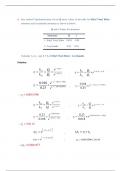
1. Free radical Copolymerization, Given Q and e values in the table for Ethyl Vinyl Ether
monomer and Acrylamide monomer as shown in below;
Q and e Values for monomer
Monomer Q e
1. Ethyl Vinyl Ether 0.018 -1.80
2. Acrylamide 0.23 0.54
Calculate r1 , r2 , and r1 r2 of Ethyl Vinyl Ether / Acrylamide
Solution:
k11 Q1 e( e1e1 ) k11 Q1 [ e1 (e1 e2 )]
r1 r1 e
k12 Q2 e( e1e2 ) ,
k12 Q2
0.018 e( ( 1.8)( 1.8))
r1 ( ( 1.8)(0.54)) , r1
0.018 [ ( 1.8)( 1.80.54)]
e
0.23 e 0.23
r1 0.0011596
k22 Q2 e( e2e2 )
r2 , r2
k22 Q2 [ e2 (e2 e1 )]
e
k21 Q1 e( e2e1 ) k21 Q1
0.23 e( 0.540.54) 0.23
r2 , r2 e[ 0.54(0.54( 1.8))]
0.018 e( 0.54( 1.8)) 0.018
r2 3.6114
(e1 e2 )2
r1r2 e
, r1r2 r1 r2
( 1.80.54)2
r1r2 e
, r1r2 0.0011596 3.6114
r1r2 0.0041877
, 2. What is the difference between the ideal and alternating behaviors in copolymerization?
Solution:
An ideal behavior in copolymerization occurs when r1 and r2 are different. The process
becomes difficult to produce copolymers containing appreciable amounts of both monomers
as the difference in r1 and r2 increases. Example, Extreme ideal behavior occurs when r1
and r2 are very different say r1 10 and r2 0.1 the obtained copolymers do not contain
appreciable amounts of M2. To yield copolymers containing appreciable amounts of both
monomers, a larger range of co-monomer feed compositions, can be used only for r1 and r2
do not differ markedly (e.g. r1 0.5 and r2 2 )
When r1r2 0 or r1 r2 0 the two monomers enters into the copolymer in equimolar
amounts in a nonrandom, alternating arrangement along the copolymer chain. This type of
copolymerization is referred to as alternating copolymerization. Likewise as ideal behavior,
there are two types of alternating behaviors similar, which are extreme alternating behavior
and moderate alternating behavior. Both r1 and r2 are zero in extreme alternating behavior.
Each of the two types of propagating chains preferentially adds to the other monomer, that is,
M1 adds only M2 and M2 adds only M1, the copolymerization equation reduces to
d M1 / d M 2 1 or F1 0.5
The behavior of most co-monomer systems lies between the two extremes of ideal and
alternating copolymerization. As the r1r2 product decreases from one toward zero, there is an
increasing tendency toward alternation. Perfect alternation occurs when r1 and r2 are both
zero. The tendency toward alternation and the tendency away from ideal behavior increase as
r1 and r2 become progressively less than unity. The range of behaviors can be seen by
considering the situation where r2 remains constant at 0.5 and r1 varies between 2 and 0.
monomer and Acrylamide monomer as shown in below;
Q and e Values for monomer
Monomer Q e
1. Ethyl Vinyl Ether 0.018 -1.80
2. Acrylamide 0.23 0.54
Calculate r1 , r2 , and r1 r2 of Ethyl Vinyl Ether / Acrylamide
Solution:
k11 Q1 e( e1e1 ) k11 Q1 [ e1 (e1 e2 )]
r1 r1 e
k12 Q2 e( e1e2 ) ,
k12 Q2
0.018 e( ( 1.8)( 1.8))
r1 ( ( 1.8)(0.54)) , r1
0.018 [ ( 1.8)( 1.80.54)]
e
0.23 e 0.23
r1 0.0011596
k22 Q2 e( e2e2 )
r2 , r2
k22 Q2 [ e2 (e2 e1 )]
e
k21 Q1 e( e2e1 ) k21 Q1
0.23 e( 0.540.54) 0.23
r2 , r2 e[ 0.54(0.54( 1.8))]
0.018 e( 0.54( 1.8)) 0.018
r2 3.6114
(e1 e2 )2
r1r2 e
, r1r2 r1 r2
( 1.80.54)2
r1r2 e
, r1r2 0.0011596 3.6114
r1r2 0.0041877
, 2. What is the difference between the ideal and alternating behaviors in copolymerization?
Solution:
An ideal behavior in copolymerization occurs when r1 and r2 are different. The process
becomes difficult to produce copolymers containing appreciable amounts of both monomers
as the difference in r1 and r2 increases. Example, Extreme ideal behavior occurs when r1
and r2 are very different say r1 10 and r2 0.1 the obtained copolymers do not contain
appreciable amounts of M2. To yield copolymers containing appreciable amounts of both
monomers, a larger range of co-monomer feed compositions, can be used only for r1 and r2
do not differ markedly (e.g. r1 0.5 and r2 2 )
When r1r2 0 or r1 r2 0 the two monomers enters into the copolymer in equimolar
amounts in a nonrandom, alternating arrangement along the copolymer chain. This type of
copolymerization is referred to as alternating copolymerization. Likewise as ideal behavior,
there are two types of alternating behaviors similar, which are extreme alternating behavior
and moderate alternating behavior. Both r1 and r2 are zero in extreme alternating behavior.
Each of the two types of propagating chains preferentially adds to the other monomer, that is,
M1 adds only M2 and M2 adds only M1, the copolymerization equation reduces to
d M1 / d M 2 1 or F1 0.5
The behavior of most co-monomer systems lies between the two extremes of ideal and
alternating copolymerization. As the r1r2 product decreases from one toward zero, there is an
increasing tendency toward alternation. Perfect alternation occurs when r1 and r2 are both
zero. The tendency toward alternation and the tendency away from ideal behavior increase as
r1 and r2 become progressively less than unity. The range of behaviors can be seen by
considering the situation where r2 remains constant at 0.5 and r1 varies between 2 and 0.


