

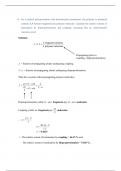
1. For a radical polymerization with biomolecular termination, the polymer is produced
contains 1.3 initiator fragments per polymer molecule. Calculate the relative extents of
termination by disproportionation and coupling, assuming that no chain-transfer
reactions occur.
Solution:
# fragment initiators
f = 1.3 =
# polymer molecules
Propagating (prior to
coupling / disproportionation)
a = fraction of propagating chains undergoing coupling.
1 − a = fraction of propagating chains undergoing disproportionation.
Then for a system with n propagating polymer molecules,
an + (1 − a) n 2
f = =
an
+ (1 − a)n 2 − a
2
Disproportionation yields (1 − a) n fragments per (1 − a) n molecules
an
Coupling yields an fragments per molecules.
2
2f −2
a=
f
2(1.3) − 2
a=
1.3
a = 0.4615
The relative extent of termination by coupling = 46.15 % and
The relative extent of termination by disproportionation = 53.85 %.
contains 1.3 initiator fragments per polymer molecule. Calculate the relative extents of
termination by disproportionation and coupling, assuming that no chain-transfer
reactions occur.
Solution:
# fragment initiators
f = 1.3 =
# polymer molecules
Propagating (prior to
coupling / disproportionation)
a = fraction of propagating chains undergoing coupling.
1 − a = fraction of propagating chains undergoing disproportionation.
Then for a system with n propagating polymer molecules,
an + (1 − a) n 2
f = =
an
+ (1 − a)n 2 − a
2
Disproportionation yields (1 − a) n fragments per (1 − a) n molecules
an
Coupling yields an fragments per molecules.
2
2f −2
a=
f
2(1.3) − 2
a=
1.3
a = 0.4615
The relative extent of termination by coupling = 46.15 % and
The relative extent of termination by disproportionation = 53.85 %.


