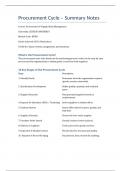
Procurement Cycle – Summary Notes
Course: Procurement & Supply Chain Management
University: ZETECH UNIVERSITY
Module Code: BPSM
Grade Achieved: 85% (Distinction)
Useful for: Exam revision, assignments, presentations
What is the Procurement Cycle?
The procurement cycle (also known as the purchasing process) refers to the step-by-step
process used by organizations to obtain goods or services from suppliers.
10 Key Stages of the Procurement Cycle
Stage Description
1. Identify Needs Determine what the organization requires
(goods, services, materials).
2. Specification Development Define quality, quantity, and technical
specs.
3. Supplier Research Find potential suppliers based on
requirements.
4. Request for Quotation (RFQ) / Tendering Invite suppliers to submit offers.
5. Evaluate Quotes Assess offers based on price, quality, and
lead time.
6. Supplier Selection Choose the best-value supplier.
7. Purchase Order Issued Formal contract/order is placed.
8. Delivery & Logistics Track and receive goods/services.
9. Inspection & Quality Control Check items for accuracy and quality.
10. Payment & Record-Keeping Pay invoices, keep records for auditing.
Course: Procurement & Supply Chain Management
University: ZETECH UNIVERSITY
Module Code: BPSM
Grade Achieved: 85% (Distinction)
Useful for: Exam revision, assignments, presentations
What is the Procurement Cycle?
The procurement cycle (also known as the purchasing process) refers to the step-by-step
process used by organizations to obtain goods or services from suppliers.
10 Key Stages of the Procurement Cycle
Stage Description
1. Identify Needs Determine what the organization requires
(goods, services, materials).
2. Specification Development Define quality, quantity, and technical
specs.
3. Supplier Research Find potential suppliers based on
requirements.
4. Request for Quotation (RFQ) / Tendering Invite suppliers to submit offers.
5. Evaluate Quotes Assess offers based on price, quality, and
lead time.
6. Supplier Selection Choose the best-value supplier.
7. Purchase Order Issued Formal contract/order is placed.
8. Delivery & Logistics Track and receive goods/services.
9. Inspection & Quality Control Check items for accuracy and quality.
10. Payment & Record-Keeping Pay invoices, keep records for auditing.