DNA Replication
Process cell needs to go through before cell replication
• Structure of DNA gives a clue to how it may be replicated – each strand can act as a
template for the synthesis of the complementary strand
• Replication would be semi-conservative, since half original parent DNA (1 strand)
would be present in each new double stranded DNA molecule
• Number of bases in a single strand of DNA is unrestricted
• Semi-conservative because one parental strand ends up in new daughter DNA
molecule (one old strand & one new)
Evidence for semi-conservative replication
Meselson-Stahl experiment
• Not radioisotopes – heavy isotopes
• Bacteria can be grown in a medium containing 15N (a heavy isotope of N) which
means their DNA will contain 15N
or
• Bacteria can be grown in a medium contain 14N and
their DNA will contain 14N
• Equilibrium density centrifugation can be used to
separate the more dense 15N labelled DNA from the 14N
labelled DNA
• Parent DNA was labelled with 15N (a heavy isotope of N)
by growing bacteria in 15NH4Cl
• DNA was isolated & then medium was changed to one
containing 14NH4Cl
• DNA was isolated after 1/2 generations
• DNA was analysed by equilibrium density centrifugation
• Samples were taken at different times to see when they
happen
Enzymology of DNA replication
• DNA replication requires a large multiprotein complex, the replisome (large central
enzyme, lot of polymerase present not just one)
• DNA polymerase is part of replisome & is responsible for synthesising the DNA
• DNA polymerase was first purified from E. coli by Arthur Kornberg
DNA polymerase = template driven enzyme
requires:
• A template – region of single stranded DNA
• Deoxynucleoside triphosphate precursors
• A 3’-OH group onto which the nucleotide is
added – can only new bases on a pre-existing
strand
Incoming Deoxynucleoside triphosphate pairs with
the base on template strand
, A phosphodiester bond is formed & pyrophosphate is released
DNA polymerase synthesis DNA in the 5’ to 3’ direction – can only add nucleotides onto 3’
end of chain
DNA polymerase is processive (stays attached in whole process)
Initiation of DNA synthesis
• DNA polymerase can’t synthesis DNE de novo
(scratch)
• During initiation of DNA synthesis, a small RNA primer
(8-12 bases) is made
• RNA primer is synthesised by primase
• DNA polymerase then starts the synthesis of new
DNA strands
^ For all organisms
Origin of replication & replication forks
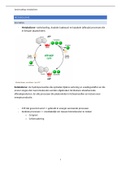
• In bacteria – DNA synthesis starts at a specific point on chromosomes, called origin
of replication (Ori)
• Local melting of DNA at the Ori & assembly of 2 replisomes
• Replisomes then move away from Ori in opposite directions generating bidirectional
replication forks (1 goes clockwise & 1
goes anticlockwise)
• Two strands will be synthesised at each
replication fork
On opposite side of chromosomes to origin of
replication is the termination region (ter)
The two replication forks will approach ter from
opposite sides, then stop
Genes closer to Ori will have a higher copy number than genes farer away – also gave
evidence to two replication forms – try question
Leading & lagging strand synthesis
• During DNA replication there’s a leading strand
9synethsised 5’ to 3’ overall) & the lagging strand with
overall synthesise 3’ to 5’
• The lagging strand is synthesised is discontinuously in
small segments called Okazaki fragments (which are
synthesised 5’ to 3’)
• In bacteria, Okazaki fragments are 1000-2000 bases in
length
^ simplifies how to get rid of RNA primers
Replacing the primer & ligation
Has 3 enzymatic activity: 1) DNA synthesis has the ability to move nucleotides on 2) has the
ability to remove nucleotides from the DNA strand = exonuclease activity (in terms of DNA
polymerase has a 5’ to 3’ exonuclease activity – important in removing the primer) – also
has a 3’ to 5’ exonuclease
Process cell needs to go through before cell replication
• Structure of DNA gives a clue to how it may be replicated – each strand can act as a
template for the synthesis of the complementary strand
• Replication would be semi-conservative, since half original parent DNA (1 strand)
would be present in each new double stranded DNA molecule
• Number of bases in a single strand of DNA is unrestricted
• Semi-conservative because one parental strand ends up in new daughter DNA
molecule (one old strand & one new)
Evidence for semi-conservative replication
Meselson-Stahl experiment
• Not radioisotopes – heavy isotopes
• Bacteria can be grown in a medium containing 15N (a heavy isotope of N) which
means their DNA will contain 15N
or
• Bacteria can be grown in a medium contain 14N and
their DNA will contain 14N
• Equilibrium density centrifugation can be used to
separate the more dense 15N labelled DNA from the 14N
labelled DNA
• Parent DNA was labelled with 15N (a heavy isotope of N)
by growing bacteria in 15NH4Cl
• DNA was isolated & then medium was changed to one
containing 14NH4Cl
• DNA was isolated after 1/2 generations
• DNA was analysed by equilibrium density centrifugation
• Samples were taken at different times to see when they
happen
Enzymology of DNA replication
• DNA replication requires a large multiprotein complex, the replisome (large central
enzyme, lot of polymerase present not just one)
• DNA polymerase is part of replisome & is responsible for synthesising the DNA
• DNA polymerase was first purified from E. coli by Arthur Kornberg
DNA polymerase = template driven enzyme
requires:
• A template – region of single stranded DNA
• Deoxynucleoside triphosphate precursors
• A 3’-OH group onto which the nucleotide is
added – can only new bases on a pre-existing
strand
Incoming Deoxynucleoside triphosphate pairs with
the base on template strand
, A phosphodiester bond is formed & pyrophosphate is released
DNA polymerase synthesis DNA in the 5’ to 3’ direction – can only add nucleotides onto 3’
end of chain
DNA polymerase is processive (stays attached in whole process)
Initiation of DNA synthesis
• DNA polymerase can’t synthesis DNE de novo
(scratch)
• During initiation of DNA synthesis, a small RNA primer
(8-12 bases) is made
• RNA primer is synthesised by primase
• DNA polymerase then starts the synthesis of new
DNA strands
^ For all organisms
Origin of replication & replication forks
• In bacteria – DNA synthesis starts at a specific point on chromosomes, called origin
of replication (Ori)
• Local melting of DNA at the Ori & assembly of 2 replisomes
• Replisomes then move away from Ori in opposite directions generating bidirectional
replication forks (1 goes clockwise & 1
goes anticlockwise)
• Two strands will be synthesised at each
replication fork
On opposite side of chromosomes to origin of
replication is the termination region (ter)
The two replication forks will approach ter from
opposite sides, then stop
Genes closer to Ori will have a higher copy number than genes farer away – also gave
evidence to two replication forms – try question
Leading & lagging strand synthesis
• During DNA replication there’s a leading strand
9synethsised 5’ to 3’ overall) & the lagging strand with
overall synthesise 3’ to 5’
• The lagging strand is synthesised is discontinuously in
small segments called Okazaki fragments (which are
synthesised 5’ to 3’)
• In bacteria, Okazaki fragments are 1000-2000 bases in
length
^ simplifies how to get rid of RNA primers
Replacing the primer & ligation
Has 3 enzymatic activity: 1) DNA synthesis has the ability to move nucleotides on 2) has the
ability to remove nucleotides from the DNA strand = exonuclease activity (in terms of DNA
polymerase has a 5’ to 3’ exonuclease activity – important in removing the primer) – also
has a 3’ to 5’ exonuclease