

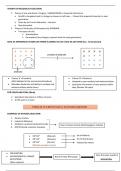
THEORY OF BIOLOGICAL EVOLUTION:
1. Theory of use and disuse of organs / LAMARCKISIM or Acquired inheritance
Giraffe’s elongated neck: to forage on leaves on tall trees --- Passed this acquired character to next
generation.
Given by the French Naturalist – Lamarck
Now discarded.
2. Theory of Continuity of Germplasm by WEISMAN
Two types of cells:
Somatoplasm
Germplasm (Any changes is passed onto the next generation)
RATE OF APPERANCE OF NEW LIFE FORMS IS LINKED TO LIFE CYCLE OR LIFE SPAN (Acc. To Darwinism)
CHANGE IN MEDIUM
MEDIUM
Colony ‘A’ of bacteria Colony ‘B’ of bacteria
(Well adapted to the environment/medium) Adapted to new medium and outbreed others
Microbes divide fast and ability to multiply and Speciation (Formation of new species) within
become millions within hours days (Shorter life span)
FOR FISHES AND FOWL (Birds)
Speciation take place in millions of years
As life span is in years
FITNESS OF ‘B’ IS BETTER THAN ‘A’ IN THE NEW CONDITIONS
EXAMPLES OF NATURAL SELECTION:
1. Darwin Finches
2. Industrial Melanism
3. Antibiotic-resistant bacteria/microbe Due to human activity (Anthropogenic activity)
4. DDT/Pesticide resistant mosquito
HbA HbA (Natural) die of Malaria
S
Hb Hb S
(Disease) die of SCA disease
HbA HbS (Carrier) Selected by nature
(Malaria prevalent areas)
PRE-EXISTING
Over the years results in
ADVANTAGEOUS, CHANCE Result in New Phenotype
MUTATIONS SPECIATION
When selected
, MORDERN SYNTHETIC THEORY: FOR EVOLUTION SPECIATION:
1. Natural Selection
2. Genetic Recombination
3. Mutation / Sattation
4. Gene flow/Migration (Immigration / Emigration)
5. Genetic drift
GENE POOL = Sum total of all genes and alleles in a population
Eg: Mice population=120
BB BB
White hair (120) Black hair (80)
BB Bb bb
Frequency of White hair mice Frequency of Black hair mice Bb
bb bb
= 120 = 6 = 0.6 = 80 = 2 = 0.4
200 10 200 5 bb
=60% =40%
P = 8 100 (frequency percentage dominant allele)
18
q = 10 100 (frequency percentage recessive allele)
18
HARDY-WEINBERG EQUILIBRIUM
P+q=1
p q
P2 + 2pq + q2 = 1
p p2 pq
Homozygous Heterozygous Homozygous
dominant individual recessive q pq q2
individual (pq) indivi dual
(pp) (qq)
2pq
1. Theory of use and disuse of organs / LAMARCKISIM or Acquired inheritance
Giraffe’s elongated neck: to forage on leaves on tall trees --- Passed this acquired character to next
generation.
Given by the French Naturalist – Lamarck
Now discarded.
2. Theory of Continuity of Germplasm by WEISMAN
Two types of cells:
Somatoplasm
Germplasm (Any changes is passed onto the next generation)
RATE OF APPERANCE OF NEW LIFE FORMS IS LINKED TO LIFE CYCLE OR LIFE SPAN (Acc. To Darwinism)
CHANGE IN MEDIUM
MEDIUM
Colony ‘A’ of bacteria Colony ‘B’ of bacteria
(Well adapted to the environment/medium) Adapted to new medium and outbreed others
Microbes divide fast and ability to multiply and Speciation (Formation of new species) within
become millions within hours days (Shorter life span)
FOR FISHES AND FOWL (Birds)
Speciation take place in millions of years
As life span is in years
FITNESS OF ‘B’ IS BETTER THAN ‘A’ IN THE NEW CONDITIONS
EXAMPLES OF NATURAL SELECTION:
1. Darwin Finches
2. Industrial Melanism
3. Antibiotic-resistant bacteria/microbe Due to human activity (Anthropogenic activity)
4. DDT/Pesticide resistant mosquito
HbA HbA (Natural) die of Malaria
S
Hb Hb S
(Disease) die of SCA disease
HbA HbS (Carrier) Selected by nature
(Malaria prevalent areas)
PRE-EXISTING
Over the years results in
ADVANTAGEOUS, CHANCE Result in New Phenotype
MUTATIONS SPECIATION
When selected
, MORDERN SYNTHETIC THEORY: FOR EVOLUTION SPECIATION:
1. Natural Selection
2. Genetic Recombination
3. Mutation / Sattation
4. Gene flow/Migration (Immigration / Emigration)
5. Genetic drift
GENE POOL = Sum total of all genes and alleles in a population
Eg: Mice population=120
BB BB
White hair (120) Black hair (80)
BB Bb bb
Frequency of White hair mice Frequency of Black hair mice Bb
bb bb
= 120 = 6 = 0.6 = 80 = 2 = 0.4
200 10 200 5 bb
=60% =40%
P = 8 100 (frequency percentage dominant allele)
18
q = 10 100 (frequency percentage recessive allele)
18
HARDY-WEINBERG EQUILIBRIUM
P+q=1
p q
P2 + 2pq + q2 = 1
p p2 pq
Homozygous Heterozygous Homozygous
dominant individual recessive q pq q2
individual (pq) indivi dual
(pp) (qq)
2pq


