

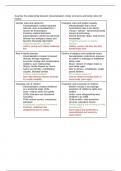
Examine the relationship between industrialisation, family structures and family roles (30
marks)
Gender roles and patriarchy Changing roles and greater equality
- Industrialisation created separate - Industrialisation led to more
spheres- men as breadwinners + symmetrical roles in the family
women as homemakers - Young + wilmott - symmetrical family
- Firestone (radical feminists)- - Impact of technology
industrialisation reinforces patriarchy - Shared domestic tasks, dual income
- Women lost workplace status and households
became financially dependent - Suggests progress in gender
- Highlights gender inequality equality
- Labour saving tech helped challenge - Oakley- women still face the dual
this burden/triple shift
Rise in family diversity Decline of religious and traditional norms
- Industrialisation created increased - Secularisation undermines pressure
diversity through migration, to confirm to marriage or traditional
economic change and secularisation family roles
- Giddens- pure relationships - Bruce- decline of religion leads to
- Stacey- family shaped by choice new family types
- Same sex families, cohabitating - Rise in divorce, cohabitation, single
couples, blended families parent families
- Reflects industrialisation - Encourages autonomy
- New right (Murray) blames diversity - Can be viewed as break down of
for social instability moral order (new right)
Changing role of children Protection and investment in children
- Industrialisation created childhood - Modern society is increasingly
as a protected stage of life protective of children's rights and
- Aries- children were mini adults welfare
- 1870s education act introduced - Jenks- more safeguarding laws
schooling - Children's act 1989
- Child centred society, compulsory - Child benefits, child protection
education services, education access
- Emphasises emotional investment - Shows ongoing role of family in child
- Postman- childhood has development
disappeared due to media - Some argue that protection is
overestimated and varies by
class.culture
marks)
Gender roles and patriarchy Changing roles and greater equality
- Industrialisation created separate - Industrialisation led to more
spheres- men as breadwinners + symmetrical roles in the family
women as homemakers - Young + wilmott - symmetrical family
- Firestone (radical feminists)- - Impact of technology
industrialisation reinforces patriarchy - Shared domestic tasks, dual income
- Women lost workplace status and households
became financially dependent - Suggests progress in gender
- Highlights gender inequality equality
- Labour saving tech helped challenge - Oakley- women still face the dual
this burden/triple shift
Rise in family diversity Decline of religious and traditional norms
- Industrialisation created increased - Secularisation undermines pressure
diversity through migration, to confirm to marriage or traditional
economic change and secularisation family roles
- Giddens- pure relationships - Bruce- decline of religion leads to
- Stacey- family shaped by choice new family types
- Same sex families, cohabitating - Rise in divorce, cohabitation, single
couples, blended families parent families
- Reflects industrialisation - Encourages autonomy
- New right (Murray) blames diversity - Can be viewed as break down of
for social instability moral order (new right)
Changing role of children Protection and investment in children
- Industrialisation created childhood - Modern society is increasingly
as a protected stage of life protective of children's rights and
- Aries- children were mini adults welfare
- 1870s education act introduced - Jenks- more safeguarding laws
schooling - Children's act 1989
- Child centred society, compulsory - Child benefits, child protection
education services, education access
- Emphasises emotional investment - Shows ongoing role of family in child
- Postman- childhood has development
disappeared due to media - Some argue that protection is
overestimated and varies by
class.culture


